

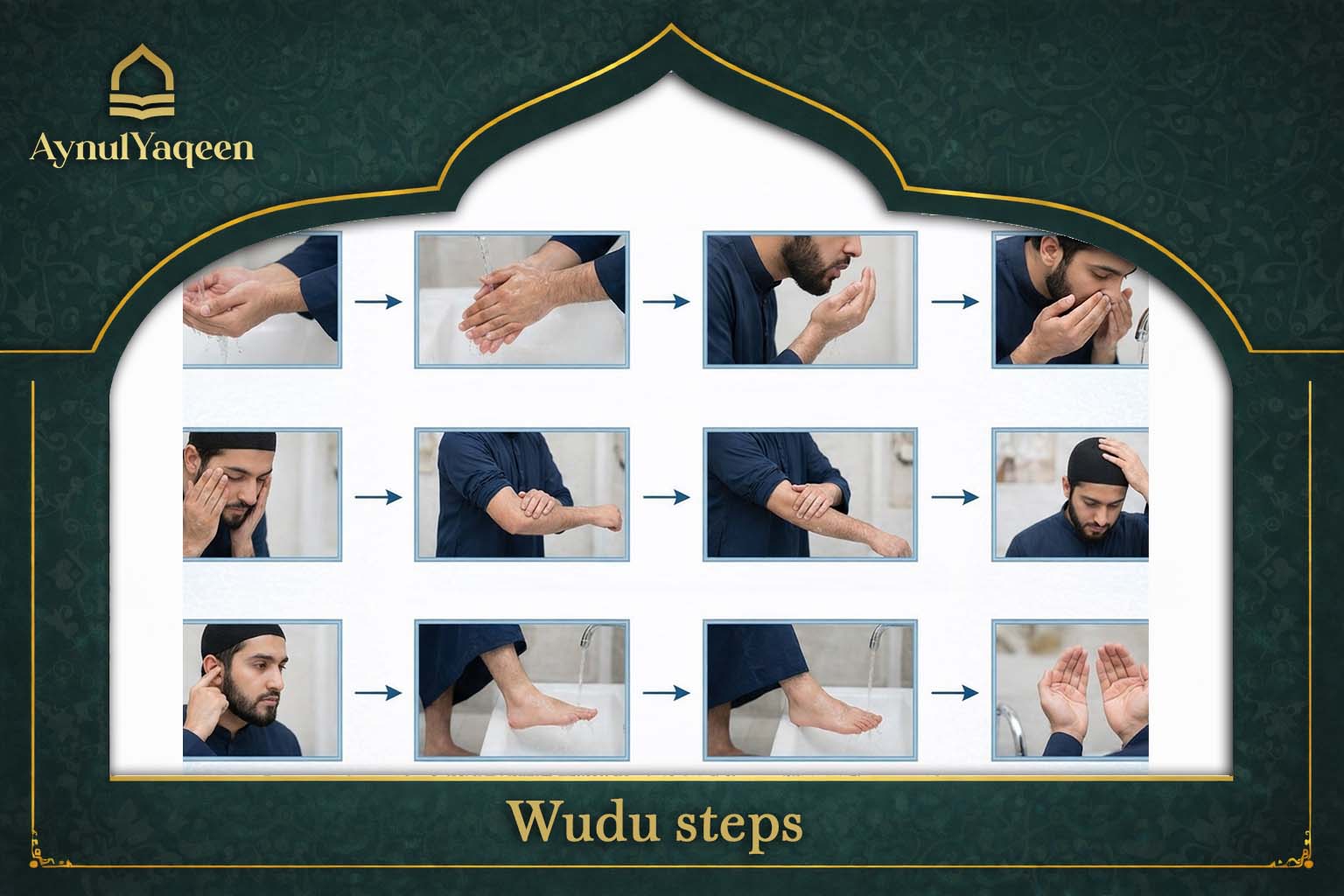
Wudu steps are essential acts of purification that connect physical cleanliness with spiritual readiness. At Aynulyaqeen Academy, we focus on teaching these steps clearly, highlighting both their legal requirements and deeper meanings.
Performing the Wudu steps correctly ensures that worship, especially prayer, is valid while also promoting hygiene and mental focus.
Beyond mere ritual, these steps cultivate mindfulness, discipline, and inner calm. Understanding and practicing the Wudu steps transforms daily ablution into a moment of spiritual reflection, preparing the believer’s heart and body for devotion, repentance, and connection with the Divine.
What Is Wudu?

To truly understand Wudu one must reflect on both its linguistic roots and its sacred meaning. The Arabic term is derived from a word that conveys brightness, purity, and radiance. This origin reflects its dual nature: an outward cleansing of the body and an inward illumination of the soul.
Wudu is not merely a physical act. It represents refinement, renewal, and preparation. Just as water removes visible impurities, this sacred purification prepares the worshipper to stand in devotion with clarity and dignity.
Legal Definition and Essential Practice
In its formal definition, Wudu is a specific act of purification performed by washing and wiping designated parts of the body with pure water. It is a necessary condition for the validity of prayer and certain other acts of worship. The Qur’an outlines the essential elements of this purification in Surah Al-Ma’idah (5:6), mentioning the washing of the face and arms, wiping of the head, and washing of the feet.
These prescribed actions form the foundation of the Wudu steps, which must be performed with intention and proper order. The Wudu steps are not random motions; they are deliberate acts of obedience rooted in revelation. Learning the correct Wudu steps ensures that one’s worship is both valid and complete.
Beyond Ritual: A Spiritual Transition
While the external actions are clearly defined, the meaning of Wudu extends far beyond its legal framework. Each of the Wudu steps carries spiritual depth. When the hands are washed, one reflects on the deeds performed. When the face is cleansed, it is as though the gaze and expressions are purified. When the limbs are washed, the heart is reminded to turn away from distraction.
Through the Wudu steps, a person moves from worldly engagement to mindful presence. It becomes a bridge between daily life and sacred devotion—a transformation from physical readiness to spiritual awareness.
Online Quran Academy
At Aynulyaqeen Academy, our Online Qur’an Academy offers flexible and interactive learning for students of all ages. Through carefully structured lessons, learners can master Qur’anic recitation, Tajweed rules, and memorization at their own pace.
The academy emphasizes both accuracy and understanding, ensuring that each student not only reads the Qur’an correctly but also comprehends its meanings.
By combining live instruction, digital resources, and personalized guidance, Aynulyaqeen Academy makes it easy to connect with qualified teachers from anywhere in the world. This approach ensures that the study of the Qur’an is accessible, engaging, and spiritually enriching.

Conditions for the Validity of Wudu
For Wudu to be valid and accepted, certain essential conditions must be fulfilled before performing the Wudu steps. These conditions ensure that the act is not merely physical cleansing, but a proper act of worship carried out with awareness and correctness.
1. Intention (Niyyah)
Intention is the most fundamental condition. An action does not become an act of worship unless it is accompanied by a conscious intention in the heart. The intention does not need to be spoken aloud; rather, it is the inner resolve to perform Wudu for the purpose of purification and devotion. Without intention, the Wudu steps remain ordinary washing and do not attain spiritual or legal validity.
2. Pure and Permissible Water
The water used must be pure and suitable for purification. It should remain in its natural state, free from impurities that alter its essential qualities such as color, smell, or taste. Using impure or contaminated water invalidates the Wudu steps, regardless of how carefully they are performed.
3. Removal of Barriers
Anything that prevents water from reaching the skin must be removed before beginning the Wudu steps. This includes non-permeable nail polish, thick substances, or any coating that blocks water from touching the required areas. The water must directly reach the skin for the purification to be valid.
4. Flowing Water Over the Limbs
It is necessary that water flows over the parts that are required to be washed. A light wipe is not sufficient, except in the case of wiping the head. Proper washing ensures that the Wudu steps are completed correctly and fulfill their intended purpose.
Learn also: learn islam online
How to Perform Wudu Step by Step
Wudu consists of obligatory acts and recommended practices. Performing the complete Wudu steps with care ensures both validity and spiritual excellence. The obligatory elements must be fulfilled, while the recommended actions perfect and beautify the purification.
Below is the proper sequence of the Wudu steps:
Follow this step-by-step guide to perform the online arabic academy for kids correctly, ensuring both validity and spiritual mindfulness in every ablution.
1. Intention and Saying “Bismillah”
Begin with the intention in the heart to perform Wudu for the sake of worship. It is recommended to say “Bismillah” (In the name of Allah) before starting.
2. Washing the Hands (Three Times)
Wash both hands up to the wrists three times, ensuring that water reaches between the fingers. This prepares the hands for the rest of the Wudu steps.
3. Rinsing the Mouth (Three Times)
Take water into the mouth and rinse thoroughly three times. This is a recommended act that enhances purification.
4. Rinsing the Nose (Three Times)
Gently inhale water into the nose and expel it three times. This completes the cleansing of the facial area before washing the face.
5. Washing the Face (Obligatory)
Wash the entire face three times, from the hairline to the chin and from ear to ear. Covering this area fully is one of the essential Wudu steps and is required for validity.
6. Washing the Arms to the Elbows (Obligatory)
Wash the right arm, then the left, up to and including the elbows three times each. Ensuring water reaches every part of the arms is necessary for the Wudu steps to be valid.
7. Wiping the Head (Obligatory)
Wipe over the head once with wet hands. It is sufficient to wipe part of the head, though wiping the entire head is recommended.
8. Wiping the Ears
Using the remaining moisture on the hands, wipe the inside and outside of the ears. This is recommended and completes the upper portion of the Wudu steps.
9. Washing the Feet to the Ankles (Obligatory)
Wash the right foot, then the left, up to and including the ankles three times each. Make sure water reaches between the toes. This final act completes the essential Wudu steps.
Learn also:female quran teacher online
Supplication After Wudu
After completing the Wudu steps, it is recommended to recite a specific supplication that carries immense spiritual reward. The Prophet ﷺ taught that whoever says the following after finishing Wudu will be granted a great honor:
“I bear witness that there is no deity worthy of worship except Allah alone, without partner, and I bear witness that Muhammad is His servant and Messenger.”
It was promised that for the one who recites this sincerely after completing the Wudu steps, the eight gates of Paradise will be opened, and he may enter through whichever gate he wishes. This highlights how the Wudu steps are not only acts of purification, but gateways to immense divine reward.
It is also recommended to add the following supplication:
“O Allah, make me among those who constantly repent and make me among those who purify themselves.”
This additional prayer deepens the spiritual meaning of the Wudu steps. Purification in Islam is not limited to washing the limbs; it is a renewal of faith, repentance, and inner clarity. By combining the physical completion of the Wudu steps with remembrance and supplication, the believer transitions from outward cleansing to inward elevation.
Thus, the act concludes not simply with dry limbs, but with a heart turned toward sincerity, repentance, and hope for eternal reward.
Learn also:online arabic tutor for kids
Does Wudu Differ for Men and Women?
From a legal perspective, there is no difference between men and women regarding the obligatory and recommended Wudu steps. The fundamentals remain identical for both.
However, there are practical considerations specific to women:
- Removing Non-Permeable Nail Polish: Water must reach the nails, so any coating that prevents water contact should be removed before performing the Wudu steps.
- Ensuring Water Reaches Beneath Jewelry: Rings, bracelets, or other adornments must not block water from touching the skin.
- Wiping Over the Hijab When Necessary: In some cases, wiping over the head covering is allowed, though it is better to wipe the hair directly if possible.
These adjustments are practical and do not alter the core Wudu steps, but they help ensure that purification is complete and valid.
The Importance of Wudu
Wudu is not just a ritual act; it is a profound practice that connects physical purification with spiritual and mental well-being. Performing the Wudu steps regularly carries multiple layers of significance in daily life and worship.
1. A Requirement for Valid Prayer
One of the primary reasons Wudu is essential is that it is a condition for the acceptance of prayer. The Prophet ﷺ emphasized this by saying:
“Allah does not accept the prayer of any one of you if he had a state of major impurity until he performs Wudu.”
Without performing the Wudu steps, the prayer is considered invalid. This shows that Wudu is not optional; it is a prerequisite for connecting with the Divine.
2. Forgiveness of Sins
Another spiritual benefit of Wudu is the purification of sins. Every drop of water that touches the skin during the Wudu steps carries the symbolic effect of erasing minor sins. This makes the practice both a physical and spiritual cleansing, allowing believers to start their prayers with a renewed sense of purity and humility.
3. A Light on the Day of Judgment
The Prophet ﷺ also mentioned that the parts washed during Wudu will shine with light on the Day of Resurrection. This emphasizes that the Wudu steps at online quran course have an eternal significance, turning each act of purification into a source of spiritual illumination and reward.
4. Health and Psychological Benefits
Beyond spiritual advantages, Wudu offers practical benefits for the body and mind. Regular washing promotes personal hygiene, which is critical for overall health.
The rhythmic, mindful practice of performing the Wudu steps can reduce stress, calm the mind, and restore mental focus. In this sense, Wudu acts as a daily ritual of both spiritual and psychological renewal.
By performing the Wudu steps carefully and with awareness, a believer achieves a state of readiness that is physical, mental, and spiritual. It transforms routine washing into a holistic act of worship, connecting the body, mind, and soul while preparing one for sincere devotion.
Learn also: online quran classes
Can One Recite the Qur’an Without Wudu?
The question of reciting the Qur’an without performing the Wudu steps depends on the manner of recitation and scholarly opinion.
1. Touching the Physical Mushaf
Most scholars agree that touching the physical Qur’an (Mushaf) requires Wudu. Performing the Wudu steps ensures that the body is in a state of ritual purity, which reflects respect for the sacred text. Without Wudu, touching the Mushaf is generally not permitted.
2. Recitation from Memory
Reciting the Qur’an from memory does not require Wudu, provided the person is not in a state of major impurity (e.g., janabah). This allows for spiritual connection and remembrance without the physical handling of the Mushaf. The Wudu steps are recommended for added respect but are not obligatory in this case.
3. Recitation from a Digital Device
Reading the Qur’an from a phone, tablet, or other electronic devices does not require Wudu, because the device is not considered a Mushaf. However, performing the Wudu steps before recitation is still preferred as a sign of reverence and mindfulness.
In summary, while the Wudu steps at online quran classes for kids are mandatory for touching the physical Qur’an, they are not strictly required for recitation from memory or digital formats. Still, performing Wudu enhances the spiritual focus and respect for the Qur’an in all forms.
Obligatory vs. Recommended in Wudu
The distinction between the obligatory (Fard) and recommended (Sunnah) components of Wudu lies primarily in the aspect of obligation and reward.
1. Obligatory Acts (Fard)
Obligatory acts are essential for the validity of Wudu. If any of these acts are omitted, the Wudu is considered invalid, and subsequent acts of worship that require purification, such as prayer, would also be invalid. Performing the obligatory Wudu steps is mandatory, and neglecting them directly affects the correctness of the ritual.
2. Recommended Acts (Sunnah)
Recommended acts, while highly encouraged, do not invalidate Wudu if omitted. Those who perform the Sunnah elements of Wudu earn additional reward and follow the example of the Prophet ﷺ, enhancing the spiritual and physical benefits of purification.
3. Combining Fard and Sunnah
A person who performs only the Fard acts completes a valid Wudu, but misses the extra virtue and completeness offered by the Sunnah. Those who combine both Fard and Sunnah in the Wudu steps at online arabic lessons for adults achieve full perfection—physically, spiritually, and in imitation of the Prophet ﷺ. This ensures that Wudu is not only legally valid but also spiritually enriching.
In essence, the Fard ensures correctness, while the Sunnah enhances reward and spiritual refinement, making the Wudu steps a holistic act of worship.
Learn also: online arabic classes
Common Mistakes in Wudu
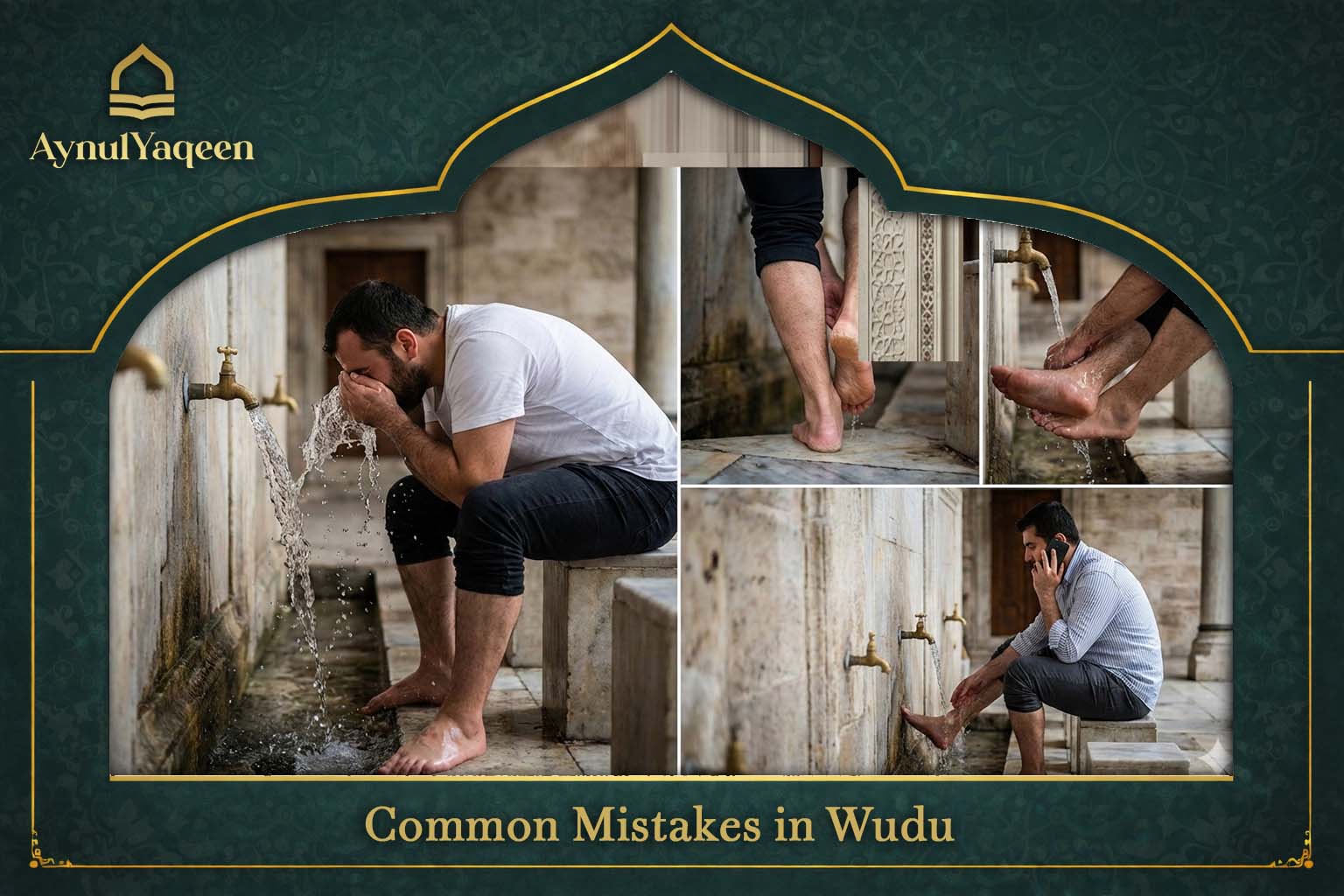
Even though performing the Wudu steps seems straightforward, there are frequent mistakes that can affect both its validity and spiritual benefits. Being aware of these ensures that Wudu is performed correctly and meaningfully.
1. Excessive Use of Water
One common error is using more water than necessary. The Prophet ﷺ practiced moderation in Wudu, using only what was needed. Overusing water is considered wasteful and goes against the principle of balance in worship.
2. Leaving Parts Unwashed
Sometimes, people unintentionally leave areas dry, such as the elbows, heels, or spaces between the fingers and toes. For Wudu to be valid, water must reach all the required parts. Skipping even small areas can invalidate the Wudu steps.
3. Ignoring the Correct Order
According to the majority of scholars, maintaining the proper sequence of the Wudu steps is important. Performing the steps out of order may affect the validity of Wudu, as the sequence is part of the prescribed ritual.
4. Being Distracted
Another frequent mistake is engaging in worldly conversation or distractions while performing Wudu. The purpose of Wudu is both physical and spiritual purification. Focusing the mind and heart on the act transforms it into worship rather than a routine washing.
By avoiding these mistakes, one can ensure that the Wudu steps at best online quran classes for kids are both valid and spiritually meaningful, turning each act of purification into a source of reward and readiness for prayer.
Frequently Asked Questions About Wudu Steps
Discover answers to common doubts about the Wudu steps, including their proper sequence, obligations, and practical tips for valid and meaningful ablution.
1. What are the essential Wudu steps?
The essential Wudu steps include washing the face, arms up to the elbows, wiping the head, and washing the feet up to the ankles. These acts are obligatory for valid Wudu.
2. Can Wudu be performed without intention?
No. Intention (Niyyah) is a required part of the Wudu steps. Without it, the purification is not considered an act of worship.
3. How many times should each part be washed?
The recommended practice is washing most parts three times, except for wiping the head, which is done once.
4. Can women perform Wudu with nail polish?
Non-permeable nail polish must be removed to allow water to reach the skin, ensuring the Wudu steps are valid.
5. Is Wudu required to touch the Quran?
Yes, touching a physical Mushaf requires Wudu, but reciting from memory or a digital device does not strictly require it.
In conclusion, mastering the Wudu steps is more than a ritual requirement—it is a pathway to spiritual, physical, and mental purification. At Aynulyaqeen Academy, we emphasize that careful practice of these steps transforms ordinary ablution into a meaningful act of worship.
By performing the Wudu steps with intention, mindfulness, and adherence to both obligatory and recommended actions, a believer not only fulfills the requirements of prayer but also nurtures inner calm, discipline, and closeness to the Divine.
Proper understanding and consistent practice make each ablution a meaningful act of worship, and those who learn Quran online can also deepen their knowledge of purification and spiritual well-being.
read more:
