


Tips for quran memorization can make the journey of learning the Quran more organized, consistent, and rewarding. Memorizing the Quran is a meaningful goal, but many learners struggle because they begin without a clear routine, realistic target, or reliable revision system. The good news is that effective memorization does not depend only on having an exceptional memory. Instead, the right method, regular practice, understanding, accurate recitation, and patience can make a significant difference.
For many Muslims, memorizing the Quran is both an educational and spiritual journey. Each person has a different schedule, learning speed, and level of Arabic. Therefore, the best approach is not necessarily to memorize the largest amount in the shortest time. A sustainable plan allows you to learn new verses while protecting what you have already memorized.
This guide brings together practical tips for Quran memorization that you can adapt to your age, experience, and daily responsibilities. Whether you are a beginner, a parent helping a child, or someone who wants to strengthen an existing Hifz routine, these strategies can help you build better habits.
Why Do tips for Quran memorization Matter?

A common mistake is to think that Quran memorization simply means reading a verse repeatedly until it becomes familiar. Repetition is important, but memorization involves several connected skills. You need to recognize the words, pronounce them correctly, understand the sequence, recall the verse without looking, and connect it accurately to what comes before and after it.
That is why having a structured approach can prevent wasted effort. Instead of spending a long time on a passage and forgetting it a few days later, you can divide your effort between new memorization and revision.
The most useful tips for Quran memorization focus on consistency rather than speed. A learner who memorizes a small amount every day and reviews it properly can often build stronger long-term retention than someone who memorizes large portions irregularly.
Learn Online with Aynulyaqeen Quran Academy
Choosing the right online Quran academy can make a significant difference in your learning journey. Aynulyaqeen Quran Academy provides structured Quran courses for beginners and advanced learners, focusing on accurate Quran reading, Tajweed, memorisation, and Islamic studies.
With qualified teachers, flexible class schedules, and personalised one-on-one lessons, students of all ages can learn at their own pace while building confidence in reciting and understanding the Holy Quran from anywhere in the world.

How to Prepare Before Using tips for Quran memorization?
Preparation can make the actual memorization session much easier. Before opening the Quran, decide exactly what you want to accomplish. Avoid starting a session with a vague goal such as “I will memorize as much as possible today.”
Instead, establish a specific target. For example, you might decide to master three verses, one short passage, or a particular section that matches your current ability.
It is also helpful to prepare your environment. Choose a place where interruptions are limited and keep the same Quran edition whenever possible. Familiarity with the page layout can eventually help you remember where verses appear visually.
Before beginning, make sure your pronunciation is correct. If you are uncertain about a word or stopping point, ask a qualified Quran teacher rather than memorizing an incorrect form and trying to correct it later.
Tips for Quran memorization: Begin With a Realistic Daily Goal
One of the most practical tips for Quran memorization is to avoid setting a daily target that is larger than your ability to retain it.
A beginner may benefit from a few verses at a time, while an experienced learner may be comfortable with a larger portion. The correct amount depends on several factors:
- Your available study time.
- Your previous memorization experience.
- Your Arabic reading ability.
- The difficulty of the selected passage.
- Your ability to revise older material.
- Your responsibilities at school, work, or home.
A realistic target should challenge you without making the process exhausting. If you repeatedly fail to complete your daily portion, reduce it temporarily. A smaller successful target is more useful than an ambitious target that creates frustration.
For example, someone with only 20 minutes available may begin with two or three verses. As concentration and confidence improve, the amount can gradually increase.
How do tips for Quran memorization Work With Repetition?
Repetition remains one of the foundations of successful Hifz, but repeating without a method can become inefficient. Instead of saying a verse dozens of times without checking your progress, use stages.
First, read the verse carefully while looking at the Quran. Then recite it several times while focusing on pronunciation and sequence. After that, look away and attempt to recite it from memory.
If you make a mistake, return to the text, identify exactly where the mistake happened, and repeat that portion. Do not simply restart the entire passage every time.
Once the first verse is stable, connect it with the next one. This creates a chain rather than a collection of isolated verses.
A useful progression can look like this:
- Read and listen carefully.
- Repeat while looking.
- Recite without looking.
- Correct mistakes immediately.
- Connect the verse to the next verse.
- Recite the complete section from memory.
This approach makes repetition purposeful and easier to monitor.
Tips for Quran memorization Should Include Listening
Listening can support memorization because it gives the learner another way to process the same words. Hearing a reliable recitation repeatedly can help you become familiar with pronunciation, rhythm, pauses, and the overall flow of a passage.
However, listening should complement active memorization rather than replace it. A person can become very familiar with a recitation while still being unable to reproduce the verses independently.
Try listening before your study session to become familiar with the passage. You can also listen afterward while following along with the Quran.
During your own memorization, pay attention to places where you regularly hesitate. These locations often need additional practice.
It is particularly useful to work with a consistent recitation instead of constantly switching between different recordings. Consistency reduces unnecessary variation and allows your mind to become familiar with one vocal pattern.
How Understanding Helps: Tips for Quran Memorization
Understanding the general meaning of a passage can provide useful mental connections. When you know what the verses are discussing, the words are less likely to feel like disconnected sounds.
You do not necessarily need to become an Arabic scholar before beginning Hifz. However, learning the basic meaning of the verses you memorize can help you recognize the progression of ideas.
For example, if several verses describe a sequence of events, knowing that sequence gives your memory a logical framework. Likewise, recognizing when a passage changes from a story to a command, warning, description, or supplication can create useful mental landmarks.
Understanding should support memorization rather than become a reason to postpone it indefinitely. You can learn vocabulary and basic explanations alongside your Hifz.
Tips for Quran memorization Using Verse Chunking
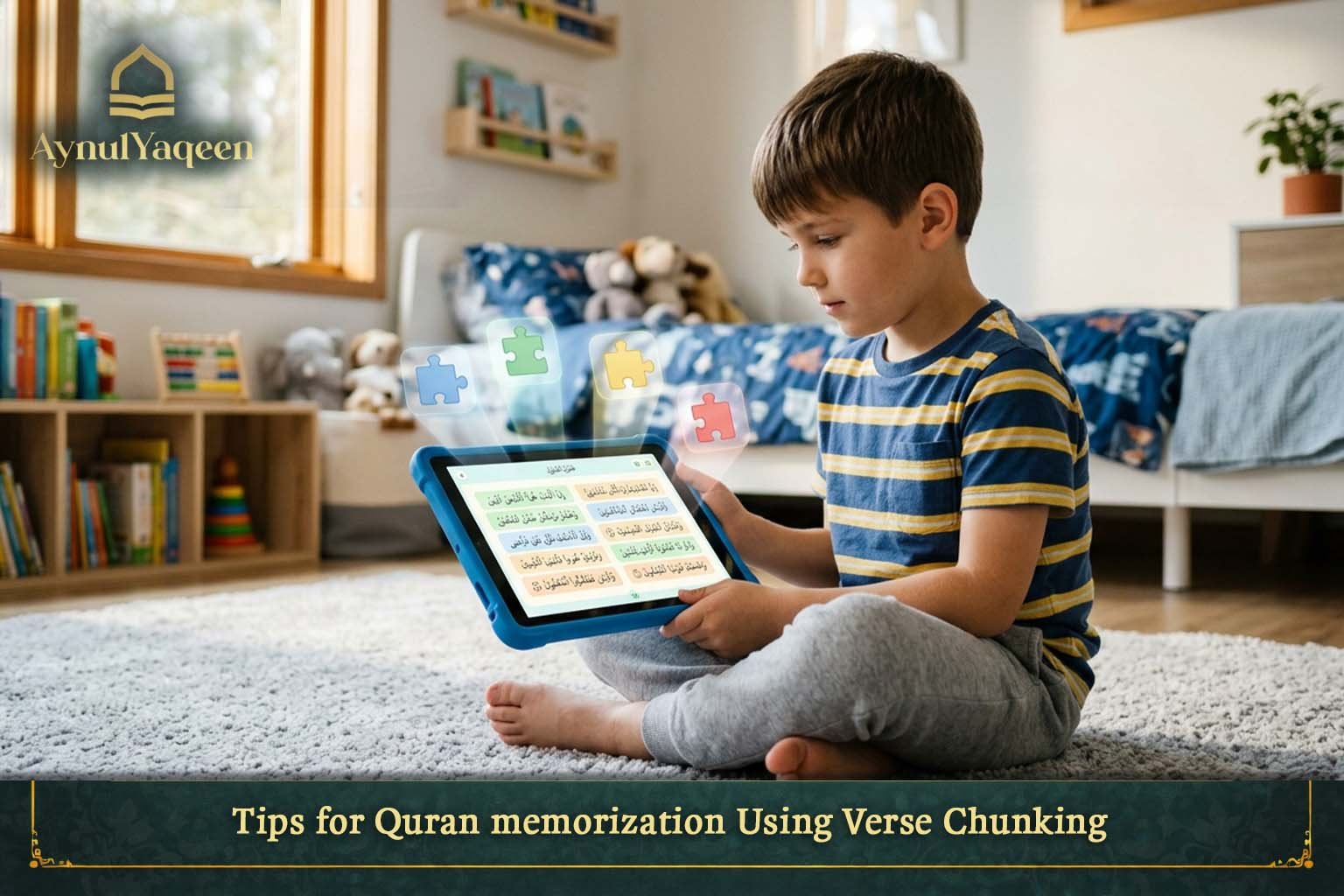
Long verses can appear intimidating when treated as one large unit. Breaking them into smaller sections can make the task more manageable.
Start by identifying natural phrases. Memorize the first phrase, test yourself, then add the next phrase. After learning both, connect them and recite the complete section.
This method is especially helpful when a verse contains several clauses or when similar expressions appear elsewhere in the Quran.
You can think of the process as building a chain:
Phrase A → Phrase B → Phrase C → Complete verse
The goal is not to memorize each fragment permanently as an isolated piece. The fragments are temporary learning units that eventually become one connected verse.
This strategy can reduce cognitive overload and help learners identify exactly where their memory breaks down.
Which tips for Quran memorization Help With Similar Verses?
Similar verses can be one of the most challenging parts of Hifz. You may know both passages individually but accidentally replace a word from one with a word from another.
When this happens, avoid treating the similarity as a problem that cannot be solved. Instead, study the differences deliberately.
Create a mental comparison between the two passages. Pay attention to:
- The first few words.
- Unique vocabulary.
- Changes in verb forms.
- The order of phrases.
- The surrounding subject.
- How one verse connects to the next.
Writing down a small distinction can also help. You might mark the particular word that changes and practice both verses separately before reciting them together.
A teacher can be particularly useful here because they may notice similarities that a learner has overlooked.
Tips for Quran memorization: Need a Strong Revision System
Memorizing new material is only one part of Hifz. Without revision, previously learned verses can become weaker over time.
A useful revision system should include both recent and older memorization. Recent material needs frequent review because it has not yet become firmly established. Older material needs periodic testing so that it remains accessible.
Consider dividing your revision into categories:
- Today: Review the portion learned during the current session.
- Recent: Review material learned during the previous few days.
- Established: Review older portions according to a weekly or monthly schedule.
- Weak areas: Give additional attention to verses where mistakes repeatedly occur.
This prevents the common situation in which a learner keeps moving forward but gradually loses earlier portions.
A good rule is to protect your previous memorization before increasing your new daily target.
How to Use Prayer With tips for Quran memorization?
Prayer can provide a natural opportunity to use memorized passages. When appropriate, reciting recently learned verses in prayer can help you recall them under conditions that differ from your study session.
This matters because genuine memorization should not depend entirely on looking at the page or following an audio recording. You want to develop independent recall.
You can use shorter newly memorized portions during prayer and then test yourself afterward. If you notice repeated hesitation, return to those verses during your next study session.
However, avoid turning prayer into a stressful examination. The primary purpose of Salah is worship. Memorization practice should support that purpose rather than make the worship experience unnecessarily anxious.
Tips for Quran memorization Become Easier With a Fixed Time
A consistent study time can reduce the mental effort required to decide when to memorize. When a specific period becomes part of your routine, you are less dependent on motivation.
Choose a time when your mind is usually alert, and your responsibilities are limited. Some learners prefer the early morning, while others perform better later in the day.
The important point is to find a schedule that you can maintain.
A simple routine might include:
- Five minutes of preparation.
- Fifteen minutes of new memorization.
- Ten minutes of testing from memory.
- Ten minutes of revision.
- A short final recitation.
The exact schedule can change according to your circumstances. What matters most is that the routine remains practical.
What Role Does Tajweed Play in tips for Quran memorization?
Correct recitation should not be separated from memorization. If you memorize a passage with pronunciation mistakes, those mistakes can become deeply established and require additional work to remove later.
For this reason, learners should study the basic rules of Tajweed and have their recitation checked by someone qualified.
Pay attention to:
- Correct pronunciation of Arabic letters.
- Proper elongation.
- Rules of stopping and starting.
- Characteristics of letters.
- Common pronunciation mistakes.
- Smooth connection between words.
You do not need to master every advanced Tajweed topic before memorizing anything. Nevertheless, your recitation should be accurate enough that you are not building your Hifz around repeated errors.
Tips for Quran memorization for Busy Students and Adults
Busy learners often assume that Quran memorization requires several uninterrupted hours every day. In reality, a shorter but consistent session can be more realistic.
If you work or study, divide your learning opportunities throughout the day. For example, you might use one period for listening, another for revision, and a focused session for new memorization.
Avoid sacrificing sleep simply to meet an unrealistic target. Mental fatigue can make learning slower and increase mistakes.
You can also use small moments for revision:
- During a quiet commute, if you are not driving.
- During a scheduled break.
- Before beginning another study activity.
- While preparing for prayer.
- During a short evening review.
The objective is to integrate Quran study into your lifestyle rather than create a routine that becomes impossible to maintain.
How Can Parents Apply tips for Quran memorization With Children?
Children often need a different approach from adults. Long sessions can quickly reduce their attention, so parents should focus on short, positive learning periods.
Choose an amount that matches the child’s age and concentration. Celebrate genuine progress without turning every session into a competition.
Parents can help by creating a predictable routine and asking the child to recite what they learned. They can also encourage the child to listen carefully and practice pronunciation.
Avoid comparing one child with another. Two children may memorize at completely different speeds while both are making excellent progress.
Most importantly, keep the experience emotionally positive. A child who associates Quran learning with encouragement and accomplishment is more likely to develop a lasting relationship with the activity.
Tips for Quran memorization with Visual and Memory Techniques
Different learners respond to different memory cues. Some people remember sound particularly well, while others benefit from visual organization.
You can experiment with several techniques without allowing the techniques themselves to become distracting.
For example, you can:
- Mentally picture the location of a verse on the page.
- Divide a passage into clearly defined sections.
- Associate a passage with its general theme.
- Notice repeated expressions.
- Identify distinctive words.
- Use written revision to reinforce difficult portions.
Visual memory can be useful because many learners eventually remember approximately where a verse appears on a page. However, page appearance should support verbal recall rather than replace it.
The ultimate goal is to recite accurately without depending on the physical page.
Why does a Teacher Strengthens tips for quran memorization?
Self-study can be useful, but guidance from a qualified teacher can make tips for quran memorization more effective. A teacher can listen to your recitation, identify pronunciation issues, test previous portions, and help you choose a realistic daily target.
This becomes especially important when you encounter similar verses or repeatedly forget the same passage. Instead of practicing the same mistake, you can receive direct correction and adjust your method.
For learners who want structured online Quran education, Aynulyaqeen Quran Academy can provide organized lessons and regular feedback. A guided learning environment can help students build consistent habits while working toward accurate memorization.
The purpose of using a teacher is not simply to memorize faster. Good instruction should help you develop accurate recitation, stronger recall, and a revision routine that remains useful over time.
How Do Tips for quran memorization Help When You Keep Forgetting Verses?
Forgetting a verse does not necessarily indicate poor memory. In many cases, it means that the passage needs more active revision or stronger connections with surrounding verses. Effective tips for quran memorization should therefore include a way to identify why forgetting happens.
First, determine where the problem occurs. Did you forget the beginning of the verse? Did you confuse it with a similar passage? Did you lose the connection between two sections? Or are you uncertain about pronunciation?
Once the problem is clear, the solution becomes easier to choose. Similar verses may require comparison, while weak connections may benefit from linking exercises. If the problem comes from insufficient revision, increase the frequency of testing.
Do not abandon a difficult passage simply because you forgot it. Return to the Quran, identify the weak point, correct it, and try again. Patience is one of the most practical tips for quran memorization because progress is rarely perfectly consistent.
How to Track Progress With tips for quran memorization?

A simple progress record can show whether your tips for quran memorization are actually working. You do not need complicated software. A notebook, calendar, or digital document can be enough.
Record the following:
| Area | What to Track |
|---|---|
| New memorization | What you learned today |
| Revision | Previous portions reviewed |
| Mistakes | Words or verses causing difficulty |
| Tajweed | Pronunciation points needing attention |
| Confidence | How easily you recalled the passage |
| Next session | What you should review next |
Tracking mistakes can be more valuable than simply counting pages. If you memorize a large amount but repeatedly make errors, your current approach may need adjustment.
Therefore, measure progress through accuracy and retention rather than quantity alone. This is one of the most useful tips for quran memorization for learners who want sustainable results.
tips for quran memorization and the Importance of Patience
Quran memorization is a long-term commitment. Some sessions will feel productive, while others may be difficult. Concentration can change because of work, school, sleep, family responsibilities, or other daily pressures.
For this reason, do not judge your entire ability according to one difficult day. Instead, evaluate your progress over several weeks.
One of the most important tips for quran memorization is to accept gradual improvement. A learner who consistently memorizes a modest amount can build strong results over time.
Patience also means accepting that revision remains necessary even after completing a large portion. Memorization is not finished simply because you reached the end of a target. Preserving what you know is part of the journey.
The objective is not to compete with another learner. It is to develop a reliable relationship with the Quran and protect the verses you have learned.
A Practical Weekly Plan Using tips for quran memorization
A weekly structure can make tips for quran memorization easier to apply. Instead of deciding every morning what to study, establish a basic pattern and adjust the amount according to your level.
- Day 1: Learn new verses and review the previous portion.
- Day 2: Continue with new material and test Day 1 from memory.
- Day 3: Add another manageable section and review earlier material.
- Day 4: Give greater attention to revision and weak verses.
- Day 5: Continue new memorization only if previous portions are stable.
- Day 6: Recite the week’s material as one connected passage.
- Day 7: Focus mainly on revision, testing, and correction.
This plan balances new learning with consolidation. If your older memorization becomes weak, reduce the amount of new material temporarily. This adjustment is among the practical tips for quran memorization that can protect long-term retention.
Common Mistakes That Weaken tips for quran memorization
Some habits make Quran memorization harder than necessary. Recognizing them early can help you improve your routine.
Memorizing Too Much
A large daily target can become counterproductive when you do not have enough time to review it.
Changing the Routine Constantly
Moving between different schedules and methods can make consistency difficult.
Ignoring Pronunciation
If a learner repeatedly memorizes incorrect pronunciation, correcting those mistakes later can require additional effort.
Neglecting Older Portions
Learning new verses every day without reviewing previous material can gradually weaken earlier memorization.
Studying While Distracted
Notifications, conversations, and frequent interruptions can reduce concentration and make each session less productive.
Comparing Your Progress
Another learner’s speed does not determine your own ability. Focus on your personal consistency.
Avoiding these problems is just as important as adding new techniques. The best tips for quran memorization should make your routine more sustainable, not simply more complicated.
How Can Aynulyaqeen Quran Academy Support Your Goal?
A structured learning environment can be particularly useful for students who struggle to remain accountable independently. Aynulyaqeen Quran Academy can support learners who want guidance while developing a consistent memorization routine.
A teacher-led approach allows students to receive feedback instead of repeatedly practicing the same mistakes. It can also help learners establish appropriate goals and maintain regular revision.
Parents may also benefit from structured instruction when they are unsure how to organize Quran learning for their children. Adults, meanwhile, can benefit from guidance that fits Quran study around work and family commitments.
When choosing an educational environment, look beyond the amount of new material covered. Effective tips for quran memorization should prioritize accurate recitation, revision, gradual progress, and individual support.
Tips for quran memorization: A Simple Daily Checklist
Before finishing your session, use a short checklist to evaluate your progress. These tips for quran memorization become more useful when you regularly check whether you are applying them correctly.
Ask yourself:
- Did I recite today’s portion without looking?
- Did I correct the mistakes I noticed?
- Did I review older memorization?
- Can I connect today’s verses correctly?
- Did I pay attention to pronunciation?
- Is tomorrow’s target realistic?
- Which verse needs additional practice?
You can also classify each portion as strong, needs review, or weak. Then use your next session to prioritize the weakest material.
This turns memorization into a continuous process of learning, testing, correcting, and strengthening.
Build Better tips for quran memorization Around Your Schedule
Your memorization plan should fit your real life. A schedule that looks excellent on paper but cannot be maintained will not provide lasting results.
Start by identifying the period when your concentration is usually strongest. Some learners prefer the morning, while others perform better later in the day. Once you find a suitable period, try to protect it consistently.
You can also divide your work into smaller sessions. For example, one session can focus on new verses while another is dedicated to revision.
These tips for quran memorization are particularly helpful for students and working adults because they remove the idea that Quran memorization always requires several uninterrupted hours.
Consistency matters more than creating a perfect schedule that lasts only a few days.
Use Meaning to Strengthen tips for quran memorization
Understanding the general meaning of a passage can give your memory an additional framework. When verses are connected to an idea, story, instruction, or sequence of events, they may become easier to recall in the correct order.
You do not need advanced Arabic knowledge before beginning Hifz. However, learning important vocabulary and the general meaning of the passage can make memorization more meaningful.
For learners who are also working on Quranic Arabic, studying the language can complement memorization. If you are wondering whether specialized language support is necessary, you may find it useful to explore Do I need a native Arabic tutor to learn Quran.
Understanding should support your Hifz rather than become an excuse to delay starting. Learn the meaning progressively while continuing your memorization.
Improve tips for quran memorization Through Active Recall
Reading a verse repeatedly while looking at the page can create familiarity, but familiarity is not the same as independent recall. One of the strongest tips for quran memorization is to regularly close the Quran and test yourself.
After studying a passage, look away and recite it. If you stop, identify the exact point where your recall failed. Then look at the text briefly and try again.
Active recall shows you what you actually know. It also prevents you from becoming dependent on visual cues.
You can make testing more challenging by starting from different points within a memorized section. Ask yourself what comes immediately before or after a particular verse.
This approach helps build flexible recall rather than memorization that works only when you begin from the first verse.
Tips for quran memorization and Tajweed Practice
Tajweed and Hifz should develop together. A learner who memorizes a passage with repeated pronunciation errors may later need to spend significant time correcting those habits.
Therefore, practice difficult letters, elongations, stopping points, and other relevant rules while memorizing.
If you are considering learning Tajweed independently, this guide can help answer a common question: Can I learn Quran with Tajweed by myself.
However, self-practice should not prevent you from seeking qualified feedback when you are uncertain. A teacher can hear details that you may not notice yourself.
Correct pronunciation is not an optional extra. It is an important part of developing reliable tips for quran memorization and maintaining accurate recitation.
How Long Should tips for quran memorization Take Each Day?
There is no single number of minutes that works for every learner. Your ideal session depends on your age, experience, concentration, schedule, and daily target.
A beginner may benefit from a shorter focused session, while an experienced student may be able to work for longer periods. Instead of copying someone else’s schedule, monitor your own performance.
If you notice that concentration drops significantly after a certain point, divide the study into shorter periods.
You should also distinguish between new memorization and revision. A learner may spend 20 minutes learning new verses and another 20 minutes reviewing previous portions.
If you want to understand how different factors can affect the overall Hifz journey, you can read How long does it take to memorize the Quran.
The most effective tips for quran memorization are flexible enough to fit the learner rather than forcing every learner into one timetable.
Use Prayer as a Memory Test
Prayer can provide an opportunity to recall suitable memorized passages without looking at the Quran. This can help you discover whether a passage is genuinely established in memory.
However, the purpose of Salah is worship, so avoid turning prayer into a source of unnecessary pressure. If you make a mistake, remain calm and continue appropriately.
Outside prayer, you can test the same passage again and identify the section that needs strengthening.
Using different contexts for recall can make your memorization more flexible. You are no longer relying on the same chair, page, or study routine every time.
This makes prayer a useful complement to your broader tips for quran memorization strategy while keeping worship at the center.
Tips for quran memorization for Children
Children often need shorter sessions, clear expectations, and positive encouragement. Parents should avoid assuming that a child must memorize the same amount as an older student.
If you are helping a child, divide the material into small portions and allow enough time for repetition. Praise genuine effort and improvement instead of focusing exclusively on how much was completed.
A predictable routine can also help children understand when it is time to study. Keep distractions away and make the session manageable.
Parents looking for a more specific approach can explore the easiest way to memorize the quran for kids.
The best tips for quran memorization for children should protect both learning and motivation. A child who feels constantly pressured may begin to associate Quran study with stress rather than affection and purpose.
Tips for quran memorization during Ramadan
Ramadan can provide a meaningful opportunity to strengthen your relationship with the Quran. However, your routine may need to change because sleep patterns, prayer schedules, family activities, and worship commitments are often different during this month.
Instead of creating an unrealistic target, select a manageable portion and build your revision around your daily schedule.
You may also find it useful to understand the broader purpose of fasting and worship during the month. For that perspective, see Why Muslims Fast During Ramadan.
During Ramadan, consistency remains important. Avoid assuming that you must dramatically increase your memorization simply because the month is spiritually significant. A sustainable routine can allow you to combine new learning, revision, recitation, and other acts of worship.
These tips for quran memorization can help you maintain balance instead of creating an exhausting schedule.
How to Create a Long-Term Hifz Routine?

Short-term enthusiasm can help you begin, but long-term consistency is what allows memorization to grow. Create a routine that you can imagine maintaining for months rather than only for a few days.
Your long-term plan should include four essential elements:
- New memorization.
- Recent revision.
- Older revision.
- Regular recitation testing.
As your memorized portion grows, revision may require more time. Therefore, your routine should evolve instead of remaining the same.
If your schedule becomes busy, reduce the new material rather than eliminating revision. Protecting what you already know should remain a priority.
This balanced approach turns individual tips for quran memorization into a complete Hifz system.
Frequently Asked Questions About tips for Quran memorization
Can I memorize the Quran if I have never studied Arabic?
Yes. You can begin Quran memorization without being fluent in Arabic. However, learning basic Quranic Arabic alongside memorization can improve your understanding and make it easier to recognize words and recurring expressions.
Is it possible to memorize the Quran while working full-time?
Yes. Many learners can combine work with Hifz by using a realistic schedule. The key is to choose a manageable daily target and protect regular revision instead of expecting several hours of study every day.
How can I stay motivated after memorizing a large portion?
Set smaller milestones rather than focusing only on completing the entire Quran. Tracking your progress, revisiting meaningful passages, and maintaining contact with a teacher or supportive learning environment can also help sustain motivation.
What should I do if I lose motivation completely?
Take a short step back rather than abandoning your goal. Review a passage you already know well, listen to a favorite recitation, and restart with a very small target. Rebuilding consistency is often easier when you remove the pressure to make immediate large progress.
In Conclusion: The most effective tips for Quran memorization are not about finding one magical technique. Strong Hifz develops through several habits working together.
Start with a realistic amount. Read and recite accurately. Understand the general meaning. Break difficult passages into manageable units. Repeat actively rather than mechanically. Listen carefully. Revise old material regularly. Test yourself without looking. Use prayer as an opportunity to reinforce suitable memorized passages. Most importantly, remain patient when progress feels slow.
If you need structured guidance, Aynulyaqeen Quran Academy can be part of your learning journey by providing support, instruction, and accountability.
Remember that memorizing the Quran is not a race against other people. Your objective is to learn Allah’s words accurately and preserve them in your heart. A small amount learned consistently can become a strong foundation when you protect it through regular revision.
The best tips for Quran memorization are therefore the ones you can actually maintain. Choose a sustainable routine, improve it gradually, and give your memorization enough time to become stable. With consistent effort and sincere intention, each new verse becomes another step in a meaningful lifelong journey.
