

Ramadan fasting rules explain the main principles Muslims should understand before and during the sacred month of Ramadan. Fasting is one of the Five Pillars of Islam, and it is an important act of worship that teaches patience, self-discipline, gratitude, and mindfulness of Allah. However, observing the fast correctly involves more than simply avoiding food and drink during the day.
Muslims also need to understand what can invalidate the fast, what behaviors should be avoided, when they can eat and drink, and which people may be excused from fasting. Therefore, learning the basic rules before Ramadan can help a person worship with greater confidence and avoid common mistakes.
For beginners and families seeking structured Islamic education, Aynulyaqeen Quran Academy can also provide an environment where students learn about Quranic and Islamic principles under appropriate guidance. Understanding the purpose behind each rule makes fasting more meaningful because it connects the physical act of abstaining with spiritual growth and sincere worship.
What Are the Main Ramadan Fasting Rules?

The central principle of fasting is to abstain from food, drink, and other actions that invalidate the fast from true dawn until sunset, while maintaining sincere intention to worship Allah. These hours are not simply a period of hunger or thirst. Instead, fasting is intended to develop taqwa, patience, self-control, and obedience.
Consequently, Muslims should approach Ramadan as a complete spiritual experience rather than focusing only on meals. The fasting person is encouraged to protect their speech, behavior, thoughts, and actions from anything sinful.
The essential principles include:
- Beginning the fast at the correct time of dawn.
- Abstaining from food and drink during fasting hours.
- Ending the fast after sunset.
- Avoiding sexual relations during the fasting period.
- Staying away from sinful behavior.
- Maintaining sincere worship and good character.
- Understanding personal circumstances that may affect the obligation to fast.
These principles form the foundation of Ramadan fasting rules and help Muslims distinguish between the physical requirements of fasting and the broader spiritual goals of Ramadan.
Learn Online with Aynulyaqeen Quran Academy
Choosing the right online Quran academy can make a significant difference in your learning journey. Aynulyaqeen Quran Academy provides structured Quran courses for beginners and advanced learners, focusing on accurate Quran reading, Tajweed, memorisation, and Islamic studies.
With qualified teachers, flexible class schedules, and personalised one-on-one lessons, students of all ages can learn at their own pace while building confidence in reciting and understanding the Holy Quran from anywhere in the world.

Ramadan Fasting Rules and the Spiritual Purpose of Fasting
Fasting has a deeper purpose than temporarily giving up food and water. Ramadan gives Muslims an opportunity to strengthen their relationship with Allah through prayer, Quran recitation, remembrance, charity, repentance, and good deeds.
Moreover, hunger and thirst can remind believers of their dependence on Allah and encourage compassion toward people who experience hardship. A successful Ramadan therefore combines physical discipline with spiritual awareness.
The fasting person should make an effort to:
- Guard their tongue from insults and harmful speech.
- Avoid unnecessary arguments and hostility.
- Stay away from lying and deliberate deception.
- Increase acts of worship.
- Give charity according to their ability.
- Recite and reflect upon the Quran.
- Ask Allah for forgiveness and guidance.
- Treat family members and other people with kindness.
In this way, Ramadan fasting rules are not merely restrictions. They help create a framework for developing better habits and becoming more conscious of one’s actions throughout the month.
What Should Muslims Avoid During Ramadan?
Knowing what not to do is an important part of understanding Ramadan fasting rules. Although eating and drinking are among the most obvious restrictions, Ramadan also calls Muslims to control harmful behavior.
For example, a person who spends the fasting day insulting others or deliberately creating conflicts may technically be avoiding food and drink, but such conduct contradicts the spiritual objectives of fasting. Therefore, believers should make an effort to avoid environments and situations that encourage sinful behavior.
During Ramadan, Muslims should particularly try to avoid:
- Lying or deliberately spreading false information.
- Insulting, cursing, or using offensive language.
- Fighting and unnecessary arguments.
- Backbiting and harmful gossip.
- Deliberately engaging in sinful activities.
- Sexual relations during the fasting hours.
- Actions that undermine the purpose of spiritual self-discipline.
However, avoiding these behaviors should not be limited to Ramadan. The month provides an opportunity to develop habits that continue after Eid.
Ramadan Fasting Rules: When Does the Fast Begin?
One of the most important practical aspects of Ramadan fasting rules is understanding when fasting begins. The daily fast starts at true dawn, known in Islamic terminology as Fajr. From that point until sunset, the fasting person abstains from the things that invalidate the fast.
This means the beginning of fasting is connected to the actual dawn time rather than simply sunrise. Therefore, Muslims should rely on a reliable local prayer timetable when determining when to stop eating and drinking.
Before dawn, many Muslims eat Suhoor. This meal provides an opportunity to eat and drink before the fasting period begins. It is also an important part of the daily Ramadan routine and can help a person prepare physically for the coming hours.
Families learning about Ramadan fasting rules should teach children the difference between Fajr, sunrise, sunset, and the Maghrib prayer so that they understand how the daily fasting schedule works.
When Can You Eat and Drink During Ramadan?
Muslims can eat and drink during the nighttime period between sunset and the following dawn. Once the sun has set and the fasting day has ended, the person may break the fast with Iftar.
The daily cycle therefore includes two familiar meals:
- Suhoor: The meal eaten before dawn.
- Iftar: The meal eaten after sunset when the fast ends.
After Iftar, Muslims may eat and drink throughout the night until the arrival of true dawn. At that point, the next fasting period begins.
Understanding this cycle is essential because one of the most common practical questions about Ramadan fasting rules concerns exactly when eating and drinking are permitted. Checking accurate local prayer times is especially important because dawn and sunset vary according to location and time of year.
Ramadan Fasting Rules for Suhoor and Iftar
Suhoor and Iftar are more than opportunities to eat. They are important parts of the Ramadan routine and can be approached with moderation and gratitude.
A person preparing for a fasting day may choose nourishing foods and sufficient fluids during the permissible nighttime period. Likewise, Iftar can be a moment of gratitude after completing the day’s fast.
At the same time, excessive eating can make worship and daily activities more difficult. Therefore, moderation is generally a better approach than treating Iftar as an opportunity to compensate for the entire day.
A balanced Ramadan routine may include:
- Eating Suhoor before dawn.
- Drinking sufficient fluids during the permitted hours.
- Breaking the fast after sunset.
- Avoiding unnecessary overeating.
- Making time for prayer and Quran recitation.
- Maintaining a regular sleep routine when possible.
A structured understanding of Ramadan fasting rules can help families create a healthier and more spiritually focused Ramadan schedule.
Who May Be Exempt From Fasting?
Not every Muslim is required to fast under every circumstance. Islamic law recognizes situations in which fasting may be excused or postponed because of age, health, travel, or other circumstances.
Common categories that may have an exemption or concession include:
- Young children who have not reached the age at which fasting becomes obligatory.
- People who are seriously ill or whose health could be harmed by fasting.
- Elderly people who are unable to fast because of permanent weakness.
- Pregnant women when fasting presents a relevant difficulty or concern.
- Breastfeeding women when fasting presents a relevant difficulty or concern.
- Women during menstruation or postpartum bleeding.
- Travelers who qualify for the relevant Islamic concession.
However, these categories involve important details, and the ruling can vary according to a person’s specific circumstances. Therefore, someone who is unsure whether they must fast should seek guidance from a qualified and trustworthy Islamic scholar rather than relying on a general internet statement.
Aynulyaqeen Quran Academy can be a useful educational setting for learning foundational Islamic concepts, but individual legal questions should be referred to qualified scholars who can consider the person’s circumstances.
Ramadan Fasting Rules for Travelers
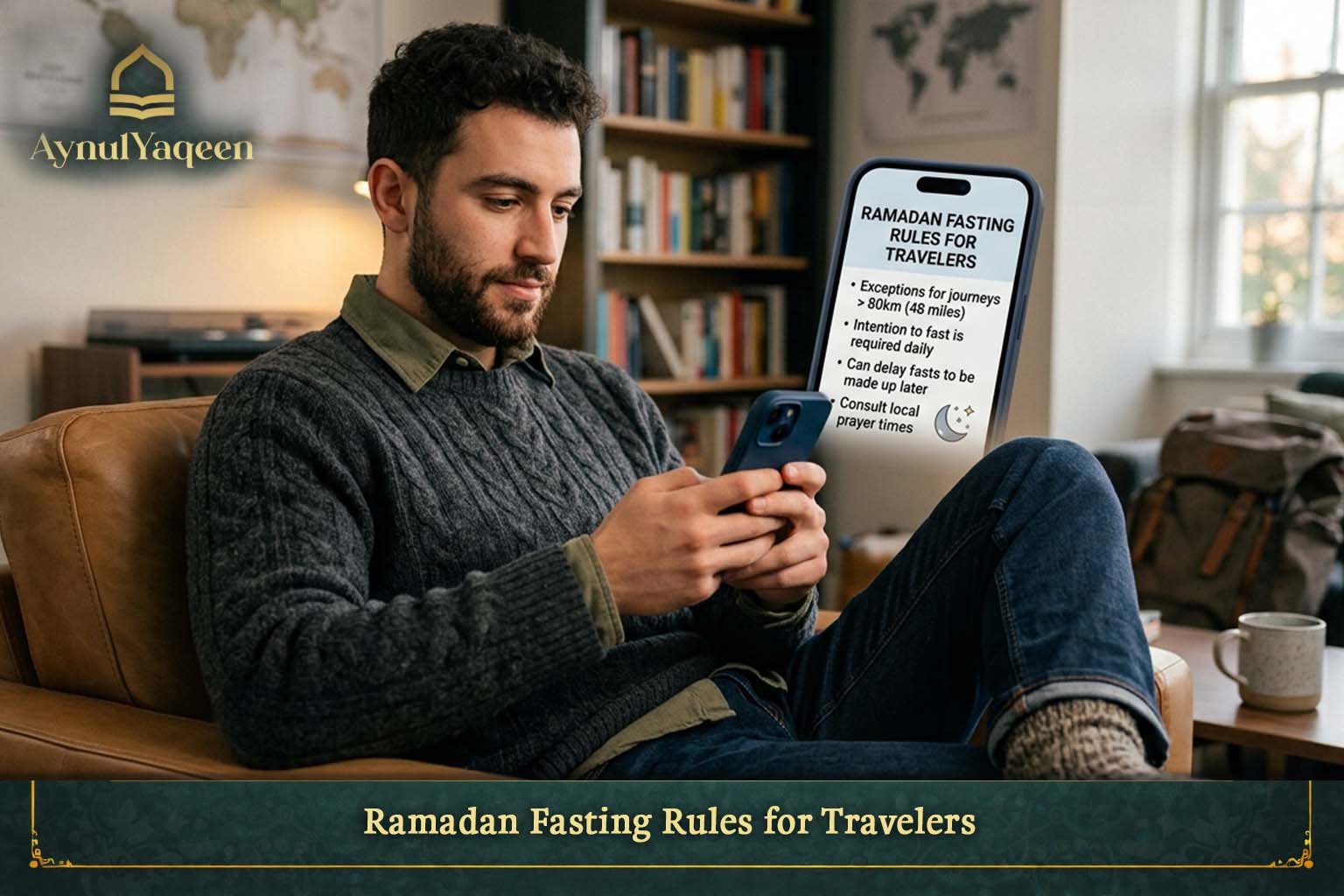
Travel is another situation frequently discussed when studying Ramadan fasting rules. Islamic teachings provide concessions for travelers who meet the conditions recognized in Islamic jurisprudence.
However, simply traveling a short distance does not automatically mean that every person is exempt. The details can depend on factors such as the nature and distance of the journey, the person’s circumstances, and the school of Islamic jurisprudence they follow.
For that reason, a traveler should not assume that a particular ruling applies without checking the relevant conditions. If there is uncertainty, consulting a qualified scholar can clarify whether the person may break the fast and whether missed days need to be made up later.
The broader principle is that Islamic law recognizes genuine hardship while preserving the importance of worship and obedience.
Ramadan Fasting Rules for Illness and Health Concerns
Health is another important consideration when discussing Ramadan fasting rules. Islam does not require a person to expose themselves to serious harm to complete a fast.
Someone with a medical condition should therefore consider appropriate religious guidance alongside qualified medical advice. The nature of the illness matters, as does the expected effect of fasting.
For example, a temporary illness may involve making up missed fasting days later, while a person with a permanent inability to fast may have a different ruling. These situations should not be treated as identical.
Anyone taking regular medication or managing a medical condition should speak with their healthcare professional before changing medication schedules or deciding to fast. At the same time, they can ask a qualified scholar about the corresponding religious ruling.
This balanced approach allows Muslims to respect both their religious responsibilities and legitimate health needs.
What Happens If You Miss a Ramadan Fast?
Missing a fast can happen for different reasons, and the appropriate response depends on why the fast was missed. Therefore, Ramadan fasting rules concerning missed days should be understood according to the person’s specific situation.
A person who has a temporary, legitimate reason may generally be required to make up the missed fasting days later when they are able. This is commonly referred to as making up the fast, or Qada.
However, a person who has a permanent inability to fast may fall under different rules, including the obligation of Fidya in circumstances recognized by Islamic law.
Because the details can differ depending on the reason and circumstances, Muslims should not assume that one solution applies to everyone.
When a missed fast is connected to illness, pregnancy, breastfeeding, travel, or another recognized excuse, seeking qualified religious guidance can prevent mistakes and provide clarity.
Ramadan Fasting Rules and Fidya
Fidya is a form of compensation associated with certain people who are unable to fast and cannot reasonably make up the missed days, according to the applicable Islamic ruling.
It is important, however, to distinguish Fidya from simply choosing not to fast. A person who is capable of making up missed fasts after Ramadan may generally have a different obligation from someone who has a permanent inability to fast.
The exact details concerning Fidya can vary depending on the reason for not fasting and the legal school or scholarly opinion being followed. Consequently, Muslims should ask a knowledgeable scholar for guidance before deciding whether Fidya applies to them.
This distinction is an important part of understanding Ramadan fasting rules, particularly for elderly people and those living with long-term health conditions.
Ramadan Fasting Rules and Good Character
Fasting should influence how a person behaves throughout the day. Therefore, good character is an essential part of the Ramadan experience.
A fasting Muslim should make a conscious effort to remain patient even when tired, hungry, or frustrated. If an argument begins, stepping away can be more beneficial than escalating the situation. Alongside fasting, Muslims can strengthen their worship by learning the virtues of reciting quran and reflecting on its guidance.
Similarly, controlling the tongue is important. Avoiding insults, gossip, backbiting, and harmful speech helps protect the spiritual value of the fast.
Ramadan can therefore become a practical training period for developing better behavior. The goal is not simply to complete a certain number of fasting days but to allow worship to influence everyday conduct.
Students studying Islam through Aynulyaqeen Quran Academy can also benefit from connecting the rules of fasting with broader Islamic values such as patience, honesty, mercy, responsibility, and self-control.
How Can Beginners Understand Ramadan Fasting Rules?
For someone experiencing Ramadan for the first time, the number of rules and recommendations can initially seem overwhelming. Fortunately, beginners do not need to memorize every detail at once.
A simple approach is to start with the essential principles:
- Understand when the fast starts.
- Know when the fast ends.
- Learn what clearly invalidates the fast.
- Understand who may receive an exemption.
- Learn what to do if a fast is missed.
- Develop good habits alongside the physical fast.
- Ask qualified scholars about personal situations.
Once these foundations are clear, a beginner can gradually learn more detailed matters. For learners who want to build a consistent Quran routine, applying tips for quran memorization can also make daily study more organized.
It is also useful to study the subject before Ramadan begins rather than waiting until the first day. Preparation reduces confusion and gives the person more confidence when following Ramadan fasting rules.
Learning Ramadan Fasting Rules With the Quran and Sunnah
The best way to understand fasting is to study it within the broader framework of Islam. The Quran establishes the obligation of fasting Ramadan, while the Sunnah provides important explanations concerning how Muslims observe the fast.
Studying these sources can help learners understand not only what they should do but also why fasting occupies such an important place in Islamic worship.
For children and beginners, lessons should be presented gradually. Simple explanations, practical examples, repetition, and opportunities to ask questions can make religious learning easier to understand. Building a strong foundation in worship can also include learning how to pray Salah step by step.
Aynulyaqeen Quran Academy can support students who want to strengthen their Quran and Islamic learning in a structured environment. Nevertheless, detailed questions involving individual legal circumstances should always be directed to appropriately qualified scholars.
Common Mistakes When Following Ramadan Fasting Rules
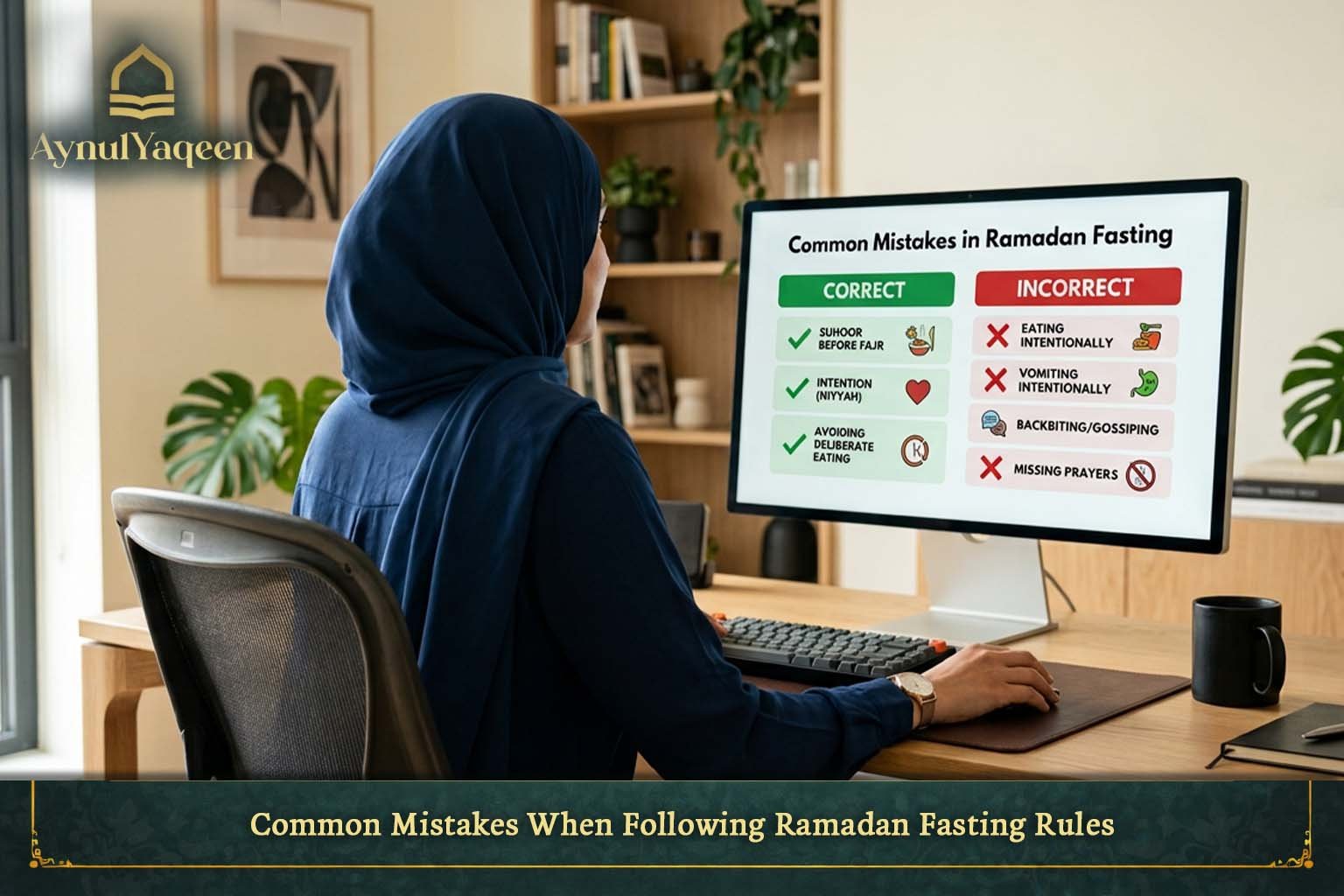
Even people who have fasted for many years can sometimes make mistakes. Most errors can be reduced through preparation and learning.
Common problems include:
- Confusing dawn with sunrise.
- Delaying the end of the fast beyond sunset unnecessarily.
- Assuming every traveler or sick person has the same ruling.
- Treating all missed fasts as if they have the same legal consequence.
- Ignoring the spiritual dimension of fasting.
- Focusing heavily on food while neglecting prayer and Quran recitation.
- Giving religious rulings without checking reliable scholarly sources.
Therefore, learning Ramadan fasting rules from trustworthy Islamic sources is preferable to depending on social media posts or unverified advice.
Ramadan Fasting Rules: A Practical Daily Routine
A simple daily routine can make Ramadan easier to manage, especially for beginners. Before dawn, the fasting person can wake for Suhoor, eat and drink moderately, and prepare for Fajr prayer. Once true dawn arrives, the fasting period begins.
During the day, the person avoids food and drink while also trying to maintain good character and increase acts of worship. Work, school, and family responsibilities can continue, but the believer should remain conscious of the spiritual purpose of Ramadan.
After sunset, the fast is broken at Iftar. The evening then provides time for meals, prayer, Quran recitation, family activities, and other permissible pursuits. Those working toward memorization may also find it helpful to understand how long does it take to memorize the Quran and create realistic study expectations.
A consistent routine makes it easier to apply Ramadan fasting rules without allowing the practical requirements of fasting to dominate the entire Ramadan experience.
How Can Aynulyaqeen Quran Academy Support Ramadan Learning?
Aynulyaqeen Quran Academy can help learners approach Ramadan as an opportunity for broader Quranic and Islamic education. Students may benefit from structured lessons that connect Quran learning with practical worship and daily Islamic values.
For beginners, guided learning can make unfamiliar concepts easier to understand. Meanwhile, children may benefit from age-appropriate explanations that help them appreciate the purpose of Ramadan rather than viewing fasting as merely going without food. Parents who want to encourage young learners can also explore the easiest way to memorize the quran for kids as part of a balanced Quran learning routine.
A structured learning environment can also encourage students to ask questions, review what they have learned, and develop consistent Quran-related habits during the holy month.
When studying Ramadan fasting rules, however, educational material should complement—not replace—qualified scholarly guidance for personal or complex legal questions.
Preparing for Ramadan: A Simple Checklist
Preparing before Ramadan can make the transition into fasting much smoother. Instead of waiting until the first day, Muslims can gradually organize their schedule and learn the essential rulings in advance.
A useful preparation checklist includes:
- Review the basic rules of fasting.
- Learn the local Fajr and Maghrib prayer times.
- Plan a manageable Suhoor and Iftar routine.
- Organize work or school around prayer when possible.
- Set realistic Quran reading goals.
- Prepare for additional acts of worship.
- Learn the rules relevant to personal circumstances.
- Ask a qualified scholar about unresolved questions.
With preparation, the practical side of Ramadan fasting rules becomes easier to follow, allowing more attention to be given to worship and spiritual development.
Why does understanding Ramadan Fasting Rules Matters?

Understanding the rules of fasting protects the worshipper from avoidable mistakes. More importantly, it allows Muslims to approach Ramadan with confidence and awareness.
When a person knows when fasting begins, when it ends, what must be avoided, and what concessions may apply, they can focus more fully on prayer, Quran recitation, remembrance, charity, and personal growth.
Ramadan is therefore not simply a month in which Muslims change their eating schedule. It is a period of worship and reflection that can influence behavior long after the month ends.
For this reason, learning Ramadan fasting rules before Ramadan begins can be one of the most useful forms of preparation for anyone who wants to observe the month correctly and meaningfully.
Frequently Asked Questions About Ramadan Fasting Rules
provide clear answers to common questions about fasting times, exemptions, daily practices, and fasting requirements.
Can a person use toothpaste while fasting?
Using toothpaste raises questions about the possibility of swallowing its contents. A person should take care to avoid swallowing toothpaste or water while brushing during fasting hours. Because detailed rulings can differ regarding specific circumstances, asking a qualified scholar is advisable when there is uncertainty.
Is it necessary to change your sleep schedule during Ramadan?
No single sleep schedule is mandatory for every Muslim. However, the Ramadan routine often changes because of Suhoor, Fajr, evening prayers, and other acts of worship. The best schedule is one that allows the person to fulfill religious obligations while maintaining sufficient rest and daily responsibilities.
Can Muslims continue working or studying while fasting?
Yes. Fasting does not generally prevent Muslims from continuing ordinary permissible work or education. In fact, maintaining responsibilities while exercising patience and self-control can become part of the broader experience of Ramadan.
How can parents introduce fasting to young children?
Parents can introduce the concept gradually according to the child’s age, health, maturity, and ability. Educational activities, simple explanations, Quran stories, and participation in Suhoor or Iftar can help children develop a positive understanding of Ramadan before fasting becomes obligatory.
In conclusion, understanding Ramadan fasting rules is essential for Muslims who want to observe Ramadan correctly, confidently, and with sincere intention. Fasting is not simply about avoiding food and drink from dawn until sunset. It is an important act of worship that teaches patience, self-control, gratitude, compassion, and greater awareness of Allah.
Learning the basic Ramadan fasting rules helps Muslims understand when the fast begins and ends, how to manage Suhoor and Iftar, what may invalidate the fast, and when exemptions may apply. People facing illness, pregnancy, travel, or other personal circumstances should seek appropriate Islamic guidance to understand their responsibilities.
Ramadan is also an opportunity to strengthen faith through Quran recitation, prayer, remembrance, charity, and good deeds. Families can encourage children to develop positive habits while learning the values of patience, kindness, and responsibility.
By following the Ramadan fasting rules with knowledge and sincerity, Muslims can avoid common mistakes and make better use of the blessed month. With preparation and consistent worship, Ramadan can become a meaningful period of spiritual growth whose lessons continue throughout the year.
