

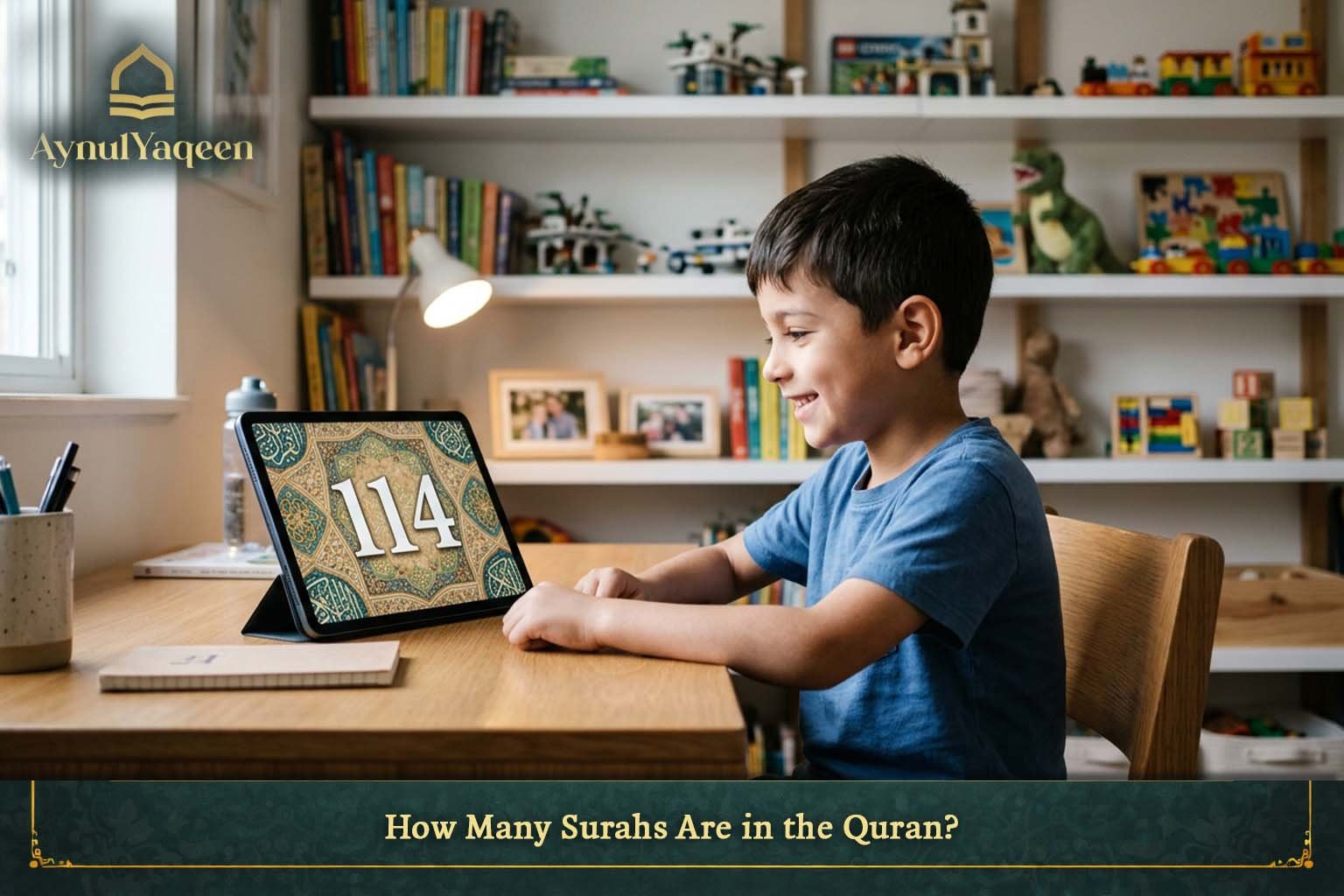
How many surahs are in the Quran is a common question for Muslims, new learners, parents, and anyone beginning to study the Holy Quran. The Quran contains 114 Surahs, and each chapter has its own name, number of Ayahs, themes, and lessons. However, knowing the number of chapters is only the beginning of understanding how the Quran is organized.
When learners ask how many surahs are in the Quran, they may also want to know how the chapters are arranged, which Surah comes first, which one is the longest, and how the shorter chapters can be approached during memorization. Therefore, understanding the structure of the Quran can make reading, recitation, memorization, and study easier.
The 114 Surahs differ significantly in length and subject matter. Some chapters contain only a few verses, while others extend across many pages. Likewise, some focus heavily on faith and the Hereafter, while others discuss worship, morality, family life, social responsibilities, and stories of earlier peoples.
For learners who want structured Quran education, Aynulyaqeen Quran Academy can provide an organized learning environment where students can work on Quran reading, Tajweed, memorization, and revision according to their individual levels and goals.
How Many Surahs Are in the Quran?
The answer to how many surahs are in the Quran is 114 Surahs. This is the standard number of chapters in the Quranic text used by Muslims around the world.
Each of these 114 chapters has a particular name and contains a specific number of Ayahs. The chapters are not equal in length. For example, Surah Al-Baqarah contains 286 Ayahs, while Surah Al-Kawthar contains only three.
Therefore, when someone searches for how many surahs are in the Quran, the direct answer is 114. Yet, a complete understanding requires looking at how these chapters differ and how they fit together within the Quran.
The Surahs are arranged in a recognized order in the Mushaf. This arrangement begins with Surah Al-Fatiha and ends with Surah An-Nas. It is important to distinguish this arrangement from the chronological order of revelation because the two sequences are not the same.
Learn Online with Aynulyaqeen Quran Academy
Choosing the right online Quran academy can make a significant difference in your learning journey. Aynulyaqeen Quran Academy provides structured Quran courses for beginners and advanced learners, focusing on accurate Quran reading, Tajweed, memorisation, and Islamic studies.
With qualified teachers, flexible class schedules, and personalised one-on-one lessons, students of all ages can learn at their own pace while building confidence in reciting and understanding the Holy Quran from anywhere in the world.

Why Is Knowing How Many Surahs Are in the Quran Important?
Knowing how many surahs are in the Quran gives learners a basic understanding of its structure. Instead of viewing the Quran as one continuous text, students can understand it as a collection of 114 connected chapters.
This knowledge can be particularly useful for students who are memorizing the Quran. A learner can divide the long-term goal into smaller stages by studying individual Surahs, groups of Surahs, or sections of the Quran.
Furthermore, understanding the number of chapters helps students follow Quran lessons more easily. A teacher can refer to a specific Surah and Ayah, and the learner can locate the passage without confusion.
For parents, this information can also make it easier to understand a child’s learning progress. Rather than focusing only on the amount of text memorized, parents can recognize the different stages involved in reading, recitation, memorization, revision, and understanding.
How Many Surahs Are in the Quran and What Is a Surah?
To understand how many surahs are in the Quran, it is useful to first understand what the word “Surah” means in Quranic studies.
A Surah is a chapter of the Quran. The plural is commonly written as Surahs. Each Surah consists of a particular number of Ayahs, or verses, and has its own name.
The chapters cover many aspects of Islamic guidance. Depending on the Surah, the content may discuss belief in Allah, worship, accountability, morality, family relationships, social responsibilities, stories of prophets, or events involving earlier communities.
As a result, the 114 chapters should not be viewed as identical units. Each one contributes to the broader message of the Quran while presenting particular themes and lessons.
What Is the Difference Between a Surah and an Ayah?
A Surah is a chapter, while an Ayah is a verse within that chapter. For example, Surah Al-Fatiha is one Surah and contains seven Ayahs. Surah Al-Baqarah is another Surah and contains 286 Ayahs.
This distinction is especially important when studying how many surahs are in the Quran because people sometimes confuse the number of chapters with the number of verses.
A Quranic reference such as 2:255 means Surah Al-Baqarah, chapter 2, Ayah 255. Once learners understand this system, finding particular passages becomes much easier.
How Many Surahs Are in the Quran From Al-Fatiha to An-Nas?
When discussing how many surahs are in the Quran, it is helpful to remember the beginning and end of the standard arrangement.
The Quran starts with Surah Al-Fatiha, number 1, and finishes with Surah An-Nas, number 114.
Between these two chapters are 112 other Surahs of different lengths and subjects.
This arrangement is familiar to Quran readers worldwide and is used when referring to Surah numbers during lessons, recitation, memorization, and research.
What Is the First Surah in the Quran?
Surah Al-Fatiha is the first Surah in the standard arrangement of the Quran. It consists of seven Ayahs and is one of the most frequently recited portions of the Quran because of its role in Salah.
The Surah teaches believers to praise Allah, recognize His mercy, worship Him, and ask Him for guidance.
For beginners, learning Al-Fatiha correctly can be especially important because it combines Quranic reading practice with an essential part of daily worship.
What Is the Last Surah in the Quran?
Surah An-Nas is the 114th and final Surah in the standard arrangement. It is a short chapter that seeks refuge in Allah from the evil of the whisperer. Together with Surah Al-Falaq, it is commonly associated with seeking Allah’s protection.
Because of its short length, An-Nas is often included in beginner memorization plans.
How Many Surahs Are in the Quran and What Are Their Main Themes?
The 114 Surahs address a broad range of subjects. Some chapters emphasize Tawheed, or the oneness of Allah. Others discuss resurrection, accountability, worship, morality, family relationships, social responsibilities, or stories of prophets and earlier communities.
Several recurring themes include:
- Faith in Allah.
- Worship and obedience.
- The Hereafter.
- Moral responsibility.
- Patience and perseverance.
- Gratitude.
- Justice.
- Repentance.
- Family and community responsibilities.
- Lessons from previous peoples.
Consequently, learning how many surahs are in the Quran should lead to a deeper question: what can a learner gain from studying those Surahs?
The answer depends on the chapter, the learner’s goals, and the level of study.
How Many Surahs Are in the Quran by Revelation Period?
Another useful way to study how many surahs are in the Quran is to understand the traditional classification of the Surahs as Meccan and Medinan.
Meccan Surahs are traditionally understood as those revealed before the Prophet Muhammad migrated to Medina. Medinan Surahs refer to those revealed after the migration.
This classification is based primarily on the period of revelation rather than simply the physical location associated with an individual verse.
Meccan Surahs
Meccan Surahs commonly emphasize foundational matters of faith. Their themes frequently include belief in Allah, resurrection, the Day of Judgment, revelation, accountability, and reflection on creation.
Many Meccan chapters remind people about the temporary nature of worldly life and the importance of preparing for the Hereafter.
Shorter Surahs found toward the end of the Quran often contain strong reminders about faith, worship, morality, and accountability. Consequently, they are frequently memorized by children and beginners.
Medinan Surahs
Medinan Surahs often contain more detailed guidance concerning individual and community life.
Their subjects may include worship, family relationships, financial responsibilities, social conduct, and other matters relevant to the Muslim community.
When learners ask how many surahs are in the Quran, understanding this classification adds historical context to the simple answer of 114. It helps students recognize that Quranic revelation addressed different circumstances throughout the Prophet’s mission.
How Many Surahs Are in the Quran and How Are They Arranged?
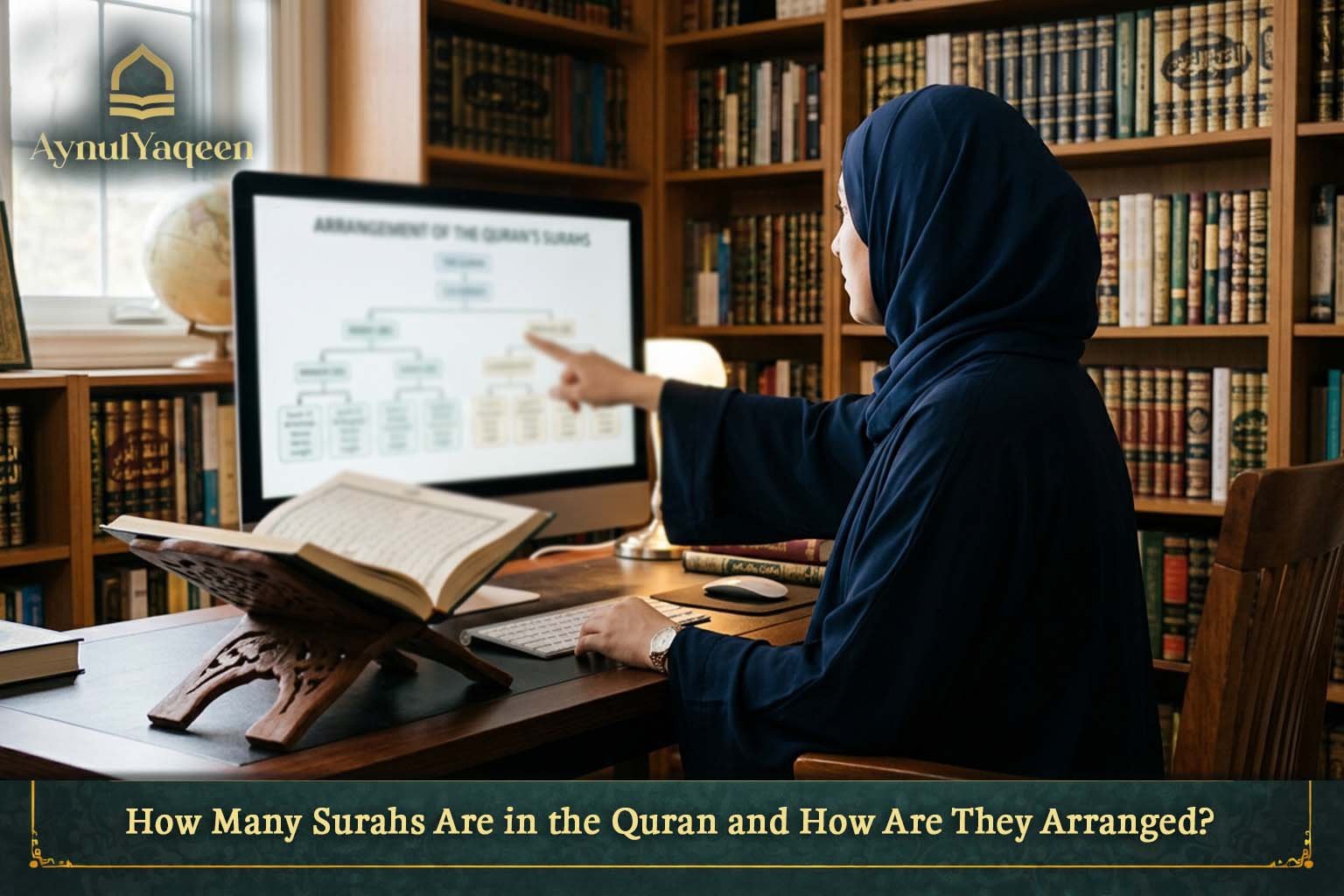
The answer to how many surahs are in the Quran remains 114, but these chapters are not arranged according to the chronological sequence in which they were revealed.
The standard Mushaf begins with Al-Fatiha and ends with An-Nas. Some Surahs that are traditionally associated with the early period of revelation appear much later in the current arrangement.
For example, Surah Al-Alaq is traditionally associated with the beginning of revelation, but it is number 96 in the standard arrangement. Surah Al-Fatiha, meanwhile, is placed first.
Understanding this distinction can prevent confusion among students who are learning about the history and structure of the Quran.
How Many Surahs Are in the Quran Before Surah Al-Fatiha?
There are no Surahs before Al-Fatiha in the standard arrangement because Al-Fatiha is the first chapter of the Quran.
The Surah contains seven Ayahs and is commonly translated as “The Opening.” It praises Allah, acknowledges His mercy and sovereignty, and asks for guidance to the straight path.
Al-Fatiha has a unique place in Islamic worship and is recited during Salah. Therefore, it is often one of the first Surahs that learners study carefully.
How Many Surahs Are in the Quran After Al-Fatiha?
There are 113 Surahs after Al-Fatiha, because Al-Fatiha is the first of the 114 chapters.
The second chapter is Al-Baqarah, followed by Aal-Imran, An-Nisa, Al-Ma’idah, and the remaining Surahs in the standard Quranic arrangement.
This sequence provides a useful reference system for Quran study. Learners can identify a chapter by its name or number and then locate particular Ayahs within it.
How Many Surahs Are in the Quran and Which Is the Longest?
If you are researching how many surahs are in the Quran, another common question is which chapter is the longest.
The longest Surah in the Quran is Surah Al-Baqarah, which contains 286 Ayahs.
It is the second Surah in the standard arrangement and addresses a wide range of subjects. These include belief, worship, fasting, charity, family matters, financial responsibilities, and guidance for individual and community life.
Because Al-Baqarah is lengthy, students may benefit from dividing it into manageable sections when reading or memorizing it.
How Many Surahs Are in the Quran Longer Than Al-Baqarah?
None of the other 113 Surahs is longer than Al-Baqarah by the number of Ayahs.
However, length can be measured in different ways, including verses, words, pages, or letters. Page counts may also differ between Mushaf editions because of variations in script, formatting, and page size.
For that reason, the number of Ayahs is the more stable way to identify Al-Baqarah as the longest Surah.
How Many Pages Is Surah Al-Baqarah?
The number of pages occupied by Surah Al-Baqarah depends on the edition of the Mushaf.
In commonly used Madinah Mushaf editions, it occupies a substantial number of pages. However, different printed formats may place different amounts of text on each page.
Therefore, learners should not assume that a page count applies to every Quran edition.
For memorization, dividing Al-Baqarah into Ayahs or manageable passages can be more useful than relying exclusively on page numbers.
How Many Surahs Are in the Quran and Which Is the Shortest?
The Quran contains 114 Surahs, and Surah Al-Kawthar is the shortest Surah by the number of Ayahs, with only three verses.
Although it is brief, Al-Kawthar contains important meanings concerning Allah’s favor and the believer’s response through worship and gratitude.
Its short length makes it accessible to beginners. Nevertheless, short does not mean unimportant. Each Surah deserves careful recitation and thoughtful study.
Which Other Surahs Are Short?
Several Surahs near the end of the Quran are relatively short and are commonly memorized by beginners.
Some familiar examples include:
- Surah Al-Kawthar
- Surah Al-Ikhlas
- Surah Al-Falaq
- Surah An-Nas
- Surah Al-Asr
- Surah An-Nasr
- Surah Al-Masad
- Surah Al-Fil
- Surah Quraysh
These chapters can help learners build confidence before progressing to longer passages.
How Many Surahs Are in the Quran That Muslims Commonly Memorize?
When considering how many surahs are in the Quran, it is important to remember that Muslims may memorize different portions according to their individual circumstances.
Some learners memorize selected short Surahs for Salah. Others work toward memorizing Juz Amma. More advanced students may aim to memorize the entire Quran.
A practical memorization plan should take several factors into account:
- Current Quran reading ability.
- Pronunciation and Tajweed level.
- Daily study time.
- Amount of previous memorization.
- Revision requirements.
- Personal learning goals.
- Ability to maintain consistency.
Memorization becomes more sustainable when new material and previous material are both included in the study routine.
How Many Surahs Are in the Quran and How Can Beginners Start?
For beginners wondering how many surahs are in the Quran, the total of 114 may initially seem overwhelming.
However, learners do not need to approach all 114 Surahs at once.
A beginner can start with basic Quran reading skills and gradually move toward selected short Surahs. At the same time, the learner can develop correct pronunciation and become familiar with basic Tajweed principles.
A simple progression may look like this:
- Learn the Arabic letters and sounds.
- Practice joining letters and reading words.
- Develop basic Quran reading fluency.
- Learn Al-Fatiha carefully.
- Begin memorizing selected short Surahs.
- Study basic Tajweed rules.
- Review previously memorized passages regularly.
- Gradually progress to longer Surahs.
This approach allows learners to build confidence without treating Quran study as a race.
How Many Surahs Are in the Quran for Children?
Parents may ask how many surahs are in the Quran when planning their children’s Quran education.
The answer is still 114, but children do not need to learn the chapters all at once. Instead, their learning can be divided into small and manageable stages.
Short Surahs can provide an accessible starting point. Children can practice a few Ayahs at a time while receiving regular correction from a qualified teacher.
A child-friendly Quran program may include:
- Short learning sessions.
- Frequent revision.
- Simple explanations.
- Correct pronunciation practice.
- Encouragement and positive feedback.
- Age-appropriate learning activities.
- A gradual increase in difficulty.
Parents should also remember that children learn at different speeds. A sustainable routine is generally more useful than comparing one child’s progress with another’s.
How Many Surahs Are in the Quran for New Muslims?
A new Muslim may wonder how many surahs are in the Quran and whether it is necessary to study all 114 chapters immediately.
There is no need to approach Quran learning as one enormous task. A new learner can begin with essential reading skills and selected Surahs while gradually becoming more familiar with the Quran.
Al-Fatiha is an important early focus because of its role in Salah. After that, learners may choose short Surahs that help them participate more confidently in prayer.
Over time, the learner can expand Quran reading, memorization, Tajweed, and understanding.
The most important element is consistency. Small amounts of regular learning can create a stronger routine than occasional intensive sessions.
How Many Surahs Are in the Quran and How Can You Study Them?
A structured approach can make the 114 Surahs easier to study. First, determine the learner’s primary goal. Someone focused on Salah may prioritize selected short Surahs. Another learner may want to improve Tajweed. A student working toward Hifz will need a stronger focus on memorization and revision. Next, establish a realistic schedule.
A useful study session may include:
- Reading a selected passage.
- Listening to accurate recitation.
- Practicing pronunciation.
- Reviewing Tajweed rules.
- Memorizing a small section.
- Revising previous material.
- Reading a translation or explanation when appropriate.
At Aynulyaqeen Quran Academy, learners can use structured Quran education to work toward different goals rather than following a single approach for every student.
How Many Surahs Are in the Quran and What Should You Know About Hifz?
For someone pursuing Hifz, knowing how many surahs are in the Quran provides a useful overview of the complete memorization journey.
The Quran contains 114 Surahs, and approaching them gradually can make the memorization process more manageable. However, successful memorization is not simply about moving from one Surah to another.
Retention requires continuous revision and a realistic study routine. Learners can also benefit from practical tips for quran memorization that help them organize new lessons and strengthen previously memorized passages.
A learner may divide the work into three categories:
- New memorization: The passage being learned for the first time.
- Recent revision: Material memorized recently and still being strengthened.
- Long-term revision: Older passages that need regular review to remain strong.
This three-part approach can help prevent a common problem: memorizing new material quickly while gradually forgetting earlier passages.
How Many Surahs Are in the Quran and Why Is Revision Important?
The answer to how many surahs are in the Quran is simple, but maintaining knowledge of all 114 Surahs requires consistent practice. Revision is particularly important for anyone working toward Hifz because previously memorized passages can become weaker without regular review.
For beginners, revision can be as simple as repeating a recently learned Surah several times throughout the week. Advanced students may work with larger sections and follow more structured revision schedules.
In addition, regular Quran recitation can strengthen familiarity with the text and support a consistent worship routine. Understanding the virtues of reciting quran can also help learners appreciate why maintaining a connection with the Quran matters beyond memorization alone.
Therefore, learners should consider revision part of Quran learning rather than an optional activity added only when they have free time.
How Many Surahs Are in the Quran and What Makes Quran Learning Effective?
Knowing how many surahs are in the Quran does not automatically make Quran study easier. The learning method matters as well. Effective Quran learning generally requires consistency, appropriate pacing, correction, and regular practice.
Students can improve their experience by:
- Setting realistic weekly goals.
- Studying at consistent times.
- Keeping track of completed lessons.
- Revising older material.
- Asking questions when something is unclear.
- Correcting pronunciation early.
- Avoiding excessive memorization in one session.
Additionally, learners should allow enough time for understanding. Memorizing words without considering their meaning may limit the educational benefit of Quran study.
Correct recitation also depends on applying pronunciation rules accurately. For this reason, learners who want to improve their recitation should understand What is the importance of tajweed and how Tajweed supports accurate Quran reading.
How Aynulyaqeen Quran Academy Can Help With Quran Study
For learners who want guided online Quran education, Aynulyaqeen Quran Academy can be part of a structured study plan.
A suitable Quran learning program should consider the learner’s current reading ability, age, goals, schedule, and previous experience.
For a beginner, the priority may be learning to read Quranic Arabic accurately. Another student may already read fluently but need help with Tajweed. Meanwhile, someone pursuing memorization may require a clear Hifz and revision routine.
Quran education can also connect memorization and recitation with practical Islamic learning. Students who are developing their overall worship knowledge may benefit from learning how to pray Salah step by step alongside their Quran studies.
This distinction is important because there is no single learning path that suits every Quran student.
By establishing a clear starting point and measurable goals, learners can approach the 114 Surahs gradually while developing stronger reading and recitation skills.
Common Mistakes When Learning the Surahs
Learning the Quran can become difficult when students try to progress too quickly. One common mistake is memorizing a large amount of material without enough revision. Although the learner may initially feel that progress is fast, previously memorized passages can become weaker.
Another mistake is ignoring pronunciation. Correcting a pronunciation issue early is generally easier than trying to remove an established habit later.
Some learners also focus only on quantity. They may count how many Surahs they have completed without considering whether they can recite them accurately and confidently.
Finally, inconsistent study can interrupt progress. A realistic routine that can be maintained over time is often more useful than a demanding schedule that lasts only a few days.
For students building a broader understanding of Islamic practice, Quran study can also be combined with learning other essential acts of worship. For example, understanding Ramadan fasting rules can complement Quran learning during Ramadan and help students connect their study routine with their wider religious practice.
How Many Surahs Are in the Quran and What Should You Remember?
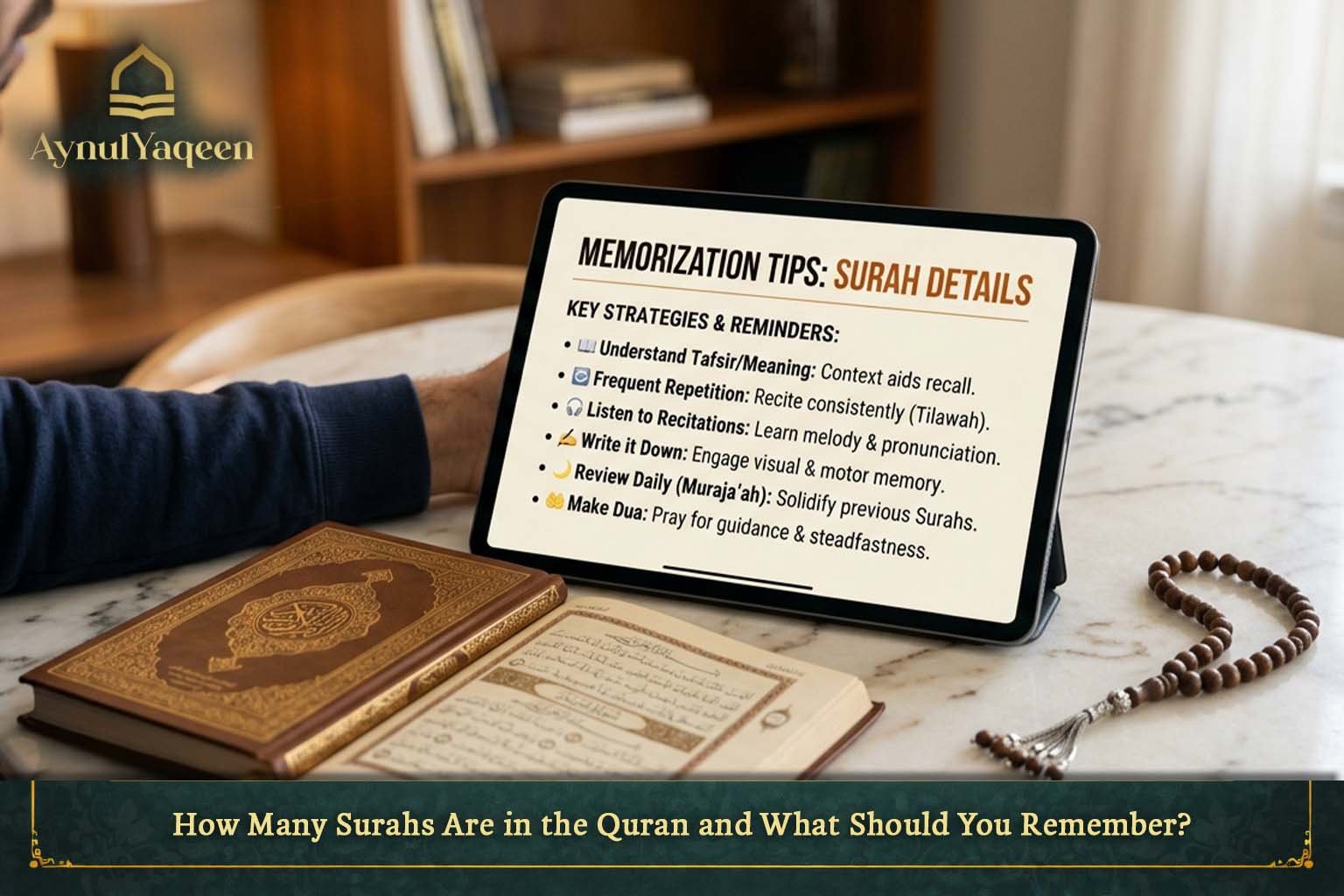
The most important fact is that the Quran contains 114 Surahs. However, there is much more to learn than the number itself. The chapters differ in length, themes, revelation period, and subject matter. Some are lengthy and detailed, while others are short.
Learners should also remember these key points:
- Al-Fatiha is the first Surah in the standard arrangement.
- An-Nas is the final Surah.
- Al-Baqarah is the longest Surah by number of Ayahs.
- Al-Kawthar is the shortest Surah by number of Ayahs.
- The Surahs are traditionally classified as Meccan or Medinan.
- A Surah consists of Ayahs.
- The current arrangement is not the chronological order of revelation.
- Regular revision is important for memorization.
Understanding these points gives learners a solid foundation for further Quran study.
Frequently Asked Questions About How Many Surahs Are in the Quran
These frequently asked questions provide clear answers about the number, arrangement, and key characteristics of the Surahs in the Quran.
1. Are the names of all 114 Surahs mentioned in the Quran itself?
The Surahs have recognized names used throughout Islamic scholarship and Quranic study. However, the way individual Surah names are established and discussed can involve scholarly explanations and traditional usage.
2. Can a Surah have more than one recognized name?
Yes. Some Surahs are known by more than one name in Islamic scholarship. These names may refer to characteristics, subjects, or notable features associated with the chapter.
3. Are Surah numbers written inside the original revelation?
The numbering used in modern Mushafs is a system that helps readers identify and navigate the chapters. It should be distinguished from the revealed Quranic text itself.
4. Why are some Surahs much longer than others?
The Surahs address different subjects and were revealed in different circumstances and periods. Their length therefore varies considerably, with some chapters containing only a few Ayahs and others containing hundreds.
In conclusion, the answer to how many surahs are in the Quran is 114 Surahs. These chapters begin with Al-Fatiha and end with An-Nas in the standard arrangement, with each Surah offering its own themes, lessons, and structure.
Learning how many surahs are in the Quran is an important first step for anyone beginning Quran study. Nevertheless, the greater value comes from reading the chapters accurately, understanding their meanings, reflecting on their guidance, and applying what is learned.
Whether the goal is Quran reading, Tajweed, memorization, or simply becoming more familiar with the Quran, learners can progress gradually. A structured plan, regular practice, and appropriate guidance can make the learning journey more manageable.
For students seeking online Quran education, Aynulyaqeen Quran Academy can provide a structured environment for developing Quran reading, recitation, memorization, and revision skills according to individual learning needs.
Ultimately, the 114 Surahs are not simply a number to remember. They represent the organized chapters through which Muslims read, recite, study, memorize, and reflect upon the Quran throughout their lives.
