


Are Online Quran Classes Effective? is an important question for parents and adult learners who want to study the Holy Quran correctly from home. As online education becomes more accessible, many families wonder whether virtual Quran lessons can provide proper pronunciation correction, effective Tajweed instruction, and meaningful learning progress.
Although learning through a screen may seem different from attending a traditional Quran class, the teaching method makes a significant difference. Live lessons allow students to recite directly to their teachers, receive immediate feedback, and practice unfamiliar Arabic sounds. Therefore, are online quran classes are effective depends largely on the quality of instruction and the student’s participation.
For parents, the main concern is whether their children are genuinely developing Quran reading skills rather than simply attending scheduled sessions. Similarly, adults want to know whether online lessons can help them improve their recitation without disrupting their daily responsibilities.
In this guide, we will explore whether online quran classes are effective for different learners, what makes virtual Quran education successful, and which challenges students should consider. We will also examine practical learning situations and explain how to evaluate an online Quran program before enrolling.
Are Online Quran Classes Effective for Learning the Holy Quran?

When people ask are online quran classes effective, the answer depends on the educational structure, teacher qualifications, and opportunities for direct interaction. Online lessons can provide meaningful Quran education when students receive individual attention and regular correction.
Unlike recorded videos, live instruction allows teachers to listen to students and identify mistakes during recitation. Consequently, learners can correct pronunciation problems before repeating them over extended periods.
For example, a beginner might recognize Arabic letters but struggle to distinguish between ح and ه. A teacher can demonstrate the correct articulation and provide exercises until the student understands the difference.
This explains why are online quran classes effective should be evaluated through actual learning activities rather than the technology used to deliver lessons. Effective online Quran instruction should include:
- Direct teacher-student interaction.
- Regular Quran recitation practice.
- Immediate pronunciation correction.
- Clear explanations of Tajweed rules.
- Lessons appropriate to individual abilities.
- Revision of previously studied material.
- Feedback about learning progress.
Furthermore, students should have opportunities to ask questions and practice unfamiliar passages. When these elements are available, are online quran classes effective becomes a question that can be answered through observable improvements in reading accuracy, confidence, and understanding.
Learn Online with Aynulyaqeen Quran Academy
Choosing the right online Quran academy can make a significant difference in your learning journey. Aynulyaqeen Quran Academy provides structured Quran courses for beginners and advanced learners, focusing on accurate Quran reading, Tajweed, memorisation, and Islamic studies.
With qualified teachers, flexible class schedules, and personalised one-on-one lessons, students of all ages can learn at their own pace while building confidence in reciting and understanding the Holy Quran from anywhere in the world.

Why Are Online Quran Classes Effective for Different Learners?
One important advantage of online Quran education is its ability to accommodate different learning needs. Children, adults, beginners, and advanced readers may require different teaching methods.
Therefore, are online quran classes effective cannot be answered without considering the learner’s age, previous experience, and educational objectives.
Personalized Instruction Supports Individual Development
Every Quran learner begins with a different level of Arabic reading ability. Some students need to recognize individual letters, while others want to improve fluency or understand advanced Tajweed rules. Personalized lessons help teachers identify these differences and adjust their explanations accordingly.
For instance, a beginner may need additional exercises involving Arabic vowels. Meanwhile, an intermediate student may benefit more from practicing difficult Quranic words and correcting pronunciation mistakes.
This individual approach helps explain are online quran classes effective for students who require different levels of attention. Personalized instruction can support learners through:
- Identifying their current reading abilities.
- Practicing difficult Arabic sounds.
- Understanding unfamiliar Tajweed rules.
- Reviewing previous mistakes.
- Improving reading confidence.
- Following realistic learning objectives.
Additionally, individual feedback helps students understand which skills require further practice.
Flexible Scheduling Makes Quran Education More Accessible
Busy schedules sometimes prevent families from attending traditional Quran classes regularly. Parents may have work responsibilities, children may have school activities, and adults may struggle to find suitable lesson times.
Online education can reduce these difficulties by allowing students to attend lessons from home. For this reason, are online quran classes effective is particularly relevant to families who need flexible learning arrangements. Online lessons can benefit:
- Children with busy school schedules.
- Adults balancing work and religious education.
- University students with changing timetables.
- Families living far from Quran teaching centers.
- Beginners who prefer studying at home.
However, flexibility should not result in irregular attendance. Consistent lesson times remain important for developing reading skills and maintaining previously learned information.
How Are Online Quran Classes Effective for Improving Tajweed?
Understanding are online quran classes are effective requires examining one of the most important parts of Quran education: correct recitation. Reading the Holy Quran involves more than recognizing Arabic words. Students must learn the correct articulation of letters and apply relevant Tajweed rules during recitation. Live online instruction can support this process when teachers listen carefully and provide practical corrections.
Direct Pronunciation Correction
Some Arabic letters have similar sounds, making them difficult for beginners to distinguish. For example, students may confuse س with ص or struggle with the pronunciation of ع and ء. Without appropriate guidance, these mistakes can become repeated habits. During a live lesson, the teacher can:
- Listen to the student’s pronunciation.
- Identify the specific articulation difficulty.
- Demonstrate the correct sound.
- Ask the learner to repeat the letter.
- Practice the sound within Arabic words.
- Review the correction during later lessons.
This process demonstrates how are online quran classes effective can be evaluated through practical recitation exercises. The teacher’s ability to recognize mistakes and explain corrections is more important than simply completing additional reading pages.
Applying Tajweed Rules During Recitation
Students sometimes understand Tajweed definitions but struggle to apply them when reading Quranic verses. For example, a learner may understand the theoretical explanation of Ikhfa but fail to recognize its application during actual recitation. Live instruction provides opportunities to practice these rules within their Quranic context. Students may work on:
- Noon Sakinah and Tanween.
- Meem Sakinah.
- Madd and its different types.
- Qalqalah.
- Ghunnah.
- Rules of stopping and starting.
- Makharij Al-Huruf.
Consequently, are online quran classes effective also depends on whether lessons combine theoretical explanations with practical recitation. Regular feedback helps students recognize mistakes and understand how to improve their application of Tajweed.
Are Online Quran Classes Effective Compared With Traditional Classes?

Parents often compare online Quran education with traditional face-to-face learning. However, both approaches have advantages and limitations. The better option depends on the student’s circumstances, teaching quality, and available learning opportunities.
When considering are online quran classes are effective, families should compare the actual educational experience rather than assuming that one format always produces better results.
| Learning factor | Online Quran classes | Traditional Quran classes |
|---|---|---|
| Accessibility | Available from different locations | Requires attending a physical location |
| Scheduling | Often more flexible | May follow fixed schedules |
| Teacher interaction | Live interaction through video | Direct face-to-face interaction |
| Learning environment | Requires a suitable home space | Uses a dedicated teaching location |
| Transportation | No regular travel required | Travel may be necessary |
| Learning resources | Can include digital materials | Often includes printed materials |
| Personal attention | Depends on class size | Depends on class size |
Online lessons may be especially helpful for students who cannot access suitable local instruction. Meanwhile, traditional classes provide direct physical interaction and a shared learning environment.
Therefore, whether online quran classes are effective should be answered according to the individual learner’s needs, not simply the location of the classroom.
Are Online Quran Classes Effective When They Include Live Teaching?
Not every online Quran learning resource provides the same experience. One important difference is whether students receive live instruction or simply watch recorded videos.
Recorded materials can introduce Arabic letters and explain Tajweed concepts. Nevertheless, they cannot independently listen to a student’s recitation or correct individual pronunciation mistakes. This distinction is essential when examining are online quran classes effective for beginners.
Benefits of Live Quran Lessons
Live lessons allow students to communicate directly with teachers throughout the session. The teacher can listen, explain, demonstrate, and provide additional exercises whenever a learner encounters difficulty. Important benefits include:
- Immediate correction of recitation mistakes.
- Opportunities to ask questions.
- Lessons adjusted to individual abilities.
- Guided pronunciation exercises.
- Regular revision with teacher feedback.
- Greater accountability during learning.
These features explain why are online quran classes effective is particularly relevant when comparing interactive instruction with passive educational materials.
How Can Recorded Lessons Support Learning?
Recorded lessons can still provide useful supplementary resources. Students may revisit explanations, review unfamiliar Tajweed rules, and practice previously studied material between live sessions.
However, recorded content should not replace direct feedback when learners need individual pronunciation correction. A balanced learning approach can combine live instruction with independent revision.
What Makes Online Quran Classes Effective?
The effectiveness of online Quran education depends on several educational factors. Having a computer and internet connection does not automatically create a successful learning environment.
When parents ask are online quran classes are effective, they should examine the teaching process and the opportunities students receive to develop their abilities.
Qualified Quran Teachers
Teacher qualifications are among the most important considerations when selecting an online Quran program. Students should receive instruction from teachers with appropriate Quranic knowledge and the ability to explain recitation rules clearly. Depending on the educational objectives, relevant qualifications may include:
- Formal Quranic studies.
- Tajweed training.
- Quran teaching experience.
- An Ijazah where relevant to the program.
- Experience teaching different age groups.
An Ijazah represents authorization connected to a recognized chain of Quranic transmission. However, qualifications alone do not establish teaching effectiveness. Instructors should also demonstrate the ability to communicate clearly, recognize mistakes, and provide suitable explanations.
A Structured Quran Curriculum
A structured curriculum helps students understand what they are learning and what comes next. Without clear objectives, learners may move between unrelated topics without developing essential reading skills. A beginner’s learning pathway may include:
- Recognizing Arabic letters.
- Understanding individual letter sounds.
- Learning Arabic vowels.
- Connecting letters into words.
- Reading simple Quranic passages.
- Learning basic Tajweed rules.
- Practicing fluent recitation.
Advanced students may require a different curriculum involving detailed Tajweed, memorization, revision, and correction of established reading habits.
This is another reason are online quran classes effective depends on selecting a curriculum that matches the learner’s starting level.
Regular Practice and Revision
Attending lessons without reviewing their content can limit progress. Students need regular opportunities to reinforce pronunciation, remember Tajweed rules, and maintain previously developed skills. A practical revision routine can include:
- Reviewing the previous lesson.
- Practicing difficult words.
- Reciting assigned Quranic passages.
- Recording mistakes that require attention.
- Revisiting unfamiliar Tajweed rules.
Even short daily practice periods can support learning when they are consistent and appropriate for the student’s abilities.
Individual Feedback and Progress Assessment
Students should understand whether their reading skills are improving. Teachers can evaluate progress by listening to familiar passages, checking pronunciation, and observing how learners apply Tajweed rules. Parents can also ask about:
- Completed learning objectives.
- Improvements in pronunciation.
- Difficulties requiring additional attention.
- Reading skills that need revision.
- The next stage of instruction.
Therefore, are online quran classes effective should be assessed through actual learning progress rather than attendance records alone.
Are Online Quran Classes Effective for Children?
Children can benefit from online Quran education when lessons reflect their ages, attention spans, and learning abilities.
However, children do not all develop reading skills at the same speed. Some recognize Arabic letters quickly, while others need additional repetition and encouragement.
When parents investigate are online quran classes effective, they should consider whether the teaching approach keeps children actively involved.
Interactive Lessons Encourage Participation
Children generally need more than long explanations to remain engaged. Interactive activities can encourage them to identify Arabic letters, read short words, repeat sounds, and practice familiar verses.
For example, a teacher might ask a child to identify a letter before demonstrating its correct pronunciation. This approach allows the child to participate instead of simply watching the screen.
Parental Support During Online Lessons
Younger children may require parental assistance, particularly when they are unfamiliar with online learning. Parents can support their children’s education by:
- Preparing a quiet learning area.
- Helping children join lessons on time.
- Keeping Quran materials available.
- Reducing unnecessary distractions.
- Encouraging daily revision.
- Following up on teacher feedback.
However, parents should avoid answering every question for their children. Allowing students to participate independently helps teachers understand their actual abilities.
Choosing an Appropriate Lesson Duration
Longer sessions are not necessarily more productive for young learners. A lesson should provide enough time for recitation, explanation, correction, and revision without overwhelming the child. Teachers should consider the student’s age, concentration, and reading level when determining an appropriate session structure.
Are Online Quran Classes Effective for Adults and Beginners?
Online Quran education is not limited to children. Adults can also develop their Arabic reading and recitation skills through structured lessons. Some adults begin learning Quran reading for the first time, while others return after many years without regular practice.
For these learners, are online quran classes effective is an Importance of online Quran classes consideration when choosing a convenient way to study.
Starting Quran Reading as an Adult
Adult beginners may have different learning needs from younger students. Some understand detailed explanations but struggle with pronunciation. Others recognize Arabic letters but find it difficult to connect them into complete words. An appropriate learning plan should identify these differences before introducing advanced material. Adults may benefit from:
- Flexible lesson arrangements.
- Clear explanations of Arabic sounds.
- Individual pronunciation correction.
- Gradual Tajweed instruction.
- Regular revision.
- Realistic learning objectives.
Moreover, adults should avoid comparing their progress with students who already have previous Quran reading experience.
Returning to Quran Learning After a Long Break
Some adults learned basic Quran reading during childhood but stopped practicing regularly. When they return, they may remember individual letters but struggle with fluency or specific Tajweed rules.
A teacher can assess their current abilities and identify which skills need revision. Instead of automatically restarting every topic, the learner can focus on the areas requiring additional attention.
This approach makes are online quran classes effective, especially relevant for adults who want to rebuild their reading confidence.
Real Learning Experiences: How Online Quran Classes Can Help
Understanding are online quran classes effective becomes easier when considering practical situations that learners may experience.
Experience 1: A Child Struggling With Arabic Pronunciation
Imagine a child who recognizes most Arabic letters but repeatedly confuses two similar sounds during Quran reading. Initially, the child may become frustrated because the same mistake appears in different words. During individual lessons, the teacher listens carefully and identifies the pronunciation difficulty.
Instead of moving immediately to new material, the teacher demonstrates the correct sounds and provides repetition exercises. The child then practices the difficult letters within familiar words and previously studied verses. Parents can also review Noorani Qaida lessons explained to understand how foundational reading skills support Quran learning.
With consistent lessons and suitable home revision, the learner may gradually become more aware of pronunciation differences. This example illustrates why are online quran classes effective depends on the teacher’s ability to recognize individual difficulties rather than simply completing lessons.
Experience 2: An Adult Returning to Quran Study
Consider an adult who learned Quran reading years ago but has not practiced consistently. Although the learner recognizes Arabic letters, reading fluency has become weaker, and some Tajweed rules are difficult to remember.
The teacher begins by listening to the student’s recitation and identifying the areas requiring revision. The learning plan then focuses on familiar passages, pronunciation correction, and practical Tajweed exercises.
Over time, the student may find familiar passages easier to read and become more confident when practicing unfamiliar verses.
This situation demonstrates that adults do not always need to restart their entire learning journey. An assessment of their current abilities can provide a more suitable starting point.
How to Stay Focused During Online Quran Lessons?
Distractions can affect students who study through digital devices. Children may become distracted by games and notifications, while adults may struggle to concentrate because of work or household responsibilities.
Therefore, are online quran classes effective also depends on creating an environment that supports attention and participation.
Create a Dedicated Learning Space
A quiet study location can help learners associate a particular environment with Quran education. It does not need to be a separate room. A comfortable corner with suitable lighting may be sufficient. Before starting a lesson, prepare:
- A reliable device.
- A working microphone and camera.
- A stable internet connection.
- A Quran or suitable digital copy.
- A notebook for recording corrections.
- Headphones when necessary.
Develop a Consistent Pre-Lesson Routine
A simple routine can help students prepare mentally for Quran learning. For example, learners can arrange their materials, perform Wudu when appropriate, review the previous lesson, and join the session a few minutes early.
Parents can also explore practical ways to motivate kids to memorize Quran, helping children approach their learning routine with greater interest and consistency.
Honest Limitations: When Online Quran Classes May Not Be Effective
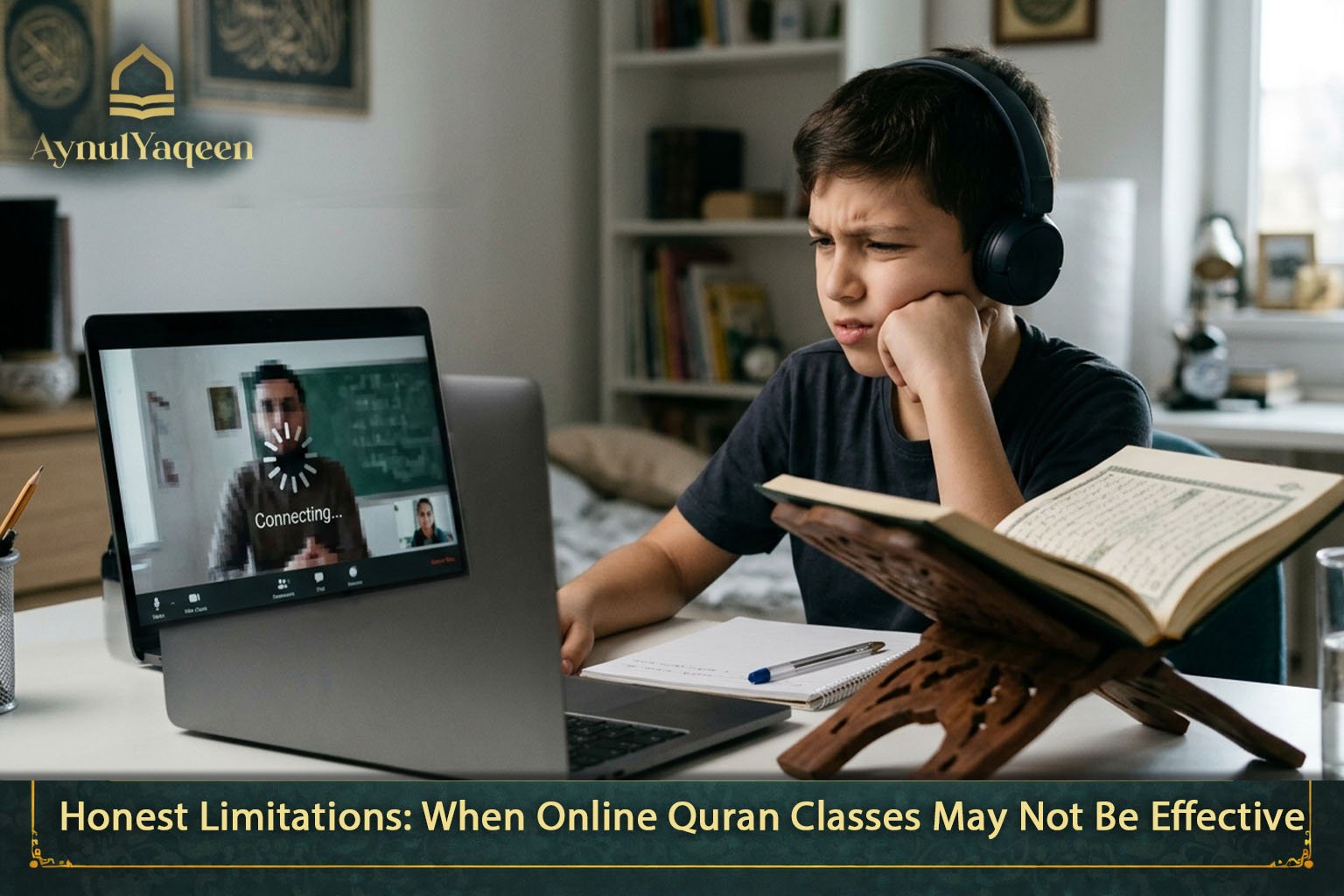
Although online education offers several advantages, it does not guarantee successful learning for every student. Understanding its limitations helps families make realistic decisions. Families comparing learning options should also understand how much online Quran classes cost before choosing a suitable arrangement.
Limited Parental Involvement
Young children may struggle to manage lessons independently. Without suitable support, they might lose focus, experience technical problems, or forget their revision assignments.
Parents can help by preparing the learning environment and encouraging consistent attendance. However, parental involvement should support the teacher’s work rather than interrupt the lesson.
Unstable Internet Connections
Technical interruptions can affect communication between teachers and students. Weak connections may cause delayed audio, frozen video, or difficulty hearing pronunciation clearly.
Because Quran recitation requires careful listening, families should check their equipment and internet connection before lessons.
Unrealistic Learning Expectations
Some students expect to master Quran reading or Tajweed after only a few sessions. However, learning speed depends on previous experience, practice frequency, teaching quality, and individual abilities.
Beginners may need additional time to recognize Arabic letters and connect them correctly. Similarly, advanced students may require extended practice to improve particular recitation habits.
Unclear Learning Objectives
Students sometimes begin Quran lessons without identifying their priorities. One learner may want to improve recitation, while another may prioritize memorization or understanding Arabic.
These goals require different learning approaches. Some families may also want to include broader Islamic education topics, such as the six pillars of iman, alongside Quran learning.
Discussing expectations before enrollment helps teachers recommend appropriate learning objectives.
How to Measure Progress in Online Quran Learning?
When evaluating are online quran classes effective, parents and students should look beyond the number of completed sessions. Real progress involves improvements in specific abilities related to the learner’s objectives.
Signs of Improvement in Quran Reading
| Learning area | Possible progress indicators |
|---|---|
| Arabic letters | Recognizing letters more accurately |
| Pronunciation | Producing difficult sounds more clearly |
| Reading fluency | Reading familiar passages with fewer interruptions |
| Tajweed | Applying previously studied rules |
| Memorization | Recalling assigned verses more consistently |
| Confidence | Participating more comfortably |
| Independence | Recognizing some mistakes without assistance |
These indicators should be considered together because improvement in one skill does not necessarily mean that every reading ability has developed equally.
The Importance of Regular Assessments
Periodic assessments help teachers determine whether students are ready to advance or need additional practice.
For example, beginners may be asked to read previously studied words without assistance. Intermediate learners may recite selected verses while applying specific Tajweed rules.
Meanwhile, students working on memorization may need to review earlier passages to assess retention. The purpose is to identify learning gaps and determine the next appropriate steps.
How to Choose an Effective Online Quran Academy?
Choosing a Quran learning program requires more than comparing prices or promotional descriptions. Families should understand the teaching process, available learning objectives, and opportunities for direct interaction before making a decision.
If you are researching whether online quran classes are effective, evaluating the following points can help you make a more informed choice.
Questions to Ask Before Enrollment
- How does the teacher assess a student’s current reading level?
- What Quranic qualifications do the teachers hold?
- Are lessons live or primarily recorded?
- How are pronunciation mistakes corrected?
- Is the curriculum suitable for beginners?
- How can parents follow their children’s progress?
- What happens when a student needs additional revision?
- Can students evaluate the teaching approach before committing?
The answers can help families understand whether the program offers an organized educational experience.
Why Is a Trial Lesson Useful?
A trial lesson allows students to experience the teaching approach before making a longer commitment. During the session, observe whether the teacher listens carefully, explains mistakes clearly, and adjusts the lesson to the student’s level.
Additionally, notice whether the learner feels comfortable asking questions and participating. A positive first impression is useful, but the consistency of subsequent lessons is more important.
How to Evaluate Aynulyaqeen Quran Academy Before Enrolling?

When exploring Aynulyaqeen Quran Academy, parents and adult learners should consider whether its available learning options match their Quran education goals.
Choosing an appropriate program begins with understanding the student’s existing abilities and the skills they want to develop. Before enrollment, discuss the following considerations:
- The student’s current Arabic reading level.
- Whether the main objective is recitation, Tajweed, or memorization.
- Preferred lesson arrangements.
- The teaching approach used during sessions.
- How pronunciation mistakes are addressed.
- How learning progress is reviewed.
- Whether the learning plan accommodates individual needs.
These questions help families assess Aynulyaqeen Quran Academy based on their learning needs, experience, and goals. Beginners should focus on foundational reading skills, while experienced students may need targeted recitation guidance. Parents should also consider whether the teaching approach suits their children’s ages and abilities. The Prophet Muhammad (peace be upon him) said:
“The best of you are those who learn the Quran and teach it.” (Sahih al-Bukhari, 5027)
This Hadith emphasizes the value of Quran learning and teaching, which require patience, regular practice, and sincere effort.
Frequently Asked Questions About Online Quran Classes
Find answers to common questions about whether online Quran classes are effective, their benefits, teaching methods, and suitability for children and adults.
1. Can Someone Learn Quran Online Without Knowing Arabic?
Yes. Students can begin learning Quran reading without previous knowledge of conversational Arabic. However, they need a suitable beginner curriculum that introduces Arabic letters, pronunciation, vowels, and basic reading combinations gradually. Learning conversational Arabic is not a prerequisite for starting Quran reading.
2. What Should I Do If I Feel Embarrassed About Making Quran Recitation Mistakes?
Making mistakes is a normal part of learning, especially when studying unfamiliar pronunciation rules. Students should remember that correction is an essential part of Quran education. Choosing a supportive learning environment and communicating difficulties honestly can make participation more comfortable.
3. Can I Continue Quran Lessons While Traveling or Moving Between Countries?
In many cases, yes. Online education can make continuing lessons easier when students travel or relocate. However, maintaining access to a reliable internet connection, suitable devices, and an agreed lesson schedule is important. Students should also confirm scheduling arrangements with their learning provider.
4. Should I Learn Quran Reading Before Starting Memorization?
For beginners, developing basic Quran reading and pronunciation skills is generally an important foundation before beginning substantial memorization. However, the appropriate starting point depends on the learner’s existing abilities and goals. A qualified teacher can assess those abilities and recommend a suitable learning sequence.
Conclusion
Are online quran classes effective is a question that deserves a practical answer rather than a simple promotional promise. Online Quran lessons can provide meaningful educational opportunities when they combine qualified teaching, direct interaction, appropriate pronunciation correction, and consistent practice.
However, successful learning requires more than attending virtual sessions. Students need realistic objectives, regular revision, and a teaching approach that addresses their individual strengths and difficulties.
For parents, the most useful way to evaluate a program is to observe how children participate, respond to corrections, and develop their reading abilities over time.
Adults should follow the same principle by assessing their progress instead of expecting immediate fluency. If you are considering Aynulyaqeen Quran Academy, explore its available learning options and ask questions about the teaching approach before choosing a program.
With suitable instruction, patience, and regular practice, online Quran education can become a valuable part of a student’s journey toward better Quran recitation and understanding.
