


How to find a Quran teacher in the UK is an important question for parents, adult learners, beginners, and anyone seeking structured guidance in Quran reading and recitation. Choosing an instructor requires more than finding someone available to teach. You need to consider relevant qualifications, teaching experience, knowledge of Tajweed, communication skills, and the ability to support your learning objectives.
The most suitable teacher depends on your current reading level and what you want to achieve. A beginner may need help recognising Arabic letters and vowel marks, whereas an experienced reader may require detailed pronunciation correction or guidance with advanced recitation rules.
Understanding how to find a Quran teacher in the UK also means knowing what to check before enrolling. Lesson formats, scheduling arrangements, individual feedback, and safeguarding procedures can all influence whether a learning arrangement meets your needs.
This guide explains how to assess potential instructors, compare online and in-person lessons, identify suitable teaching methods, and prepare questions before making a decision. It also explores Aynulyaqeen Quran Academy as one option to investigate during your search.
Identify Your Quran Learning Goals
Before contacting potential instructors, establish what you want to learn and assess your current ability. Clear objectives make it easier to identify teachers whose experience matches your needs.
When considering how to find a Quran teacher in the UK, begin by identifying which of the following learning goals best describes your situation:
- Learning Quran from the beginning: Develop familiarity with Arabic letters, vowel marks, letter combinations, and basic reading.
- Improving Quran recitation: Work on pronunciation, fluency, and recurring reading mistakes through guided practice.
- Learning Tajweed: Understand the rules of Quranic recitation and practise applying them accurately.
- Memorising Quran: Establish a manageable routine for memorising new passages and reviewing previously learned material.
- Improving existing skills: Focus on specific weaknesses instead of repeating topics you already understand.
- Supporting a child: Find age-appropriate instruction that considers the child’s reading level, attention span, and learning needs.
Your objectives should also determine how progress is assessed. For instance, a beginner might work towards reading unfamiliar words correctly, while an intermediate student may concentrate on articulation points or the application of particular Tajweed rules.
Write down two or three priorities before arranging an assessment. Explain your previous learning experience and ask the instructor how the lessons would address those priorities.
This preparation makes finding a Quran teacher in the UK a more focused process because you can compare instructors according to your actual learning requirements rather than general descriptions.
Learn Online with Aynulyaqeen Quran Academy
Choosing the right online Quran academy can make a significant difference in your learning journey. Aynulyaqeen Quran Academy provides structured Quran courses for beginners and advanced learners, focusing on accurate Quran reading, Tajweed, memorisation, and Islamic studies.
With qualified teachers, flexible class schedules, and personalised one-on-one lessons, students of all ages can learn at their own pace while building confidence in reciting and understanding the Holy Quran from anywhere in the world.

Where to Find Quran Teachers in the UK?
Several places can provide starting points for your search. Local mosques, Islamic centres, independent tutors, online teaching services, and recommendations from trusted contacts may help you identify potential instructors.
An effective approach to finding a Quran teacher in the UK involves comparing more than one instructor before making a commitment. Look beyond general descriptions and investigate teaching experience, lesson arrangements, assessment methods, and the type of feedback students receive.
Explore Local Mosques and Islamic Centres
Local mosques and Islamic centres may provide Quran classes for children, adults, beginners, and learners interested in improving their recitation. Available arrangements vary, so contact the organisation directly to establish which programmes are offered.
Ask whether classes cover foundational reading, Tajweed, memorisation, or several areas of Quran study. You should also clarify the class size, timetable, registration requirements, and the instructor’s relevant experience.
Group classes can provide a structured learning environment and opportunities to practise alongside other students. However, learners who need detailed correction may require additional individual attention.
Before enrolling, find out how instructors identify individual mistakes and whether students receive feedback according to their reading ability. These questions are useful when deciding how to find a Quran teacher in the UK through a local organisation.
Search for Online Quran Teachers
Online lessons allow students to learn from home without travelling to a teaching venue. This option may be suitable for families with busy schedules, adults balancing work and study, or learners who cannot easily access appropriate local instruction.
When exploring how to find a Quran teacher in the UK through online services, check whether the lessons involve live recitation and direct feedback. Watching recorded material or reading explanations can support learning, but these resources do not replace an instructor’s individual assessment when pronunciation correction is needed. Before choosing an online teacher, establish:
- Which Quran subjects and reading levels the instructor teaches.
- How the student’s ability is assessed before regular lessons begin.
- Whether lessons are individual or group-based.
- How pronunciation mistakes are identified and corrected.
- Which devices and communication platforms are required.
- What arrangements apply to missed lessons and technical interruptions.
- How learning targets and progress are reviewed.
If an introductory assessment is available, use it to observe how the teacher explains instructions, listens to recitation, and responds to mistakes.
Consider Independent Tutors and Recommendations
Independent tutors may offer lessons tailored to a student’s reading level and objectives. This can be useful when you need focused guidance on pronunciation, fluency, or particular Tajweed rules.
Ask prospective tutors about their experience with learners of a similar age and ability. Find out how they structure lessons, explain corrections, and decide when a student is ready to progress.
Recommendations from friends, relatives, or community members may help you identify potential instructors. However, a positive recommendation does not establish that a particular teaching approach will suit every learner.
Treat recommendations as a starting point, then assess the instructor’s qualifications, communication style, and ability to address your specific goals. This approach makes how to find a Quran teacher in the UK a process based on evidence rather than assumptions.
Evaluate Qualifications and Teaching Experience
A teacher’s qualifications can help you understand their educational background, but certificates should not be the only basis for your decision. Practical teaching ability matters because students need clear explanations, accurate demonstrations, and opportunities to practise what they learn.
An important consideration in how to find a Quran teacher in the UK is whether the instructor’s background matches your intended course. Teaching beginners, guiding advanced recitation, and preparing students for an ijazah may require different areas of expertise.
Check Quran Recitation and Tajweed Knowledge
If you want to improve recitation, look for an instructor who can explain the rules relevant to your level and demonstrate their application during reading practice.
Depending on your learning objectives, relevant topics may include:
- Makharij al-huruf: The articulation points from which Arabic letters are produced.
- Sifat al-huruf: The characteristics that distinguish the sounds of individual letters.
- Noon sakinah and tanween: Rules governing their pronunciation in different contexts.
- Meem sakinah: Rules affecting the pronunciation of meem sakinah.
- Madd: Rules concerning elongation during Quranic recitation.
- Waqf and ibtida: Principles for stopping and beginning at appropriate points during recitation.
Beginners do not need to master every topic at once. A suitable teacher should introduce concepts progressively, demonstrate examples, and allow sufficient practice before introducing more complex material.
If you have an advanced objective, ask about qualifications relevant to that particular area. For example, students preparing for an ijazah should verify the instructor’s experience and authorisation in the relevant recitation tradition.
Assess Practical Teaching Skills
Knowing Tajweed rules and explaining them effectively are related but distinct abilities. A teacher must be able to recognise the source of an error and demonstrate how to correct it.
When assessing how to find a Quran teacher in the UK, pay attention to whether the instructor can:
- Identify recurring pronunciation mistakes.
- Demonstrate the correct articulation clearly.
- Explain corrections in language you understand.
- Allow enough time for guided repetition.
- Review previously studied material.
- Adjust the lesson when a concept remains difficult.
These qualities help you assess how the teacher translates Quranic knowledge into practical instruction.
Consider Communication and Patience
Students may need to ask the same question more than once or practise a difficult sound repeatedly. An instructor should explain corrections respectfully and give learners enough time to apply the guidance.
Communication is particularly important for beginners who are unfamiliar with Arabic terminology. It also helps parents understand their child’s progress and the practice required between lessons.
Before committing, discuss your expectations and observe whether the teacher listens carefully, answers questions clearly, and explains the learning process. These details can help you decide whether the instructor is a suitable match for your learning style.
Choose a Teacher for Children or Adults

Children and adults may require different teaching approaches. Age, previous experience, confidence, attention span, and available study time should all influence the choice of instructor.
For parents researching how to find a Quran teacher in the UK for a child, teaching style and safeguarding arrangements deserve particular attention. Adults, meanwhile, may prioritise flexibility, independent practice, and lessons that accommodate existing responsibilities.
Quran Lessons for Children
Children often benefit from short activities, repetition, clear instructions, and achievable learning targets. The appropriate approach depends on the child’s age, reading ability, and familiarity with Arabic.
Ask how the teacher introduces new letters, corrects mistakes, and responds when a child finds a topic difficult. A structured approach should allow children to practise regularly without being expected to master unfamiliar material immediately.
Parents should also ask how progress is communicated. Useful updates explain what the child has learned, which skills require more practice, and what to work on before the next lesson.
Check Safeguarding and Supervision
Before enrolling a child, establish how attendance, supervision, communication, and concerns about student welfare are handled.
For online lessons, ask who can access the sessions, how teacher-child communication is managed, and what procedures apply if a concern arises. For in-person classes, clarify the arrangements for supervision and collection where relevant.
These questions should be addressed before lessons begin. Educational suitability and student welfare are both important parts of choosing a learning environment.
Quran Lessons for Adults
Adults may start by learning Arabic letters or continue from an established level of Quran reading. Some want to improve fluency, while others need detailed guidance on Tajweed or want to establish a memorisation routine.
When considering how to find a Quran teacher in the UK as an adult learner, think about how lessons will fit around work, family commitments, and independent practice.
Explain your available study time and previous experience to the instructor. This allows you to discuss a realistic learning plan rather than committing to a schedule that may be difficult to maintain.
Find a Suitable Learning Pace
A beginner may need repeated practice with individual letters and vowel marks before progressing to unfamiliar words. An experienced reader may benefit more from targeted correction of recurring errors.
Ask how the instructor decides when to introduce new material and what happens when you need additional explanation. A suitable learning plan should respond to your demonstrated ability rather than relying entirely on a fixed timetable.
Find a Teacher for Tajweed or Quran Memorisation
Choosing the right instructor depends on whether you want to improve recitation, learn Tajweed, or memorise Quranic passages. These learning goals require different teaching methods, so identifying your priorities helps you select an appropriate programme.
An essential part of how to find a Quran teacher in the UK is matching the instructor’s experience to the subject you intend to study. A teacher who specialises in foundational reading may not necessarily provide the advanced instruction required for a specific recitation tradition.
Choosing a Tajweed Teacher
A qualified Tajweed teacher should be able to identify pronunciation errors, demonstrate corrections, and explain the rules relevant to your current level. Lessons should include practical recitation rather than relying exclusively on theoretical explanations.
When applying how to find a Quran teacher in the UK to specialised instruction, consider whether the programme covers:
- Makharij al-huruf: Understanding the articulation points of Arabic letters.
- Sifat al-huruf: Learning the characteristics that distinguish letter sounds.
- Noon sakinah and tanween: Applying their pronunciation rules in different contexts.
- Meem sakinah: Understanding the rules governing its pronunciation.
- Madd: Applying the rules of elongation during recitation.
- Waqf and ibtida: Learning appropriate principles for stopping and beginning recitation.
Students do not need to master all these subjects at once. A suitable instructor should introduce each topic according to the learner’s ability and provide enough guided practice to reinforce understanding.
If you have advanced objectives, such as studying a specific riwayah or preparing for an ijazah, verify that the teacher has relevant training and experience.
Choosing a Hifz Teacher
Quran memorisation requires a consistent routine that balances new passages with revision. The appropriate workload depends on the student’s current memorisation, available practice time, and ability to retain previously learned material.
When exploring how to find a Quran teacher in the UK for Hifz, ask how the instructor establishes memorisation targets and checks accuracy. Find out whether lessons include revision of earlier passages and how the teacher responds when a student struggles to retain material.
A useful memorisation plan should not focus exclusively on learning additional verses. Regular revision helps students identify gaps and maintain what they have already memorised.
Match the Course to Your Current Ability
A beginner may need to establish accurate reading before beginning an intensive memorisation programme. An experienced reader, by contrast, may benefit from targeted Tajweed instruction.
To understand how to find a Quran teacher in the UK for your current level, discuss your starting point with the instructor and ask which skills should be developed before moving to the next stage. This makes the learning process more manageable and provides realistic expectations.
Compare Online and In-Person Quran Lessons
Online and in-person lessons can both support Quran learning. The right format depends on your location, schedule, learning preferences, access to suitable instructors, and ability to practise consistently.
Understanding how to find a Quran teacher in the UK involves comparing the practical advantages and limitations of each arrangement rather than assuming one format suits everyone.
| Factor | Online lessons | In-person lessons |
|---|---|---|
| Location | Learn remotely from home or another suitable space | Travel to the teaching venue |
| Scheduling | Depends on the instructor’s availability | Depends on local timetables and travel |
| Communication | Requires reliable audio and internet | Allows direct face-to-face interaction |
| Recitation feedback | Live listening and correction may be available | Live listening and correction may be available |
| Learning environment | Requires a quiet space and suitable device | Depends on the classroom setting |
| Teacher selection | May provide access to instructors outside your area | Usually depends more on local availability |
When Online Lessons May Be Suitable?
Online instruction can be useful for students with busy schedules, families living far from local classes, and adults who prefer studying at home. Parents exploring How can a girl child learn Quran online may also want to compare lesson formats and confirm that the teaching environment suits their child’s needs.
When exploring online options, confirm that lessons include live recitation and individual feedback where needed. The instructor should be able to hear your pronunciation clearly and explain how to correct mistakes.
Before enrolling, check the platform used for lessons, the equipment and internet connection required, and the arrangements for missed sessions or technical interruptions. Also ask how progress is reviewed and how revision exercises are assigned.
These details help you determine whether online instruction is practical for your circumstances.
When In-Person Lessons May Be Preferable
Some students prefer face-to-face interaction or find a classroom environment more suitable for maintaining a routine. Local mosques, Islamic centres, and independent tutors may provide opportunities to investigate.
However, choosing a nearby instructor does not automatically guarantee a suitable learning experience. The teacher’s expertise, communication style, and ability to correct individual mistakes remain important.
A careful approach to finding a Quran teacher in the UK involves comparing teaching quality and accessibility together. Choose the arrangement that allows you to attend consistently, receive appropriate guidance, and complete practice between lessons.
Consider Aynulyaqeen Quran Academy
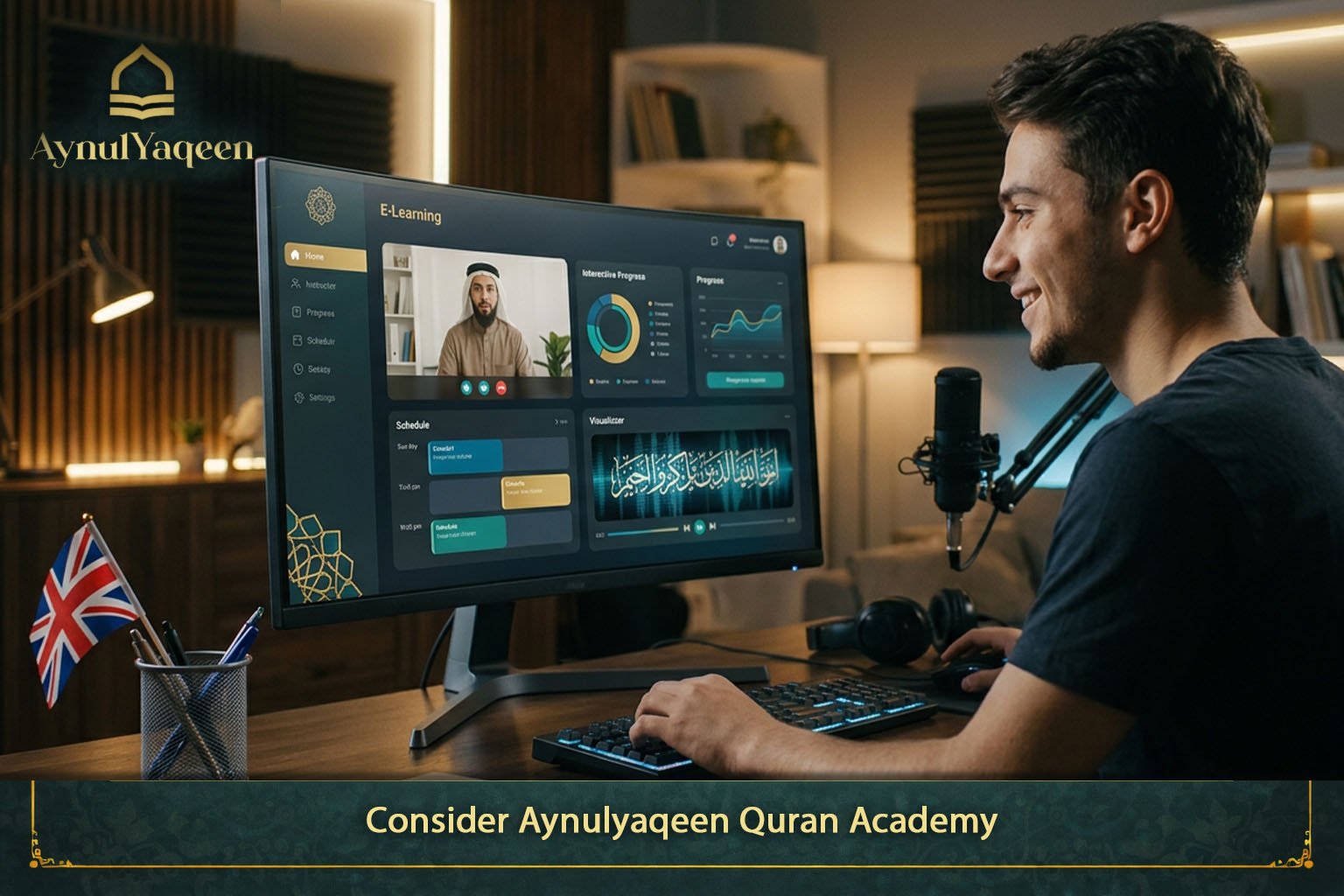
Aynulyaqeen Quran Academy is one option to investigate when comparing Quran learning arrangements. When researching how to find a Quran teacher in the UK, assess its instructors, programmes, teaching methods, and lesson arrangements.
For anyone researching how to find a Quran teacher in the UK, evaluating an academy using clear criteria can make comparisons more useful and objective. Verify important details directly instead of assuming that all providers offer identical teaching methods or levels of individual support.
Ask About Available Learning Options
Explain whether you want to learn basic Quran reading, improve pronunciation, study Tajweed, or work towards memorisation. If you are beginning with prayer and its recitation, reviewing How to pray Salah step by step can help you identify the skills you may want to practise with an instructor.
When assessing how to find a Quran teacher in the UK through an academy, clarify whether instruction includes guided recitation, correction, revision, and progress reviews. These details help establish whether the teaching arrangement meets your objectives.
Review Instructor Experience
Ask about the instructors’ relevant qualifications and experience teaching learners with similar needs. You can also enquire how students are assessed before regular lessons begin and how teachers identify areas that require improvement.
When considering how to find a Quran teacher in the UK, confirm that the instructor’s background matches your intended learning outcome. Students seeking specialised recitation instruction should confirm that the relevant expertise is available. Understanding what is the importance of Tajweed can also help learners recognise why accurate pronunciation and rule application matter.
Clarify Scheduling and Expectations
Before enrolling, confirm the available lesson times, teaching format, communication arrangements, and expectations for independent practice.
Parents should ask about safeguarding and how information about their children’s progress is communicated. Adult learners may want to clarify whether the timetable can accommodate work and family commitments.
Use how to find a Quran teacher in the UK as a basis for comparing providers. Check verifiable information rather than relying solely on general descriptions.
Assess Teaching Quality Before Committing
Qualifications and recommendations can help you create a shortlist, but observing the teaching approach provides additional information. An introductory assessment, if available, may help you understand how the instructor explains concepts and responds to mistakes.
A key part of how to find a Quran teacher in the UK is determining whether the teacher can turn Quranic knowledge into clear instruction suited to your ability.
Ask About an Introductory Assessment
An introductory session may establish your current reading level and identify the skills you need to develop. Learners who want to understand the Quran’s structure can also review how many surahs are in the Quran as part of their independent study.
During the assessment, notice whether the teacher listens carefully, explains the purpose of each exercise, and gives you opportunities to ask questions. Beginners may be assessed on letter recognition and pronunciation, while experienced readers may be asked to recite a passage.
Use how to find a Quran teacher in the UK to guide your assessment and establish realistic objectives rather than expect immediate mastery.
Look for Constructive Feedback
Useful feedback explains the mistake and demonstrates how to correct it. Simply being told that a recitation is incorrect does not provide enough guidance for meaningful improvement.
For example, an instructor may demonstrate a sound, explain its articulation point, and ask you to repeat the word in context. Repeated practice helps you recognise similar mistakes and apply corrections more independently.
When evaluating how to find a Quran teacher in the UK, consider whether feedback is specific enough for you to understand both the problem and the correction.
Check How Progress Is Measured
Progress should reflect the student’s objectives. A beginner may work towards reading unfamiliar words accurately, while an intermediate learner may focus on applying particular Tajweed rules. Families planning a memorisation journey can explore What is the best age for Quran memorization while discussing suitable goals with a teacher.
Use how to find a Quran teacher in the UK to compare progress reviews and learning targets. If a topic remains difficult, the plan should allow additional explanation and practice.
Regular reviews make it easier to identify improvements and decide which skills require further attention. They also help ensure that lessons remain relevant to your learning goals.
Questions to Ask and Mistakes to Avoid
Preparing questions before contacting an instructor helps you compare options fairly. Focus on practical details that influence teaching quality, lesson arrangements, and student welfare.
When researching how to find a Quran teacher in the UK, use your questions to establish whether the instructor’s experience and teaching methods match your requirements.
Questions to Ask Before Enrolment
Consider asking the following questions to compare Quran teachers, assess their qualifications, understand their teaching methods, and determine whether their lessons suit your learning goals and schedule.
- How do you assess a new student’s Quran reading level?
- What experience do you have teaching students of a similar age and ability?
- How do you identify and correct recurring pronunciation mistakes?
- What practice should students complete between lessons?
- How do you monitor progress and identify areas for improvement?
- How do you support learners who need additional explanation?
- What arrangements apply to missed lessons and schedule changes?
- What safeguarding procedures do you follow when teaching children?
You do not need to ask every question in one conversation. Prioritise the matters most relevant to your circumstances and request clear answers before committing to regular sessions.
Common Mistakes to Avoid
Several mistakes can lead to an unsuitable learning arrangement. Therefore, compare instructors carefully, verify their experience, and consider your learning needs before committing to lessons.
- Choosing based only on convenience: Consider teaching ability and relevant experience alongside scheduling.
- Assuming all certificates are equivalent: Ask what a qualification covers and whether it relates to your learning objectives.
- Ignoring teaching style: A knowledgeable instructor may not use the approach that best suits your needs.
- Skipping an assessment: Understanding your current ability helps establish realistic learning targets.
- Expecting immediate results: Reading accuracy, Tajweed, and memorisation require consistent practice.
- Overlooking safeguarding: Parents should understand supervision and communication arrangements.
- Comparing only lesson duration: Consider the quality of feedback, guided practice, and revision.
These considerations are essential when exploring How to find a Quran teacher in the UK because they help you evaluate the actual learning experience rather than relying on general claims.
Slow progress does not necessarily indicate ineffective teaching. Some pronunciation difficulties require repeated practice, and memorisation results vary according to the learner’s routine and the material being studied.
Prepare for Your First Lesson
Write down your main objective before the first session. Explain your previous learning experience, the areas you find difficult, and the skills you want to develop.
For online lessons, test your internet connection, microphone, and device in advance. Choose a quiet space where you can hear instructions and recite without unnecessary interruptions.
Use How to find a Quran teacher in the UK as a reminder to review your goals after the first lesson. Record assigned exercises and set aside time to practise them.
After the session, consider whether the instructor explained corrections clearly, adapted the lesson to your level, and provided practical guidance for improvement. This evaluation can help you decide whether to continue with the same teacher or explore other suitable options.
When deciding how to find a Quran teacher in the UK, review these points before making your final choice.
Build a Consistent Quran Learning Routine
Selecting a suitable instructor is only the beginning. Regular practice, revision, and communication help students turn individual lessons into meaningful progress.
A practical approach to finding a Quran teacher in the UK should include a plan for maintaining consistent study habits after the initial selection. Use these practices to support your learning:
- Set realistic targets. Concentrate on a particular skill or passage instead of trying to improve everything at once.
- Practise between lessons. Repeat assigned exercises and apply the corrections you received.
- Review previous material. Revision reinforces earlier learning and reveals mistakes that still need attention.
- Ask questions. Request another explanation whenever a rule or correction is unclear.
- Record progress. Track completed topics, recurring mistakes, and skills requiring additional practice.
- Adjust your routine. Discuss a more manageable plan if your schedule changes or the workload becomes difficult.
For how to find a Quran teacher in the UK, parents should consider a consistent routine that encourages children’s practice without unnecessary pressure. Adults may benefit from reserving a regular period for Quran study that fits their daily responsibilities.
Communication should continue after enrolment. If how to find a Quran teacher in the UK leads you to an instructor whose lessons become too easy, too difficult, or insufficiently focused, discuss possible adjustments. Regular reviews help determine whether the arrangement meets your needs.
Frequently Asked Questions
The following frequently asked questions address common concerns about choosing a suitable Quran teacher, comparing learning options, and finding an instructor who matches your goals.
1. Should I choose a teacher who specialises in a particular recitation tradition?
When researching how to find a Quran teacher in the UK, consider an instructor trained in your specific riwayah if you have an advanced recitation goal. For general beginner instruction, explain your objectives and ask whether the teacher’s background is appropriate. Specialised training matters when the course requires knowledge beyond foundational reading and Tajweed.
2. What if I feel embarrassed about making Quran recitation mistakes?
If finding a Quran teacher in the UK is complicated by concerns about making mistakes, explain these concerns to the instructor and ask for patient, constructive correction. A supportive teacher should treat mistakes as a normal part of learning, demonstrate correct pronunciation, and allow sufficient time for practice.
3. Can siblings learn Quran from the same teacher?
When considering how to find a Quran teacher in the UK for siblings, compare their ages, abilities, and learning objectives. They may be able to study with the same instructor, but different reading levels can require separate lesson plans or individual sessions. Ask how the teacher will assess each child’s progress.
4. How can I tell when I am ready for a more advanced Quran course?
To determine how to find a Quran teacher in the UK for your next learning stage, discuss progression with your current instructor. Consider whether you can read familiar passages accurately, apply previously studied rules, and retain memorised material. Your teacher can identify remaining gaps and recommend the next stage according to your demonstrated ability.
In conclusion, How to find a Quran teacher in the UK becomes more manageable when you follow a structured selection process. Begin by identifying your learning objectives, then explore local mosques, Islamic centres, private tutors, and online teaching options. Compare qualifications, relevant experience, communication skills, lesson arrangements, and safeguarding procedures before deciding.
The most suitable instructor should understand your current ability, provide constructive feedback, and help you follow a realistic learning plan. Whether you are arranging lessons for a child or improving your own recitation as an adult, consistent practice and clear communication remain essential.
You can also investigate Aynulyaqeen Quran Academy as part of your research. Ask about its available teaching arrangements, instructor experience, student assessment, and support for your particular goals before making a decision.
Ultimately, choosing a Quran teacher means finding a learning environment that suits your needs rather than selecting the first available option. Careful research, realistic expectations, and regular practice can help you develop stronger foundations for accurate, confident, and consistent Quran recitation.
