

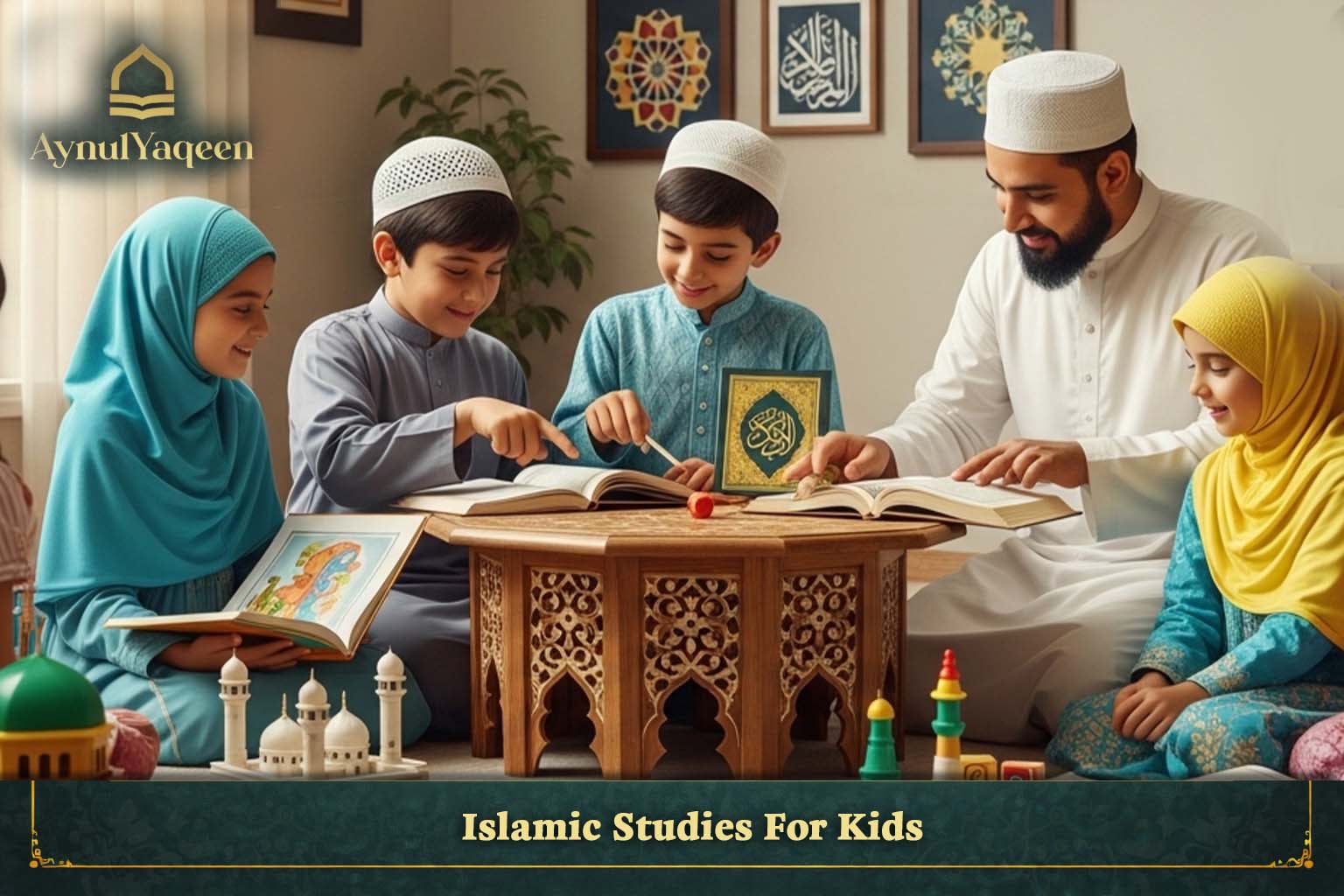
Islamic studies for kids is one of the most important foundations for raising a generation that understands its faith and develops a strong Muslim identity from an early age.
Aynulyaqeen Quran academy for kids supports this mission by providing structured and engaging Islamic education designed for young learners. In today’s fast-changing world, children need meaningful learning that helps them connect with Allah, understand their purpose, and build good character.
This is not only about memorization but about shaping behavior and nurturing the heart. Parents are increasingly seeking reliable programs that offer simple, effective, and age-appropriate Islamic education for their children.
Understanding Islamic Studies for Children

Islamic studies for kids refers to simplified and age-appropriate Islamic education designed specifically for children. It introduces them to the core beliefs of Islam, daily practices, and moral values in a way that is easy to understand and enjoyable to learn.
The goal is not to overwhelm children with complex details, but to help them gradually build love for Islam and a strong connection with their Creator.
Children typically learn:
- The meaning of Tawheed (Oneness of Allah)
- Stories of the Prophets teach faith, patience, and trust in Allah.
- The importance of Salah (prayer)
- Basic Qur’an recitation and short Surahs
- Daily Duas and Islamic etiquette
- Good manners (Akhlaq) in daily life
- Introduction to the Day of Judgment and accountability
When taught correctly, Islamic education becomes something children look forward to rather than something they are forced to study.
Online Quran Academy
An Online Quran Academy provides children and adults with a flexible and effective way to learn the Qur’an, Islamic studies, and essential religious knowledge from the comfort of their homes.
It combines qualified teachers, interactive lessons, and structured programs to ensure steady progress in recitation, understanding, and application. One of the trusted platforms in this field is Aynulyaqeen Quran academy for kids, which focuses on delivering high-quality Islamic education in an engaging and supportive environment.
Through personalized attention and modern teaching methods, students develop a strong connection with the Qur’an while building good manners and a deeper understanding of their faith.

Why Early Islamic Education Matters?
Early childhood is the most powerful stage of learning. What a child learns in the early years often stays with them for life. This is why Islamic education during this stage plays a critical role in shaping identity and behavior.
One of the strongest benefits of early Islamic learning is that it builds a natural love for Allah and His Messenger ﷺ. When children grow up understanding why they pray, why they behave kindly, and why they follow Islamic teachings, their actions become more meaningful and consistent.
It also helps children develop strong moral values. Honesty, respect, patience, and kindness are not just taught as abstract ideas but practiced in daily life.
Another important benefit is protection. A child who understands their faith is less likely to be negatively influenced by harmful environments or confusing ideas. Instead, they grow with clarity and confidence.
The Prophet Muhammad ﷺ said:
“Every child is born upon the fitrah (natural disposition).”
This natural purity needs guidance and nurturing, and that is where structured Islamic learning becomes essential.
Core Areas of Islamic Learning for Kids
A well-structured Islamic curriculum usually focuses on four main areas that work together to build a balanced understanding of faith and practice.
1. Belief and Faith (Aqeedah)
Children are introduced to the foundations of belief in a simple way. They learn about Allah, His names and attributes, and why He alone deserves worship. They also learn about angels, prophets, divine books, and the concept of accountability in the Hereafter.
This stage helps build spiritual awareness from a young age.
2. Worship and Practice (Ibadah)
At this stage, children learn how to perform basic acts of worship such as:
- How to make Wudu
- How to pray Salah correctly
- The importance of fasting in Ramadan
- Giving charity and helping others
- Understanding Islamic months and events
These lessons are taught step-by-step with practical examples so children can easily follow and apply them.
3. Qur’an and Prophetic Teachings
Children begin with short Surahs from the Qur’an and gradually build their recitation skills. Alongside this, they are introduced to simple Hadiths that teach manners, honesty, kindness, and responsibility.
Story-based learning plays a big role here because stories help children remember lessons more effectively.
4. Islamic Manners and Character
Good character is at the heart of Islam. Children are taught how to behave with parents, teachers, friends, and even strangers. They learn respect, gratitude, patience, and humility.
These values are reinforced through daily examples and real-life situations, helping children naturally adopt Islamic behavior.
Making Islamic Learning Engaging and Practical
One of the biggest challenges in teaching children is keeping them interested. Traditional methods alone are often not enough. That is why modern teaching methods now include interactive and engaging techniques.
Storytelling is one of the most powerful tools. When children hear stories of the Prophets, they not only learn history but also absorb moral lessons in a memorable way.
Visual aids like flashcards, animations, and illustrated books help simplify complex ideas. Children learn faster when they can see and interact with what they are studying.
Games and activities also play an important role. Instead of passive learning, children actively participate, which improves memory retention and understanding.
Reward systems, such as certificates and encouragement badges, also motivate children to stay consistent in their learning journey.
Online Learning and Modern Islamic Education
With the rise of digital education, parents now have access to structured Islamic programs from the comfort of their homes. Online learning has made it easier for children to study consistently without geographical limitations.
One of the trusted platforms offering structured learning is Aynulyaqeen Quran academy for kids. This academy focuses on providing a balanced kids islamic education that combines faith, practice, and character building.
Through interactive lessons and personalized attention, Aynulyaqeen Quran academy for kids helps children develop a strong connection with the Qur’an and Islamic teachings in a supportive environment.
The flexibility of online classes allows parents to choose schedules that fit their daily routine, making it easier to maintain consistency in learning.
In many cases, students enrolled in Aynulyaqeen Quran academy for kids show noticeable improvement not only in their knowledge but also in their behavior and discipline.
This approach ensures that learning is not limited to theory but becomes a lived experience in the child’s daily life.
The Role of Parents in Islamic Upbringing
Parents play the most important role in shaping a child’s Islamic identity. Teachers and classes can guide, but the home environment is where habits are formed.
Children observe more than they are told. If they see their parents praying regularly, speaking kindly, and showing honesty, they naturally adopt these behaviors.
Simple daily practices can make a big difference:
- Reading short islamic courses online stories before bedtime
- Encouraging daily prayers together
- Teaching small Duas for everyday actions
- Practicing good manners at home
- Limiting distractions and encouraging meaningful learning
When combined with structured programs like Aynulyaqeen Quran academy for kids, the results become even stronger and more lasting.
Learning Through Fun and Interaction
Children learn best when they are enjoying the process. That is why interactive learning methods are essential in Islamic education.
Some effective methods include:
- Matching games about Prophets and their stories
- Quizzes on basic learn islam online knowledge
- Puzzle activities related to Surahs
- Role-playing good manners in daily situations
These methods transform learning into an enjoyable experience rather than a routine task.
Interestingly, when children enjoy learning, they are more likely to retain information and apply it in real life. This is one of the reasons structured programs that include engagement activities are highly effective.
In fact, Islamic studies for kids becomes far more impactful when combined with practical and fun-based learning approaches.
How Structured Online Classes Work
A well-organized online islamic courses for beginners program usually follows a clear learning path. It begins with an assessment of the child’s current level. Based on this, a personalized learning plan is created.
Then, step-by-step lessons are introduced, starting from basic concepts and gradually moving toward more advanced topics. Regular feedback is provided to parents so they can track progress and understand their child’s development.
In platforms like Aynulyaqeen Quran academy for kids, this structured system ensures that no child is left behind and every student progresses at a comfortable pace. Certificates are often awarded upon completion of levels, which helps boost confidence and motivation.
Why Choose a Structured Islamic Learning Program

Choosing the right learning environment can make a significant difference in a child’s development. A structured program provides consistency, guidance, and accountability.
Aynulyaqeen Quran academy for kids is designed to offer:
- Qualified and experienced teachers
- Child-friendly teaching methods
- One-on-one attention when needed
- A safe and supportive learning environment
- Balanced focus on knowledge and character
- Flexible learning schedules for families
These features ensure that children receive a complete Islamic education that supports both their spiritual and personal growth.
Parents often notice that children not only learn islamic classes for kids knowledge but also become more respectful, disciplined, and aware of their actions.
Frequently Asked Questions (FAQ)
1. At what age should children start learning Islamic studies?
Children can begin basic Islamic learning as early as 4 to 6 years old with simple concepts like Duas, manners, and short Surahs.
2. Can online Islamic classes be effective for kids?
Yes, with structured lessons and interactive teaching methods, online learning can be highly effective and engaging for children.
3. How can parents support their child’s Islamic learning at home?
Parents can support by practicing daily prayers together, sharing Islamic stories, encouraging good manners, and maintaining consistency in learning routines.
In conclusion, Islamic studies for kids form a vital foundation in shaping a strong Muslim identity built on faith, values, and good character. When children learn Islam in a simple and engaging way, they grow with love for Allah and a clear understanding of their religion.
This type of education goes beyond knowledge, as it nurtures behavior and instills daily moral values. With structured learning environments such as Aynulyaqeen Quran academy for kids, the learning journey becomes more effective and consistent. Combined with parental support, it helps build a balanced, confident, and mindful personality from an early age.
