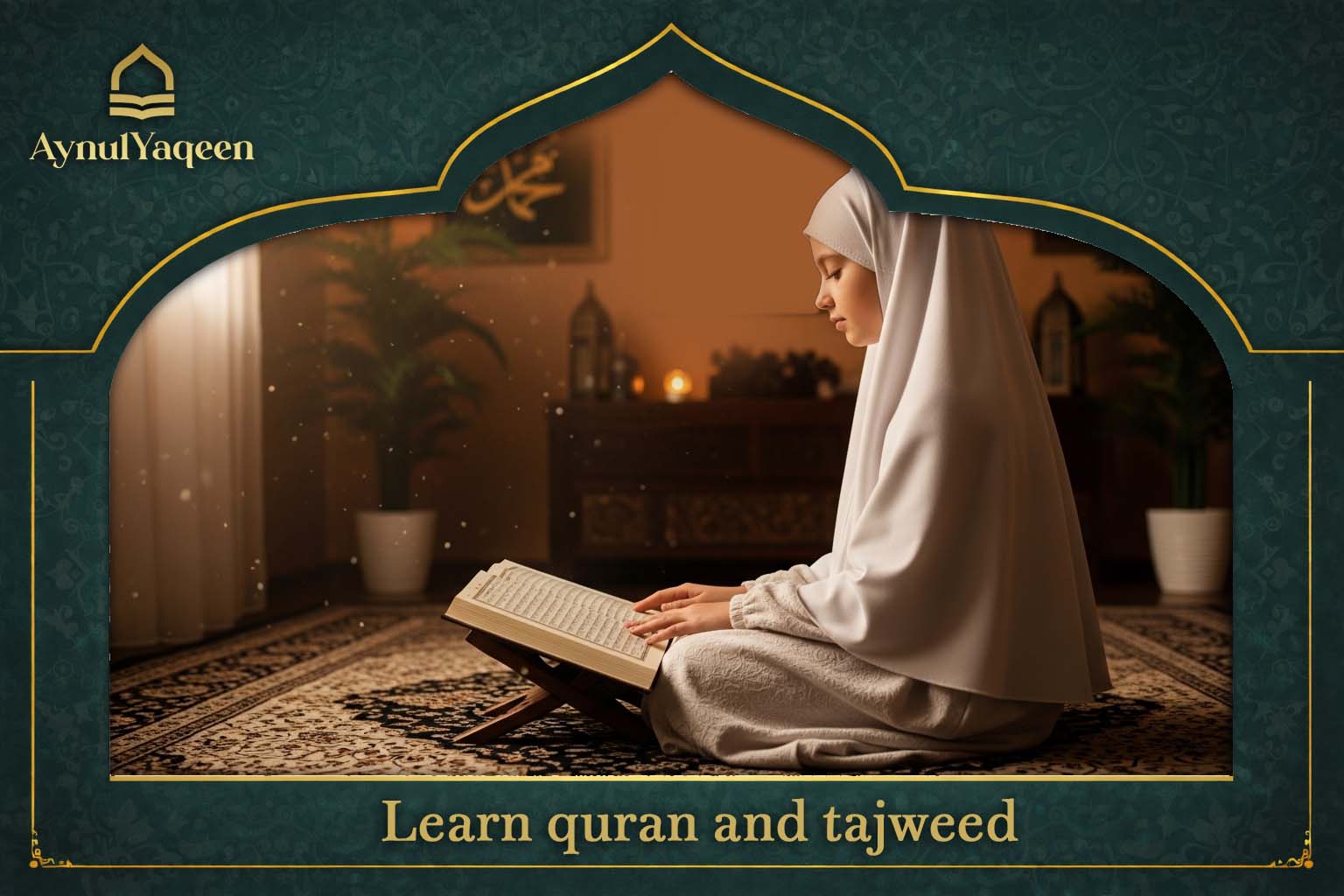
Learn Quran and tajweed is a transformative journey for every Muslim who seeks to recite the Book of Allah correctly and beautifully. At Aynulyaqeen Quran school, this journey is made simple, structured, and accessible for learners of all ages and levels.
The Quran is not only meant to be read, but to be recited with proper pronunciation, reflection, and understanding. Tajweed ensures that every letter is given its right, preserving both meaning and beauty.
Through guided lessons, consistent practice, and expert support, students gradually build confidence in their recitation and strengthen their connection with the words of Allah, making learning both spiritual and practical.
The Meaning and Importance of Tajweed in Quran Recitation

Tajweed, in simple terms, means “to make something better” or “to improve.” When applied to Quran recitation, it refers to giving every letter its rights and proper pronunciation without distortion or mistake.
The Arabic language is very precise, and even a small change in sound can completely change the meaning of a word. That is why Tajweed is not optional decoration—it is a necessary part of preserving the message of the Quran.
When Muslims begin to learn Quran with Tajweed, they realize that recitation is not only about reading words but about honoring divine speech.
Each sound has a place of origin in the mouth or throat, known as “Makhraj,” and each letter carries unique characteristics called “Sifaat.” Without understanding these rules, recitation may lose accuracy.
A learner who joins Aynulyaqeen Quran school is gradually introduced to these principles in a structured way, making the learning process smooth even for beginners.
Online Quran Academy
An online Quran academy provides a modern and flexible way for students to learn the Holy Quran from anywhere in the world, without the limitations of time or location.
Through structured lessons, qualified teachers, and interactive sessions, learners can easily develop their recitation skills, improve Tajweed, and build a strong spiritual connection with the Quran.
Aynulyaqeen Quran school offers a supportive online learning environment where students of all ages can progress step by step at their own pace. This approach makes Quran learning more accessible, especially for those who are unable to attend in-person classes, while still maintaining high quality education and personal guidance.

Why Proper Quran Recitation Matters
The Quran was revealed in Arabic and preserved through oral transmission. This means it was passed from teacher to student generation after generation. Proper recitation ensures that the Quran remains unchanged in pronunciation and meaning.
There are several reasons why Tajweed is important:
1. Protecting the Meaning of the Quran
Even slight pronunciation mistakes can change meanings. For example, confusing similar Arabic letters may turn a meaningful word into something completely different. Tajweed prevents such errors and protects the divine message.
2. Following the Sunnah of the Prophet ﷺ
The Prophet Muhammad ﷺ recited the Quran slowly, clearly, and beautifully. Learning Tajweed allows Muslims to follow his exact method of recitation, strengthening their spiritual connection.
3. Strengthening Spiritual Connection
When recited correctly, the Quran touches the heart differently. The rhythm, pauses, and pronunciation create a calming effect that increases focus and devotion during recitation and prayer.
4. Gaining Reward from Allah
Authentic narrations mention that those who struggle while reciting the Quran still receive double reward. This shows that effort in learning correct recitation is highly valued in Islam.
This is why many students now begin their journey through structured programs like Aynulyaqeen Quran school, where they receive guided support and correction.
Core Rules of Tajweed Explained Simply
Understanding Tajweed does not require mastering everything at once. It is learned step by step, starting from basic rules and gradually advancing. Below are some of the essential principles:
Makhraj (Articulation Points)
This refers to where each letter comes from in the mouth, throat, or lips. Learning Makhraj is the foundation of correct pronunciation.
Sifaat (Characteristics of Letters)
Each Arabic letter has qualities such as heaviness, softness, or breathiness. These characteristics shape how the letter sounds in recitation.
Noon Saakinah and Tanween Rules
These rules determine how the sound of “n” changes depending on the letter that follows it, creating nasal sounds or clear pronunciation.
Madd (Prolongation)
This rule controls how long certain vowel sounds are stretched. Proper elongation is important for maintaining meaning and rhythm.
Qalqalah
Certain letters produce a slight bouncing sound when they have no vowel. This adds clarity and balance to recitation.
Learning these rules step by step becomes much easier when guided properly, which is why learners often prefer structured environments like Aynulyaqeen Quran school for consistent improvement.
The Journey of Learning Quran with Tajweed
Every learner starts from a different level. Some are complete beginners, while others already read Arabic but want to refine their recitation. The journey typically includes three stages:
Stage 1: Learning Arabic Letters
At this stage, students learn how each Arabic letter is formed and pronounced correctly.
Stage 2: Basic Recitation Practice
Students begin reading short verses while applying simple Tajweed rules.
Stage 3: Advanced Fluency
At this stage, learners focus on rhythm, pauses, and more advanced rules of recitation.
Those who choose to learn quran and tajweed in a structured environment often progress faster because they receive feedback and correction from qualified teachers. Programs like Aynulyaqeen Quran school support students at each stage, helping them build confidence gradually.
Effective Methods to Learn Tajweed
There are several practical ways to improve Quran recitation:
1. Learning with a Qualified Teacher
A teacher can correct mistakes instantly and guide proper pronunciation.
2. Listening to Skilled Reciters
Listening to renowned Quran reciters helps train the ear to recognize correct pronunciation and rhythm.
3. Daily Practice
Consistency is key. Even a few minutes daily can significantly improve fluency over time.
4. Recording Recitation
Recording yourself and comparing it with expert recitation helps identify mistakes.
5. Structured Learning Programs
Joining a guided program such as Aynulyaqeen Quran school helps learners stay consistent and motivated.
Common Challenges and How to Overcome Them
Learning Tajweed can be challenging, especially for non-Arabic speakers. However, every challenge has a solution:
- Difficulty in pronunciation: Practice slowly and focus on each letter individually.
- Confusion between similar sounds: Repetition and listening practice help solve this.
- Forgetting rules: Regular revision is essential.
- Lack of consistency: Setting a daily schedule helps maintain progress.
The key is patience. Quran learning is not a race but a lifelong journey of improvement.
Building a Lifelong Quran & Tajweed Connection
Building a lifelong connection with the Quran is not simply about learning correct pronunciation or mastering the technical rules of Tajweed, but about developing a deep and lasting relationship with the Book of Allah that remains in the heart throughout life.
When a Muslim begins to learn quran and tajweed, they gradually discover that every verse carries meaning, emotion, and guidance that touches the soul in a unique way. Correct recitation with Tajweed helps the heart become more attentive, more peaceful, and more connected to the message of Islam.
This connection strengthens over time through consistent practice, patience, and sincere intention. The more a person recites the Quran with proper Tajweed, the more they feel its impact in their daily life, worship, and behavior.
It becomes not just a habit, but a source of comfort and spiritual strength. For anyone seeking true transformation, the journey to learn quran and tajweed is one of the most meaningful and rewarding paths they can follow in their spiritual life.
Spiritual Benefits of Learning Tajweed

The impact of correct recitation goes beyond pronunciation. It deeply influences the heart and behavior of a person.
Inner Peace
Reciting the Quran correctly brings calmness and emotional stability.
Stronger Faith
Understanding and applying Tajweed increases love for the Quran and strengthens belief.
Better Understanding
Correct recitation helps learners reflect more deeply on meanings.
Positive Influence on Others
Beautiful recitation inspires family and community members to improve their own connection with the Quran.
Many students who begin their journey with Aynulyaqeen Quran school often describe a noticeable transformation in their relationship with the Quran over time.
Frequently Asked Questions (FAQ)
The Frequently Asked Questions (FAQ) section is an important part of any article because it provides clear and concise answers to the most common questions readers may have.
It helps clarify points that may not be fully covered in the main content and improves overall understanding of the topic in a quick and simple way.
1. Can I learn Tajweed if I am a complete beginner in Arabic?
Yes, Tajweed can be learned step by step, even if you are starting from zero. Beginners usually start with Arabic letters before moving to pronunciation rules.
2. How long does it take to improve Quran recitation with Tajweed?
It depends on consistency. With daily practice, noticeable improvement can be seen within a few months.
3. Is it necessary to learn with a teacher?
While self-study helps, learning with a teacher is highly recommended because direct correction speeds up progress and reduces mistakes.
In conclusion, learning to recite the Quran with proper Tajweed is a deeply rewarding journey that combines knowledge, practice, and spirituality.
At Aynulyaqeen Quran school, students are supported at every step to develop correct pronunciation, understand Tajweed rules, and build a strong connection with the words of Allah.
This process not only improves recitation skills but also enhances faith, brings inner peace, and strengthens consistency in worship. With patience, dedication, and sincere intention, every learner can progress steadily and experience the true beauty and impact of the Quran in their daily life.
Read articles that might interest you: