

Noorani Qaida lessons explained is the starting point for understanding how beginners learn to read Arabic and prepare for Quran recitation. The Noorani Qaida introduces Arabic letters, vowel marks, connected forms, and basic pronunciation rules through a gradual learning process.
Therefore, understanding the purpose of each lesson helps students build confidence and recognize unfamiliar words more accurately. This guide covers the essential topics in Noorani Qaida, from recognizing individual letters to practising introductory Tajweed rules. In addition, it explains how children and adults can practise effectively, avoid common mistakes, and prepare for reading the Quran.
Whether you are learning independently or seeking structured instruction, noorani qaida lessons explained can help you understand the skills involved before choosing a learning plan. The goal is not simply to finish a book quickly. Instead, learners should develop accurate pronunciation, recognize written patterns, and apply what they learn consistently.
How Does Noorani Qaida Build the Foundation for Quran Reading?
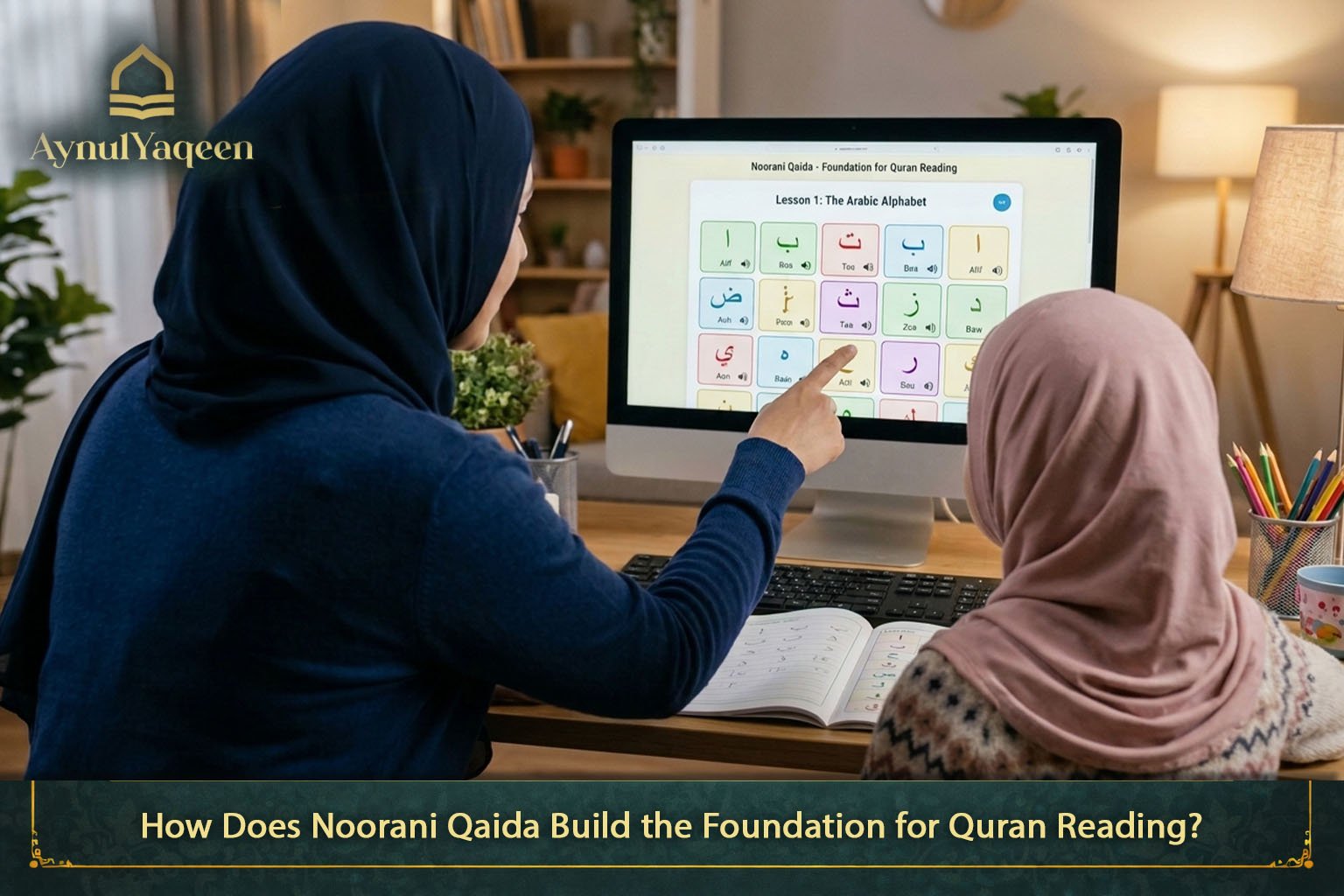
Noorani Qaida is a beginner-friendly method for learning Arabic reading, particularly for Quranic study. It introduces essential reading skills in a progressive sequence, helping students move from recognising individual letters to reading connected words. Most commonly used editions cover topics such as:
- Arabic letters and their different written forms.
- Short vowels and tanween.
- Long vowels and basic elongation.
- Sukoon and shaddah.
- Connected letter combinations.
- Introductory Tajweed rules.
- Reading practice using increasingly complex examples.
The precise order and number of lessons may differ between editions. Nevertheless, the overall purpose remains similar: students develop the ability to recognize letters, understand vowel marks, and pronounce written combinations correctly.
When Noorani Qaida lessons explained are taught systematically, beginners can focus on one skill at a time before combining several rules in the same word. These fundamentals are the first step in understanding the subject as a complete beginner.
Learn Online with Aynulyaqeen Quran Academy
Choosing the right online Quran academy can make a significant difference in your learning journey. Aynulyaqeen Quran Academy provides structured Quran courses for beginners and advanced learners, focusing on accurate Quran reading, Tajweed, memorisation, and Islamic studies.
With qualified teachers, flexible class schedules, and personalised one-on-one lessons, students of all ages can learn at their own pace while building confidence in reciting and understanding the Holy Quran from anywhere in the world.

Why Are Noorani Qaida Lessons Important?
Learning to read Quranic Arabic involves more than memorizing the alphabet. Students must recognize letters in different positions, distinguish similar sounds, and understand how vowel marks affect pronunciation.
For this reason, Noorani Qaida lessons provide a useful foundation for learners who want to progress from individual letters to connected Arabic text. A structured approach also helps teachers identify the skills that need additional practice. The main benefits include:
- Letter recognition: Students become familiar with Arabic characters and their distinguishing features.
- Pronunciation practice: Repeated listening and reading help learners identify unfamiliar sounds.
- Reading accuracy: Understanding vowel marks reduces dependence on guessing.
- Gradual progression: Each stage introduces skills that support later lessons.
- Preparation for Tajweed: Beginners encounter reading principles that will be developed further during Quran study.
However, completing the Qaida does not automatically guarantee mastery of every pronunciation rule. Continued practice and appropriate correction remain important throughout the learning process. This progression is central to learning the material in a beginner-friendly way.
Noorani Qaida Lessons Explained for Children
Children benefit from clear demonstrations, short activities, and regular opportunities to practise. Because attention spans and reading abilities differ, teachers should adapt the pace to each child’s needs. A practical lesson can include:
- Reviewing previously learned letters or rules.
- Introducing a small amount of new material.
- Demonstrating correct pronunciation.
- Allowing the child to read aloud.
- Correcting errors calmly.
- Reviewing difficult examples before finishing.
Letter cards and simple games can make practice more engaging. Nevertheless, activities should support accurate reading rather than replace pronunciation instruction.
Parents can encourage children by praising their effort and consistency. Furthermore, comparing children with one another should be avoided because prior Arabic exposure and individual learning needs differ. Short sessions help keep Noorani Qaida lessons explained manageable for young learners. Parents can also learn at what age should I teach my child the Quran to understand how age and readiness influence Quran learning.
Noorani Qaida Lessons Explained for Adults
Adults can also use Noorani Qaida to develop the reading skills needed for Quran recitation. Some recognize Arabic letters but struggle with vowel marks, while others can read slowly yet have difficulty pronouncing particular sounds.
A structured learning plan can help identify these differences and address them systematically. Adult learners may benefit from:
- Scheduling practice around work and family commitments.
- Reviewing difficult letters before beginning new lessons.
- Asking questions whenever a rule is unclear.
- Listening carefully to pronunciation demonstrations.
- Keeping a record of recurring errors.
- Reading aloud rather than relying only on silent practice.
Importantly, recognizing a familiar Arabic word does not necessarily mean it is being pronounced correctly. Accurate reading requires attention to vowel marks, consonants, and applicable rules. A flexible pace keeps Noorani Qaida lessons explained appropriate for adults returning to Arabic study.
For learners who need more structured guidance, understanding the importance of online Quran classes can help them evaluate how remote instruction supports regular practice and teacher feedback.
Noorani Qaida Lessons Explained: The Main Learning Sequence
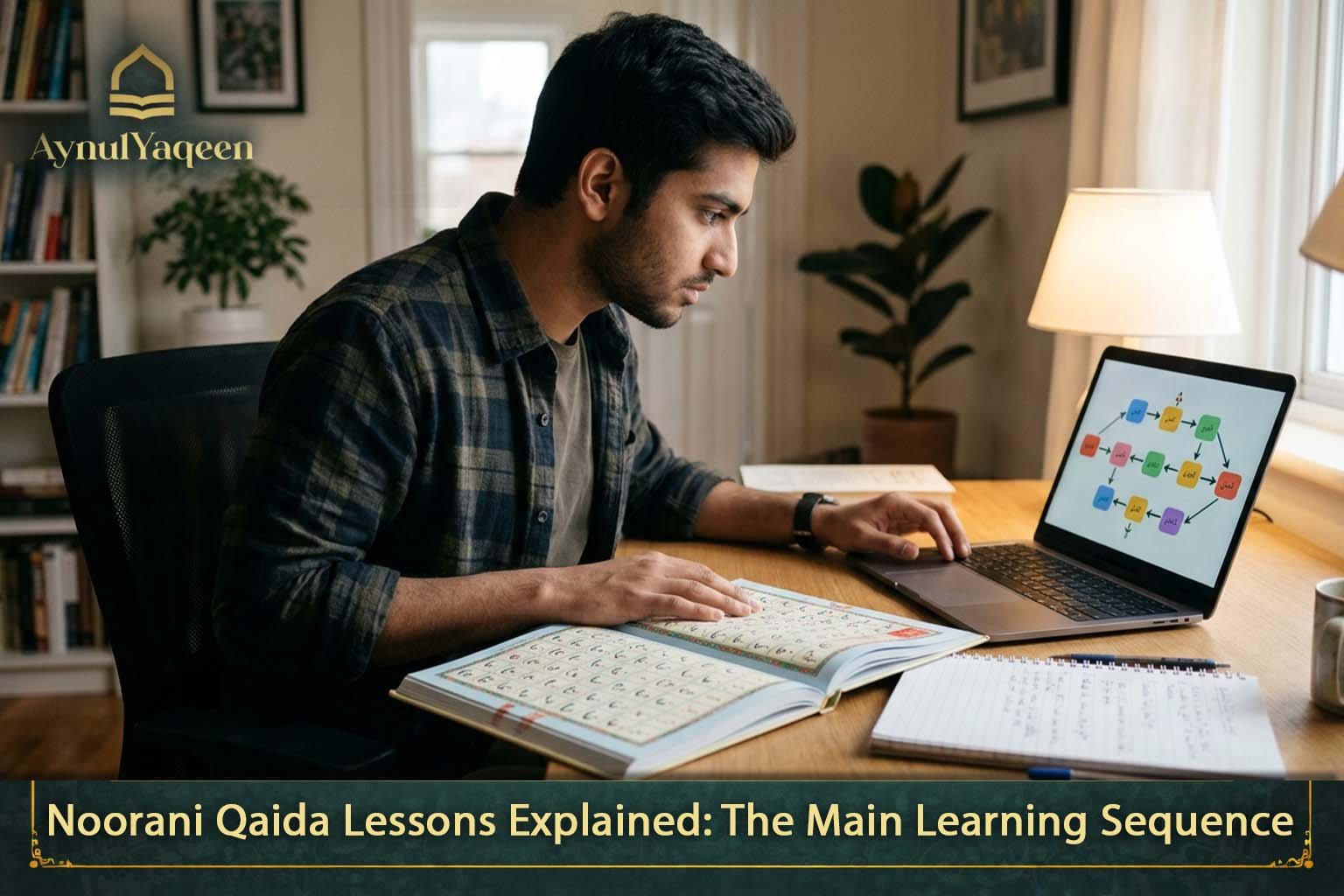
helps beginners understand how Arabic reading skills develop step by step. Students start by recognizing letters, then learn vowel marks, letter combinations, Sukoon, and Shaddah before practising connected words and basic pronunciation rules.
This gradual approach builds a foundation for reading Quranic text more accurately and progressing toward Tajweed.
Lesson 1: Learning the Arabic Alphabet
The first lesson introduces individual Arabic letters. Students learn to recognize their shapes, identify their names, and practise their sounds.
Some letters have similar shapes but differ in the number or position of their dots. For example, ب، ت، and ث share a similar basic form, yet their distinguishing marks identify different letters.
Beginners should practise identifying letters in mixed order rather than relying exclusively on alphabetical memorization. Additionally, listening to accurate pronunciation helps students connect written symbols with their corresponding sounds.
During this stage, the noorani qaida lessons explained should emphasize recognition and pronunciation before students attempt complicated reading exercises. Teachers can adapt the practice to each learner’s starting level.
Lesson 2: Recognizing Connected Arabic Letters
Arabic letters may appear differently depending on their position within a word. Therefore, learners need to recognize initial, medial, and final forms where applicable.
They should also understand that some Arabic letters connect to the preceding letter but do not connect to the following one.
Useful exercises include:
- Comparing isolated and connected letter forms.
- Identifying individual letters within short combinations.
- Reading examples from right to left.
- Recognizing letters without depending on their position on the page.
Through these exercises, the noorani qaida lessons explained become more practical because students learn to identify letters in real reading situations rather than only as isolated symbols. Careful letter practice makes the sequence easier to follow from the beginning.
Lesson 3: Understanding Huroof Muqatta’at
Huroof Muqatta’at are disconnected letters appearing at the beginning of certain Quranic chapters. Examples include الم and كهيعص.
These combinations are read according to the names of their individual letters rather than treated as ordinary words.
At this stage, students should focus on recognizing the written forms and practising their established pronunciation. Understanding their interpretation is a separate area of Quranic study.
The lesson also introduces learners to letter combinations that look different from the ordinary words they have encountered so far. Listening and repeating are important when learners encounter unfamiliar Arabic sounds.
Lesson 4: Learning Harakat and Short Vowels
Harakat are vowel marks that affect how Arabic letters are pronounced. Three fundamental marks are fathah, kasrah, and dammah.
| Vowel mark | Arabic name | Basic sound |
|---|---|---|
| َ | Fathah | Short “a” |
| ِ | Kasrah | Short “i” |
| ُ | Dammah | Short “u” |
Students practise combining each mark with different letters. For example, بَ، بِ، and بُ demonstrate how the same letter produces different sounds depending on its vowel.
A useful approach is to read each combination slowly before increasing the pace. Meanwhile, teachers should correct mistakes rather than allow learners to repeat inaccurate sounds.
In noorani qaida lessons explained, understanding short vowels is essential because these marks appear throughout vowelled Quranic text. Teachers can revisit this topic whenever students confuse the different vowel marks.
Lesson 5: Understanding Tanween
Tanween consists of double vowel marks that generally introduce an “n” sound at the end of a word when read in connected recitation.
The three forms are:
- Fathatayn: ً
- Kasratayn: ٍ
- Dammatayn: ٌ
Students first learn to identify each symbol visually. Next, they practise reading examples containing tanween alongside familiar letters and vowel patterns.
Although tanween resembles ordinary vowel marking, its pronunciation differs. Learners should therefore listen carefully and practise each form separately before combining it with other rules.
Pronunciation at a word ending may also change depending on whether the reader continues or stops. A qualified teacher can explain these distinctions through appropriate examples. Reading aloud supports learning through sound as well as visual recognition.
Lesson 6: Combining Harakat and Tanween
Once students recognize individual vowel marks, they begin practising combinations that include both harakat and tanween.
This stage reinforces earlier learning while helping students read more complex sequences. Rather than memorizing every example, learners should identify the marks and understand how each one affects pronunciation.
For example, a teacher can present several short combinations and ask the student to identify the vowel pattern before reading aloud.
If confusion persists, returning to simpler examples can help. Consequently, noorani qaida lessons explained through gradual revision allow learners to strengthen weak areas before progressing. Regular review is especially useful when a student repeatedly confuses similar vowel patterns.
Lesson 7: Recognizing Standing Vowels
Some editions introduce standing fathah, standing kasrah, and inverted dammah. These symbols indicate lengthened vowel sounds in the relevant reading patterns.
Students should learn to distinguish these marks from ordinary short vowels and practise producing the appropriate length.
A simple comparison can help:
- Short vowels produce short sounds.
- Relevant standing vowels indicate lengthened sounds.
- The surrounding letters and reading rules determine the appropriate pronunciation.
Because notation may vary between editions, students should follow their book and confirm unfamiliar examples with their teacher. Comparing examples side by side can make the differences easier to recognize.
Lesson 8: Learning Madd Letters
Madd refers to elongation in Quranic recitation. Alif, waw, and ya can function as madd letters under specific conditions.
The basic patterns commonly taught include:
- Alif preceded by fathah.
- Waw with sukoon preceded by dammah.
- Ya with sukoon preceded by kasrah.
Basic madd is commonly prolonged for two counts. However, additional rules may change the duration, so learners should not assume that every occurrence of these letters has the same reading.
Through noorani qaida lessons explained with listening exercises, beginners can learn to distinguish short vowels from basic elongation. The distinction deserves attention because vowel length affects recitation.
Lesson 9: Practising Madd Patterns
After learning the basic elongation rules, students practise combinations involving madd letters and familiar vowel marks.
They should identify the relevant letters, listen to the pronunciation, and repeat each example while maintaining a consistent length.
Two common mistakes are shortening a sound that requires elongation and stretching a sound that should remain short.
Side-by-side comparisons can make these differences easier to recognize. In addition, teachers should correct the student’s pronunciation before introducing more complicated examples. Guided repetition helps learners develop consistency.
Lesson 10: Understanding Huroof Leen
Huroof Leen are soft-letter patterns commonly associated with waw or ya carrying sukoon after fathah.
These patterns differ from ordinary madd combinations, so students need to recognize the relevant letters and listen to how they are pronounced in context.
Stopping at a word ending may affect the reading of certain sounds. Therefore, learners should practise examples with their teacher’s guidance and follow the reading conventions being taught.
Teachers can use Noorani Qaida lessons explained to highlight differences between similar patterns, especially when students confuse soft letters with ordinary elongation.
Lesson 11: Learning Sukoon
Sukoon indicates that a consonant does not carry a short vowel of its own. It helps students move from reading separate vowelled letters to reading connected combinations.
For example, بْ shows a letter marked with sukoon. Its pronunciation depends on the surrounding sounds and how the combination is read.
Students should practise:
- Identifying letters marked with sukoon.
- Connecting consonants with preceding vowels.
- Avoiding unnecessary vowel sounds.
- Reading short combinations carefully.
- Repeating corrected examples.
This stage of noorani qaida lessons explained requires patience because adding an unintended vowel can change the pronunciation of a word. Teachers should slow the pace if a learner repeatedly adds an extra vowel.
Lesson 12: Reading Connected Words with Sukoon
This lesson builds on the previous stage by combining sukoon with different vowel marks and letter arrangements.
Learners begin to recognize how sounds connect within a word. Consequently, they become more comfortable reading complete combinations instead of treating every letter as a separate exercise.
Teachers can introduce short examples, ask students to read independently, and correct specific difficulties.
Parents can support this process by encouraging children to slow down when a word feels difficult. Careful practice is generally more useful than guessing or rushing through a page. These exercises help learners move from isolated symbols to connected reading.
Lesson 13: Learning Shaddah
Shaddah, also called tashdeed, indicates a doubled consonant. The marked letter represents two consonant occurrences, with the first carrying sukoon and the second carrying its relevant vowel.
Students should practise recognizing the symbol and producing the doubled consonant correctly.
They must avoid reading the marked letter as though it were an ordinary single consonant. Listening to an experienced teacher is particularly useful because the distinction may be difficult for beginners to hear.
Consistent correction is valuable throughout Noorani Qaida lessons explained, especially when students are learning to pronounce doubled consonants.
Lesson 14: Combining Shaddah and Sukoon
As learners progress, they encounter combinations that require them to apply shaddah alongside previously studied concepts.
Students should identify the relevant symbols before attempting to read the entire sequence. This encourages attention to the written text instead of relying on memorized examples.
When Noorani Qaida lessons explained include regular revision, learners can connect earlier rules with newer combinations more confidently. Simple examples also help students practise without memorizing every word.
Lesson 15: Practising Multiple Reading Patterns
Noorani Qaida Lessons Explained help students understand how to combine shaddah, vowel marks, elongation, and previously introduced concepts through increasingly complex exercises.
The objective is to help students apply several rules within the same word. For instance, they may need to recognize a doubled consonant while identifying a separate vowel-lengthening pattern.
Teachers should introduce manageable examples before moving to longer sequences. Practising Noorani Qaida Lessons Explained step by step allows students to build accuracy before attempting more challenging combinations.
Once students demonstrate accuracy, they can gradually practise more complex examples. Reviewing Noorani Qaida Lessons Explained alongside earlier exercises also helps reinforce foundational skills.
Students should return to previous pages whenever the same mistakes appear repeatedly. Regular revision of Noorani Qaida Lessons Explained supports consistent practice and helps learners apply multiple reading rules more confidently.
Lesson 16: Introducing Basic Tajweed Rules
Many editions introduce selected Tajweed rules after learners become familiar with the fundamental reading patterns.
Common introductory topics include:
- Izhar: Clear pronunciation under the relevant conditions.
- Idgham: Merging sounds according to specified rules.
- Ikhfa: Concealing a sound under its established conditions.
- Iqlab: Changing the noon sound to a meem-like sound before the relevant letter.
- Qalqalah: Producing a characteristic echoing sound on designated letters when the rule applies.
These descriptions provide an introduction rather than complete Tajweed instruction. Correct application depends on the letters involved and their surrounding context.
Teachers should use noorani qaida lessons explained to introduce these concepts at an appropriate pace, without overwhelming beginners with too many rules at once.
Lesson 17: Reading Quranic Words and Passages
Many commonly used editions conclude with exercises that combine the earlier lessons into more complete reading practice.
Students apply letter recognition, harakat, tanween, sukoon, shaddah, elongation, and the introductory Tajweed rules included in their edition.
The aim is to read increasingly complete Quranic words and passages with greater accuracy and less hesitation.
However, finishing the Qaida does not automatically establish mastery of every Tajweed rule. Continued reading and feedback remain important. The next learning step becomes clearer when students connect their current ability with suitable reading exercises.
How to Practise Noorani Qaida at Home?
Home practice reinforces classroom learning and helps students remember what they have studied. However, sessions should be focused and manageable rather than unnecessarily long.
A daily routine of 10–15 minutes can be a practical starting point. Learners can adjust the duration according to their concentration, age, and schedule.
| Activity | Suggested time | Purpose |
|---|---|---|
| Review the previous lesson | 3 minutes | Reinforce earlier learning |
| Practise the current lesson | 5 minutes | Develop familiarity with new patterns |
| Read aloud | 4 minutes | Identify pronunciation difficulties |
| Review challenging examples | 3 minutes | Strengthen weaker skills |
These timings are suggestions, not strict requirements. Younger children may need shorter sessions, while other students may benefit from additional practice.
When studying independently, learners should follow the printed examples carefully. If they are uncertain about a sound, they should ask a qualified teacher instead of repeatedly guessing. A clear schedule makes Noorani Qaida lessons explained easier to practise consistently.
Families seeking personalized instruction can also explore how to find a Quran teacher in the UK for guidance on evaluating teachers and choosing appropriate learning support.
Common Mistakes to Avoid
Even motivated learners can develop habits that slow their progress. Understanding Noorani Qaida lessons explained can help students recognize these problems early and correct them more effectively.
Moving Ahead Too Quickly
Completing a page does not necessarily mean that the student has mastered it. Teachers should check whether the learner can read examples accurately before introducing more difficult material.
Confusing Similar Letters
Letters with similar shapes can be difficult to distinguish. Regular comparison, listening, and pronunciation practice can help reduce confusion. Reviewing similar letters reinforces Noorani Qaida lessons explained by helping students distinguish shapes, dots, and sounds.
Lengthening Every Vowel
Short vowels and elongated sounds serve different purposes. Students should learn to distinguish them rather than stretching sounds whenever they are uncertain.
Ignoring Sukoon and Shaddah
These symbols affect how letters are pronounced. Overlooking them can change a word’s pronunciation, so learners should identify each mark carefully. Practising Noorani Qaida lessons explained with teacher feedback can help students recognize these symbols correctly.
Practising Without Feedback
Independent practice is useful, but beginners may not notice their own errors. Periodic correction from a qualified teacher helps identify problems and improve accuracy. Feedback keeps learning focused on pronunciation instead of speed.
Memorizing Without Understanding
Memorization can support learning, yet it should not replace understanding. Students need to recognize familiar patterns when they appear in unfamiliar words. Applying Noorani Qaida lessons explained during regular reading practice helps learners strengthen their understanding of foundational Arabic reading rules.
Parents supporting their children’s memorization can also review how to motivate kids to memorize Quran for practical ideas that encourage consistent practice without unnecessary pressure.
Choosing a Suitable Noorani Qaida Teacher
When Noorani Qaida lessons explained are taught clearly, beginners can better understand Arabic pronunciation and foundational reading rules. Students should also feel comfortable asking questions when a rule is confusing.
Before choosing a course, consider these factors:
- Pronunciation expertise: The teacher should demonstrate accurate Arabic sounds.
- Structured lessons: The curriculum should follow a logical progression.
- Individual feedback: Corrections should address each learner’s difficulties.
- Flexible pacing: Students should receive extra practice when necessary.
- Progress updates: Families should understand what the learner has mastered.
- Suitable teaching methods: Activities should match the student’s age and experience.
Understanding Noorani Qaida lessons explained in a structured way helps families evaluate teaching quality and learning progress. These criteria are more useful than promises of guaranteed results or unusually fast completion.
Before enrolling, families should also compare tuition and available learning arrangements. This makes how much online Quran classes cost a useful resource when assessing course affordability and planning a suitable learning schedule.
Learning with Aynulyaqeen Quran Academy
Aynulyaqeen Quran Academy may be an option for beginners seeking structured Quran learning. Families exploring noorani qaida lessons explained should review the available curriculum, teaching methods, teachers’ qualifications, and opportunities for individual feedback before enrolling.
For students studying Noorani Qaida, noorani qaida lessons explained should cover recognizing Arabic letters, understanding vowel marks, and practising correct pronunciation. Lessons should also introduce reading rules gradually, allowing beginners to strengthen their skills before moving to more challenging material.
When considering Aynulyaqeen Quran Academy, ask how teachers evaluate students’ progress and address recurring pronunciation mistakes. Understanding noorani qaida lessons explained through regular revision and personalized guidance can help learners identify areas that need improvement.
Choosing a suitable program also involves considering the student’s age, current reading ability, and learning goals. Families can use noorani qaida lessons explained as a starting point when discussing course structure and learning expectations with prospective teachers.
What Happens After Completing Noorani Qaida?
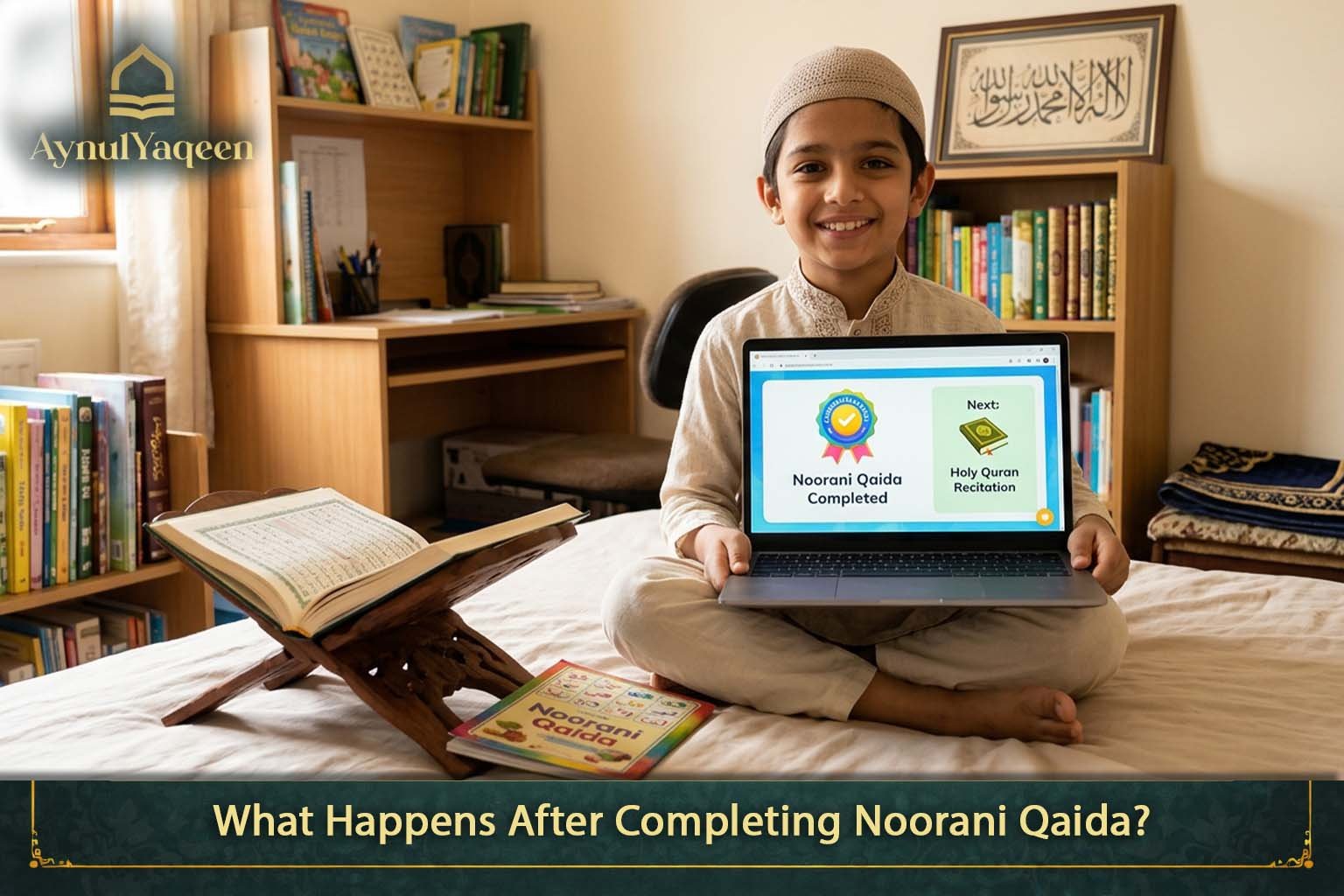
After completing the foundational lessons, students can begin practising Quranic text with guidance from a qualified teacher. Understanding noorani qaida lessons explained helps learners recognize how beginner exercises prepare them for reading complete verses.
The transition should be gradual because reading Quranic passages requires several skills to work together. Reviewing noorani qaida lessons explained can reinforce the foundations needed for the next learning stage. The next stage may involve:
- Reading short Quranic passages aloud.
- Reviewing letter articulation and pronunciation.
- Practising the rules introduced in the Qaida.
- Learning additional Tajweed rules.
- Developing fluency without sacrificing accuracy.
- Receiving corrections when mistakes occur.
Students should continue asking questions when they encounter unfamiliar patterns. Moreover, noorani qaida lessons explained should not be understood as a guarantee that every pronunciation difficulty disappears after completing a beginner’s book.
Learners considering Aynulyaqeen Quran Academy can ask how its current program supports the transition from introductory exercises to reading directly from the Quran. Reviewing noorani qaida lessons explained alongside a teacher’s assessment can help determine the appropriate next step.
Frequently Asked Questions About Noorani Qaida
Frequently Asked Questions About Noorani Qaida address common learner concerns about pronunciation, reading practice, and mastering foundational Quranic reading skills.
1. Can someone learn Noorani Qaida without knowing Arabic?
Yes. Noorani Qaida teaches foundational Arabic reading skills, so conversational Arabic is not required to begin. Studying Noorani Qaida lessons explained can help beginners understand letter recognition and pronunciation before progressing to connected Quranic text.
However, learning to read Arabic is different from understanding Quranic vocabulary and meanings.
2. Is a printed Qaida better than a digital version?
Either format can be suitable if it presents the lessons clearly. Printed books may help students focus on the page, while digital versions can offer convenient access and audio support.
For learners reviewing Noorani Qaida lessons explained, the best format depends on individual needs, available resources, and the teacher’s materials.
3. How can parents know when a child is ready to begin?
A child can begin when they can participate in short learning activities with suitable guidance. Recognizing letters is helpful but not essential if the course starts with the alphabet.
Parents can discuss the child’s attention and learning needs with the teacher. Reviewing Noorani Qaida lessons explained together may also help families understand what beginners will practise first.
4. Must students repeat the entire Qaida after finishing it?
Not necessarily. Reviewing specific lessons may be sufficient when only certain difficulties remain. A teacher can identify whether the student needs a full review or additional practice with selected topics.
Revisiting Noorani Qaida lessons explained can reinforce difficult rules without requiring every learner to repeat the entire book.
Conclusion
Understanding Noorani Qaida lessons explained helps beginners see how Arabic reading develops from individual letters to connected Quranic text. Each stage builds on earlier knowledge, making accurate pronunciation and regular revision more important than speed.
Students should review difficult topics, listen to reliable pronunciation models, and seek correction when needed. Parents can support children by encouraging consistent practice without creating unnecessary pressure.
For learners considering Aynulyaqeen Quran Academy, the next step is to confirm the available beginner curriculum, teaching approach, and feedback process. Using Noorani Qaida lessons explained as a guide to the learning sequence can help families ask relevant questions before enrolling.
With an appropriate learning plan and regular practice, students can build a strong foundation for continuing their Quran reading journey.
