

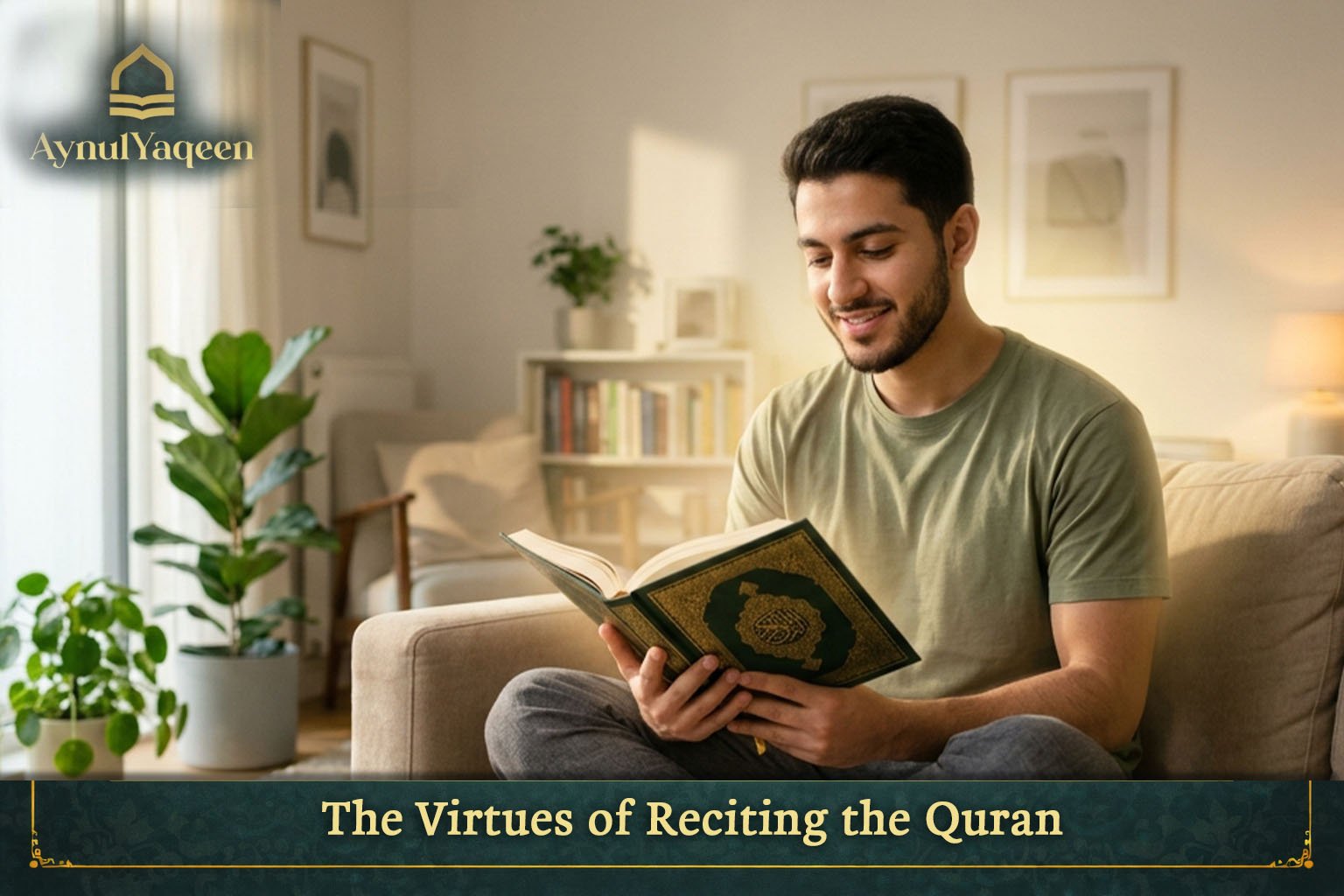
The virtues of reciting quran are not limited to the reward a Muslim receives for reading the words of Allah. Reciting the Quran is an act of worship that can strengthen faith, nurture the heart, improve character, and provide guidance through different stages of life.
For this reason, many Muslims want to understand the virtues of reciting the Quran and learn how to make Quran recitation a meaningful part of their daily routine.
The Quran is not a book that a believer reads once and puts away. It is a source of guidance that can be revisited throughout life. A person may read the same verse at different ages and discover a new lesson each time. Moreover, regular recitation creates an opportunity to remember Allah, reflect on His guidance, and develop a stronger relationship with revelation.
For beginners, however, starting a Quran routine can feel difficult. Some struggle with Arabic pronunciation, while others can read but find it challenging to remain consistent. Aynulyaqeen Quran Academy can provide structured Quran learning for students who want to improve their recitation, develop better reading habits, and approach the Quran with greater confidence.
What Are the Virtues of Reciting Quran?

Understanding the virtues of reciting quran begins with recognizing that Quran recitation itself is worship. Muslims do not read the Quran merely for information. They recite it because it is the speech of Allah and because the Prophet Muhammad ﷺ encouraged believers to maintain a relationship with the Quran.
One of the clearest indications of its reward appears in the hadith reported by Jami at-Tirmidhi. The Prophet ﷺ explained that whoever recites a letter from the Book of Allah receives a reward, and that each reward is multiplied by ten. He then clarified that Alif, Lam, and Mim are separate letters.
This teaching gives Muslims an important reason to continue reciting even when their daily amount seems small. A person does not need to finish several chapters every day to benefit from Quran recitation. A few verses read consistently can become an important part of a believer’s routine.
Therefore, the virtues of reciting quran include both the reward associated with recitation and the broader spiritual opportunity to remain connected to Allah’s guidance.
Learn Online with Aynulyaqeen Quran Academy
Choosing the right online Quran academy can make a significant difference in your learning journey. Aynulyaqeen Quran Academy provides structured Quran courses for beginners and advanced learners, focusing on accurate Quran reading, Tajweed, memorisation, and Islamic studies.
With qualified teachers, flexible class schedules, and personalised one-on-one lessons, students of all ages can learn at their own pace while building confidence in reciting and understanding the Holy Quran from anywhere in the world.

The Virtues of Reciting Quran as an Act of Worship
One of the virtues of reciting quran is that it turns ordinary moments into opportunities for worship. A Muslim can open the Mushaf after Fajr, during a quiet afternoon, or before sleeping and dedicate that time to reciting the words of Allah.
Allah instructs believers to recite the Quran with measured and deliberate recitation. This teaches an important principle: Quran reading should not always be treated as a race to complete a certain number of pages. Quality, attention, pronunciation, and reflection all matter.
A beginner may read slowly because Arabic letters and sounds are unfamiliar. That does not mean the effort is insignificant. In fact, the Prophet ﷺ described a special reward for the person who recites the Quran while finding the task difficult.
A useful approach is to focus on steady improvement rather than perfection. A learner can:
- Practice difficult Arabic letters individually.
- Read short passages aloud every day.
- Review mistakes with a qualified teacher.
- Learn basic Tajweed rules gradually.
- Increase the reading amount as fluency improves.
This approach makes the virtues of reciting quran accessible to beginners as well as advanced readers.
The Virtues of Reciting Quran for the Heart
The Quran has a special relationship with the believer’s heart. Allah says in Surah Ar-Ra’d 13:28 that hearts find rest in the remembrance of Allah. Quran recitation can therefore become an important part of a Muslim’s spiritual routine.
Many people live with busy schedules, constant notifications, work responsibilities, and family commitments. Setting aside even a short period for Quran recitation creates a deliberate pause in the day. Instead of moving from one task to another, the reader sits with the words of revelation.
This is one reason the virtues of reciting quran cannot be measured only by the number of pages completed. The experience can also encourage a person to slow down, remember Allah, reconsider personal priorities, and approach difficulties with greater patience.
However, it is important not to make exaggerated claims about the Quran producing identical emotional results for everyone. A believer may experience immediate comfort, while another person may need time to develop concentration and reflection. The key is to continue approaching the Quran sincerely and consistently.
How does the Quran Guide Everyday Decisions?
Another important aspect of the virtues of reciting quran is guidance. The Quran addresses faith, worship, family relationships, honesty, patience, justice, forgiveness, responsibility, and many other areas of human life. Understanding these principles also helps Muslims strengthen their knowledge of the core teachings of Islam, including What Are the Five Pillars of Islam?.
Regular reading allows these teachings to remain familiar. When a person repeatedly encounters Quranic guidance about patience, for example, that message may become easier to remember during a difficult situation. Similarly, verses concerning forgiveness can encourage a believer to reconsider how they respond to conflict.
This does not mean that every personal decision can be solved by randomly opening the Quran to a page. Rather, Muslims should learn its teachings systematically and apply established principles to their circumstances.
A beneficial reading routine therefore combines three elements:
- Recitation to maintain a relationship with the Quran.
- Understanding to recognize the meanings of its teachings.
- Application to bring those teachings into everyday behavior.
Together, these elements make Quran reading more purposeful.
The Virtues of Reciting Quran and Receiving Reward
The reward promised for Quran recitation is among the most encouraging parts of the virtues of reciting quran. The hadith about receiving ten rewards for each letter gives believers a powerful reason not to underestimate small acts of recitation.
Consider a learner who reads only one page each day. The amount may appear modest, especially when compared with someone completing a large portion of the Quran. Nevertheless, that single page represents a daily commitment to worship.
After several weeks, the reader has created a stable routine. After several months, that routine can become part of the person’s lifestyle. Learners who want to develop stronger Quran reading habits may also consider whether they need additional guidance, such as Do I need a native Arabic tutor to learn Quran.
This is an important lesson for anyone beginning Quran study: do not judge the value of an act only by its size. Consistency can transform a small daily practice into a lasting relationship with the Quran.
For this reason, a realistic target is often better than an ambitious schedule that cannot be maintained. Starting with five or ten minutes can be more beneficial for habit formation than committing to an unrealistic reading target.
The Virtues of Reciting Quran With Tajweed
Correct pronunciation is an essential part of learning to recite the Quran. Tajweed provides principles that help readers pronounce Arabic letters correctly, observe appropriate characteristics, and understand where sounds should be extended, merged, or stopped.
Learning Tajweed does not mean that beginners must master every rule immediately. Instead, students can progress step by step. They might begin by correcting the pronunciation of individual letters, then learn basic rules and gradually apply them while reading complete verses. For independent learners, understanding Can I learn Quran with Tajweed by myself can also help them choose an appropriate learning approach.
This is another practical dimension of the virtues of reciting quran. When a learner improves pronunciation, recitation becomes more confident and deliberate.
A qualified instructor can also identify mistakes that a student may not notice independently. This is particularly helpful for learners whose first language is not Arabic.
Students looking for structured support can explore Aynulyaqeen Quran Academy, where Quran learning can be approached through organized lessons designed to help students improve their reading and recitation skills.
The Virtues of Reciting Quran With Reflection
Recitation is important, but the Quran also calls believers to reflect on its message. Allah asks in Surah Muhammad 47:24 whether people do not reflect upon the Quran.
Tadabbur means engaging thoughtfully with Quranic meanings. It does not require a person to become a scholar before reflecting. A learner can begin by asking simple questions:
- What is the main message of these verses?
- What quality does Allah encourage here?
- What behavior is being discouraged?
- Is there a lesson I can apply to my life?
- What does this passage teach me about faith?
These questions can turn a short reading session into a meaningful spiritual exercise.
One of the virtues of reciting quran is therefore the opportunity to move beyond pronunciation and develop a deeper relationship with its message. Recitation brings the words to the tongue, while reflection allows their lessons to reach the mind and heart.
The Virtues of Reciting Quran for Personal Character
The Quran repeatedly teaches qualities such as patience, honesty, gratitude, humility, forgiveness, justice, and compassion. Regular exposure to these teachings can encourage Muslims to examine their own behavior.
For example, a person may read about controlling anger and begin thinking about how they respond to family members. Another reader may encounter verses about generosity and consider whether they can give more freely. Someone facing hardship may reflect on Quranic examples of patience and trust in Allah.
The transformation does not happen simply because a person completes a certain number of pages. It requires attention and willingness to apply what is learned.
This is why the virtues of reciting quran are closely connected to practice. The goal is not merely to increase the amount of Quran a person can read but to allow Quranic guidance to influence choices, relationships, and attitudes. For learners who later decide to focus on memorization, resources such as How long does it take to memorize the Quran can help them understand the commitment involved.
For children, developing these habits early can be especially valuable. A structured approach such as The easiest way to memorize the quran for kids can support young learners as they build familiarity with Quranic passages and establish positive study routines.
The Virtues of Reciting Quran for Children
Introducing children to Quran recitation early can help establish familiarity with Arabic letters, Quranic sounds, short surahs, and Islamic worship. However, children should not be taught through constant pressure.
A positive learning environment can make a major difference. Parents can create a simple routine in which Quran time is associated with encouragement, patience, and achievement.
Children can benefit from:
- Short and age-appropriate lessons.
- Repetition without excessive pressure.
- Encouragement when they correct a mistake.
- Listening to skilled Quran reciters.
- Learning short surahs gradually.
- Connecting memorized verses with their meanings.
For younger learners, the goal should be to build a positive relationship with Quran study. As their reading ability develops, their lessons can become more advanced.
Parents seeking organized instruction may consider Aynulyaqeen Quran Academy as an option for supporting their children’s Quran learning journey.
How do the Virtues of Reciting Quran Benefit Beginners?
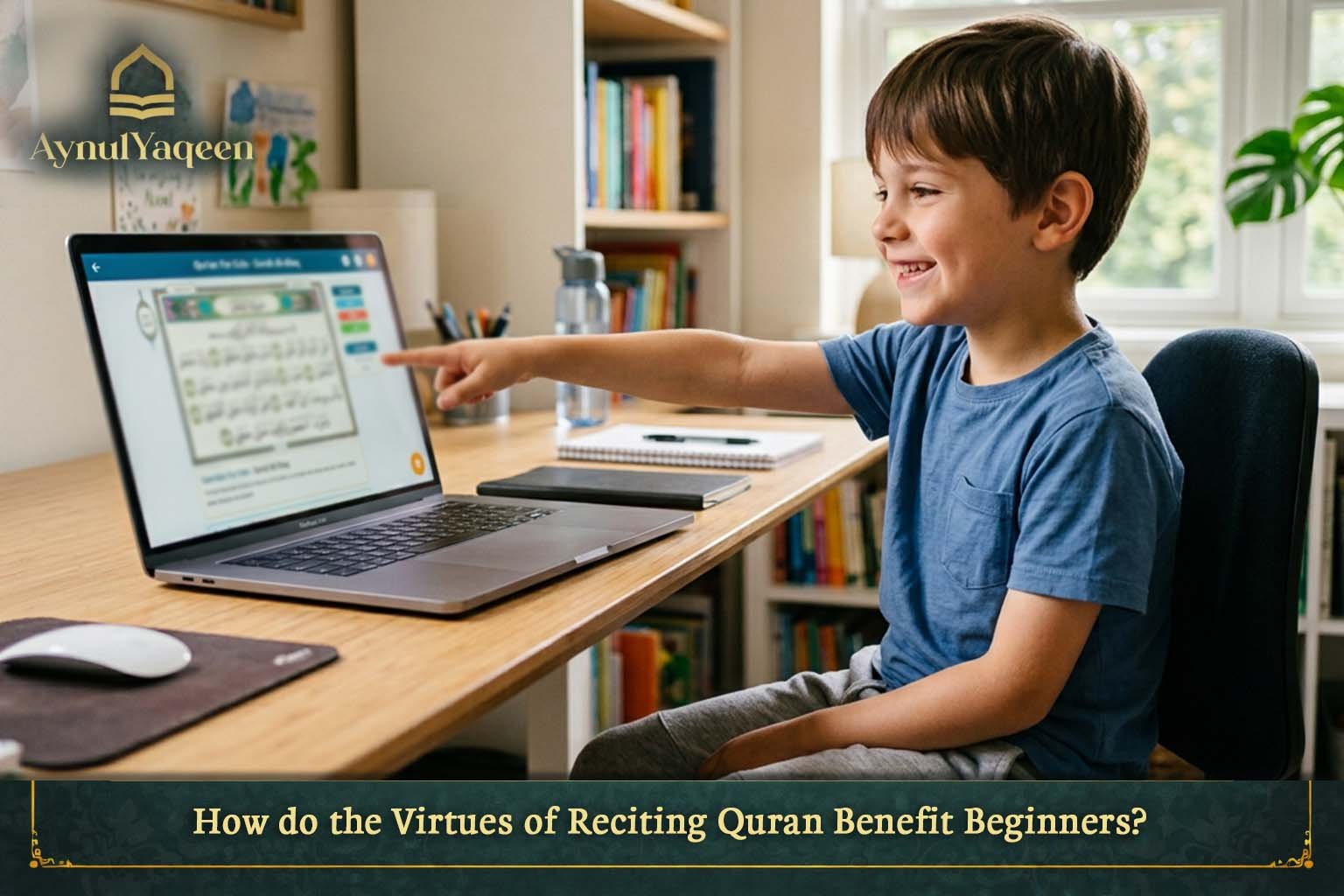
Beginners sometimes believe that they must already know how to read Arabic before they can experience the virtues of reciting quran. This is not the right mindset.
Learning itself is part of the journey. A new student may begin by recognizing Arabic letters, learning their sounds, joining letters together, and eventually reading complete words.
The process can take time, particularly for adults who have never studied Arabic. Rather than feeling embarrassed by mistakes, beginners should view corrections as part of learning.
A practical beginner’s pathway may look like this:
- Learn the Arabic alphabet.
- Practice letter pronunciation.
- Study basic vowel marks.
- Read simple combinations.
- Begin short Quranic passages.
- Learn foundational Tajweed.
- Practice with a teacher.
- Increase reading fluency gradually.
With consistent practice, a difficult passage can become familiar. That progress is one of the personal rewards of continuing the journey.
Creating a Daily Quran Reading Routine
Knowing the virtues of reciting quran is valuable, but knowledge alone does not create a habit. A practical schedule makes regular recitation much easier.
Instead of waiting for a large block of free time, choose a specific part of the day. Some people prefer the quiet after Fajr, while others find that evening reading works better.
The most important factor is consistency.
A beginner might start with:
- 5 minutes: Read a few verses slowly.
- 10 minutes: Read approximately one page.
- 15 minutes: Read and briefly review meanings.
- 20–30 minutes: Combine recitation with Tajweed or memorization practice.
The target can change as fluency improves. What matters initially is making the habit easy enough to repeat.
Keeping the Quran in a visible and convenient location can also help. Digital tools may be useful, but some learners find that using a physical Mushaf reduces distractions.
The Virtues of Reciting Quran in the Morning
Morning Quran recitation can provide a calm beginning to the day. After completing Fajr, a Muslim may dedicate several minutes to reading before beginning work, study, or household responsibilities.
There is no requirement that every person must read at the same time. Nevertheless, attaching Quran reading to an established routine can make the habit easier to maintain.
For example:
Fajr → prayer → Quran recitation → daily activities
This simple sequence reduces the need to decide every morning whether to read. The habit becomes connected to something that already happens consistently.
For someone trying to understand the virtues of reciting quran, this practical dimension is important. Spiritual benefits are easier to pursue when recitation becomes a sustainable part of everyday life.
The Virtues of Reciting Quran Before Sleep
Some Muslims prefer to include Quran recitation in their evening routine. Reading before sleep can create a peaceful transition away from the activities of the day.
Rather than scrolling through a phone immediately before bed, a person can spend a few minutes reciting familiar surahs and remembering Allah.
The evening session does not need to be long. A short selection that is maintained consistently can be enough to establish the habit.
Muslims should also learn the authentic supplications and Quranic passages associated with the morning and evening routines rather than assuming that every commonly circulated practice has the same level of evidence.
Learning from qualified teachers can help students distinguish established practices from popular claims.
Choosing What to Read Every Day
There is no single daily Quran schedule that suits everyone. A beginner may benefit from short surahs, while an experienced reader may choose a larger portion.
One useful method is to divide the Quran into manageable daily sections. Another is to read according to available time.
For example:
- Busy day: a few verses.
- Normal day: one to three pages.
- Longer session: several pages with reflection.
- Friday: include appropriate Friday-related Quran reading practices.
- Ramadan: increase recitation gradually according to ability.
The goal is not competition. Quran reading should remain an act of worship rather than a source of unnecessary pressure.
Reading, Understanding, and Memorizing the Quran
Reading and memorization are closely connected, but they are not identical activities. A person can read the Quran regularly without attempting to memorize large portions.
For beginners, improving reading accuracy should usually come first. Once the student becomes comfortable with pronunciation, memorizing short surahs can become easier.
Understanding the meaning is also important. A learner who reads Arabic but understands very little can use a reliable translation or explanation to gain context.
This three-part approach can be especially effective:
Read → Understand → Review
Over time, some verses may become familiar enough to memorize naturally. The aim of the virtues of reciting quran is not to force every Muslim into exactly the same learning program. Instead, each learner can build a realistic path based on their current ability.
Overcoming Common Quran Reading Challenges
Many people want to experience the virtues of reciting quran but encounter practical obstacles. Recognizing these challenges can make them easier to overcome.
Lack of Time
If your schedule is crowded, start with a small target. Five consistent minutes are better than an ambitious plan that repeatedly gets postponed.
Difficulty With Arabic
Begin with foundational Arabic reading lessons. There is no shame in starting from the alphabet, regardless of age.
Fear of Mistakes
Mistakes are normal during learning. A teacher’s role is to identify them and help you improve.
Losing Motivation
Connect Quran reading to a fixed daily event. A stable routine often works better than waiting for motivation.
Not Understanding the Meaning
Use a trusted translation and age-appropriate explanation while continuing to learn Arabic recitation.
A structured program at Aynulyaqeen Quran Academy can also help learners approach these challenges through guided instruction rather than trying to correct every difficulty alone.
The Virtues of Reciting Quran and Family Life
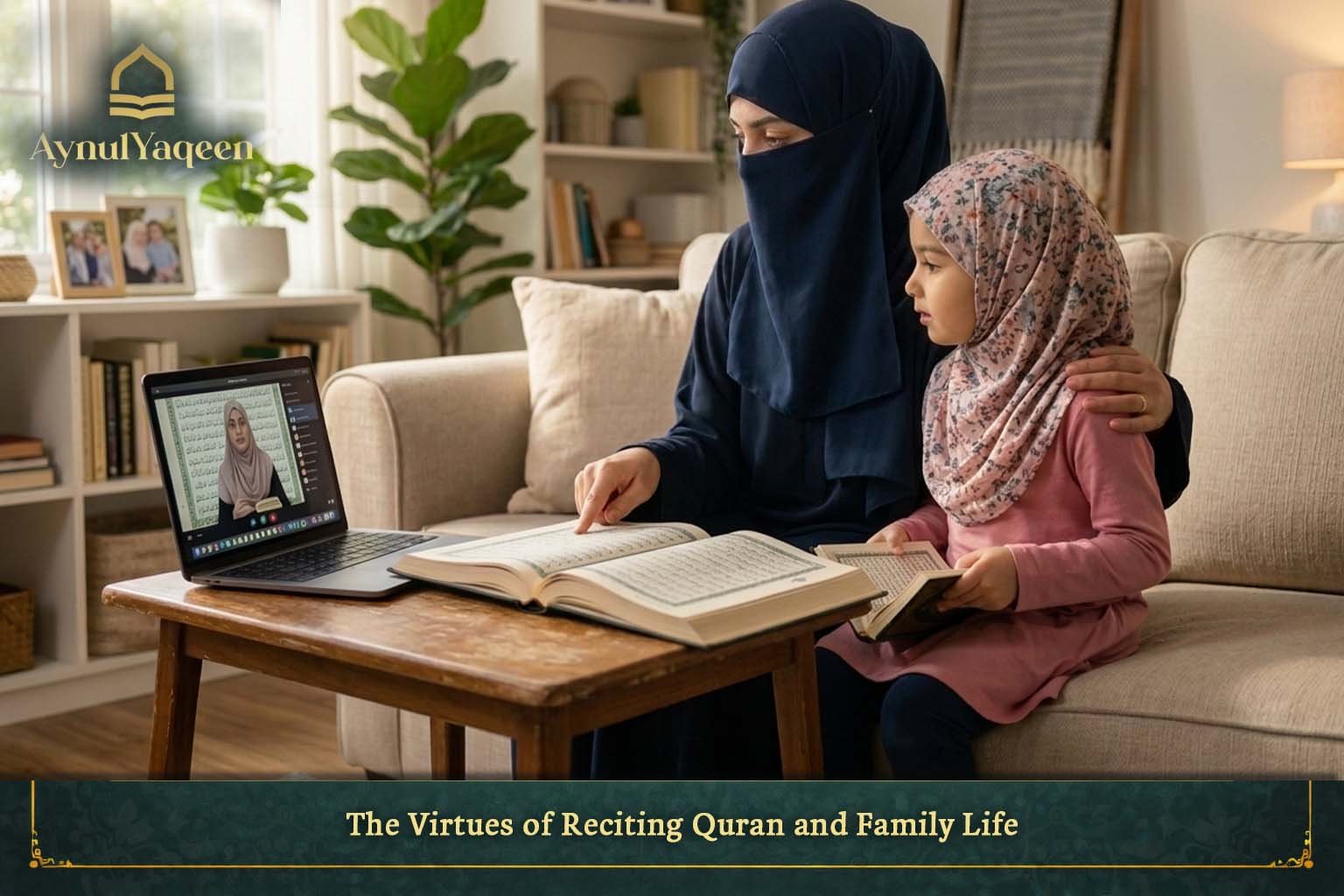
The Quran can become part of a family’s shared routine. Parents can read with their children, listen to recitation together, or set aside a few minutes for family Quran time.
A family does not need to turn every session into a formal class. Sometimes simply hearing a parent recite calmly can help children become familiar with the sound of Quranic Arabic.
Families can also establish simple goals, such as:
- Reading together several times each week.
- Reviewing one short surah.
- Discussing the general meaning of selected verses.
- Encouraging children to recite what they have learned.
- Celebrating steady improvement rather than speed.
This environment can help children see the Quran as a natural part of home life rather than something associated only with lessons or examinations.
How to Make Quran Recitation More Meaningful?
To gain more from the virtues of reciting quran, improve the quality of your reading session rather than focusing only on quantity.
Before beginning, remove unnecessary distractions. Sit comfortably, choose a manageable passage, and remind yourself that you are engaging with the words of Allah.
During recitation, pay attention to pronunciation and pauses. Afterward, select one verse or theme that deserves further thought.
You can also keep a simple Quran journal. Write down:
- A verse that affected you.
- A new word you learned.
- A lesson you want to remember.
- A behavior you want to improve.
- A question you would like to ask a teacher.
This turns Quran reading into an ongoing learning process.
Learning Quran With Aynulyaqeen Quran Academy
Students who want structured guidance may benefit from studying with Aynulyaqeen Quran Academy. A guided learning environment can be particularly useful for people who struggle to know where to begin or how to progress from basic reading to confident recitation.
A good Quran learning program should consider the student’s current level instead of assuming that every learner has the same needs. Beginners may require foundational reading practice, while intermediate students may need focused Tajweed correction or greater fluency.
The value of a structured program is not simply the number of lessons. It is the combination of regular practice, teacher feedback, gradual progression, and accountability.
For learners who are serious about experiencing the virtues of reciting quran, building accurate and consistent reading habits can make their Quran journey more sustainable.
A Practical Weekly Quran Plan
A simple weekly plan can help students develop consistency and experience the virtues of reciting quran. The schedule can be adjusted according to age, ability, and available time. A realistic routine also makes it easier to maintain the virtues of reciting quran as part of daily life.
Monday
Read a short portion and focus on accurate pronunciation. Careful reading helps learners appreciate the virtues of reciting quran while improving their fluency.
Tuesday
Review Monday’s passage and correct difficult words. Regular revision supports confidence and helps learners benefit from the virtues of reciting quran.
Wednesday
Read a new portion and consider its general meaning. Understanding what you read can deepen your connection with the Quran and the virtues of reciting quran.
Thursday
Practice the Tajweed rules you encountered during the week. Better pronunciation allows students to approach the virtues of reciting quran with greater confidence.
Friday
If time permits, increase your Quran reading and include established Friday practices. This extra time can strengthen your awareness of the virtues of reciting quran.
Saturday
Review previously read passages instead of always starting new ones. Repetition improves fluency and reinforces the virtues of reciting quran through consistent practice.
Sunday
Assess your progress and set a realistic target for the coming week. Small, achievable goals make it easier to continue benefiting from the virtues of reciting quran.
Why Does Weekly Review Matter?
A weekly plan prevents every session from becoming a race to read something new. Review improves familiarity, fluency, and confidence, while a balanced routine helps learners continue experiencing the virtues of reciting quran over time.
The Virtues of Reciting Quran Over a Lifetime
One of the virtues of reciting quran is that its importance does not disappear when a person becomes older. Quran learning can begin during childhood, continue through adulthood, and remain meaningful throughout old age.
A young learner may focus on pronunciation and memorization. A university student may turn to the Quran for guidance while navigating new responsibilities. A parent may use Quranic teachings when raising children. An older adult may find renewed meaning in verses they have known for decades.
The same Quran can therefore accompany a person through many different stages of life.
This lifelong relationship is one of the reasons Muslims are encouraged to maintain regular recitation rather than treating Quran study as a temporary project.
What If You Miss a Day of Quran Reading?
Missing a day does not mean that your entire routine has failed. One of the biggest mistakes learners make is abandoning a habit because they could not maintain it perfectly.
If you miss a session, simply return at the next available opportunity. Avoid trying to compensate by creating an exhausting schedule. Instead, resume the previous target and continue.
For example, if you normally read two pages a day and miss Tuesday, you do not necessarily need to read four pages on Wednesday. Returning to two pages may be enough. The objective is long-term consistency.
This mindset makes the virtues of reciting quran easier to pursue because the learner understands that a lasting relationship with the Quran develops gradually.
Building a Lifelong Relationship With the Quran

The strongest Quran routine is one that can survive changes in circumstances. School schedules, work commitments, travel, family responsibilities, and unexpected events can all affect a person’s available time.
For this reason, create a minimum reading target that remains realistic even on busy days. You can then increase the amount when you have more time.
For example, your minimum might be five minutes. On a normal day, you could read for fifteen minutes. On a quiet weekend, you might spend an hour reading, studying meanings, or practicing Tajweed.
This flexible structure protects the habit from all-or-nothing thinking.
Ultimately, the virtues of reciting quran are best approached through sincerity, consistency, correct recitation, reflection, and practical application.
Frequently Asked Questions About the Virtues of Reciting Quran
Below are some common questions about the virtues of reciting the Quran and how regular recitation can become a meaningful part of daily Muslim life.
Can someone benefit from Quran recitation while learning Arabic from the beginning?
Yes. A learner does not have to reach an advanced level of Arabic before beginning Quran recitation. Starting with basic letters and pronunciation allows the student to build skills gradually while developing familiarity with the Quran.
Is it better to read the Quran silently or aloud?
Both approaches can be useful depending on the situation. Quiet recitation may be appropriate when others are sleeping or studying, while audible recitation can help learners hear their pronunciation and identify mistakes. The important consideration is to maintain proper etiquette and avoid disturbing others.
How can a busy professional maintain a Quran routine?
A busy person can create a minimum daily target that fits realistically into their schedule. Keeping the target small, connecting it to an existing routine, and preparing the reading material in advance can reduce the chances of skipping the session.
When should a learner seek a Quran teacher instead of studying independently?
A teacher can be especially valuable when pronunciation errors remain difficult to identify, when Tajweed rules become confusing, or when the learner is unsure how to progress. Regular feedback can prevent mistakes from becoming established habits.
In conclusion, the virtues of reciting quran extend beyond completing a daily reading goal. Regular Quran recitation can help Muslims strengthen their connection with Allah, improve their reading skills, develop greater patience, and create a peaceful routine centered on faith.
A practical weekly plan makes this habit easier by balancing new passages with revision, Tajweed practice, and reflection. Moreover, learners do not need to begin with long reading sessions. Starting with a manageable portion and gradually increasing it can make the habit more sustainable.
Consistency is more important than trying to accomplish too much in a short period. By reviewing previous passages, improving pronunciation, and setting realistic weekly goals, students can make steady progress. Over time, this approach can help them experience the virtues of reciting quran more deeply and maintain a meaningful relationship with the Quran throughout their lives.
