

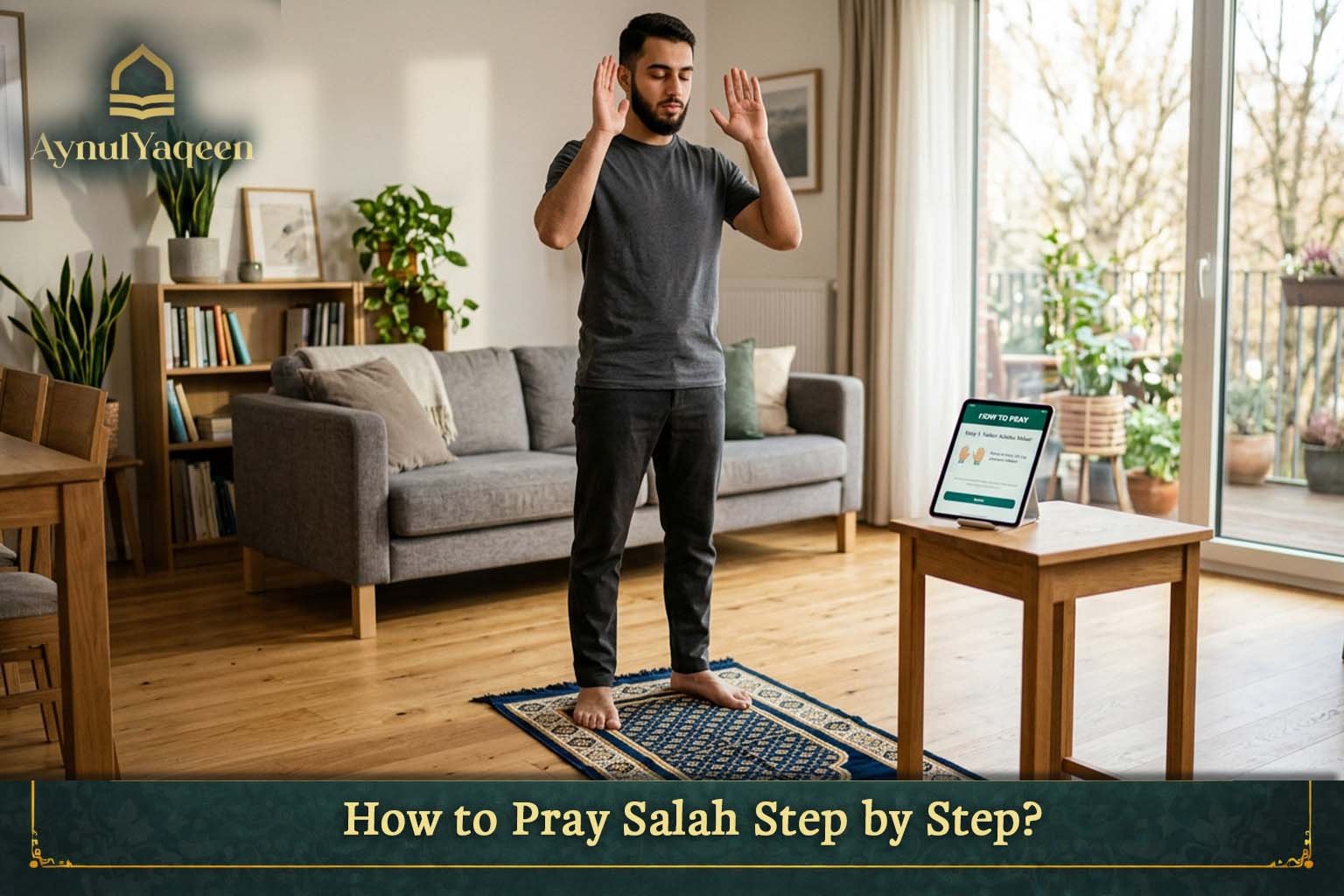
How to pray Salah step by step is one of the most important questions asked by Muslims who are beginning to learn the daily prayer or trying to improve their understanding of its movements and recitations. Salah is not simply a sequence of physical positions. Rather, it is a direct act of worship that combines intention, remembrance of Allah, Quranic recitation, bowing, prostration, and supplication.
For a beginner, learning all of these elements at once may initially feel difficult. However, the process becomes much easier when the prayer is divided into clear stages. At Aynulyaqeen Quran Academy, learners can approach Salah gradually, focusing on one movement and one recitation at a time before combining everything into a complete prayer.
This guide explains how to pray Salah step by step in a simple and organized way. It covers the basic structure of a rakah, the positions performed during prayer, important recitations, the differences between the five daily prayers, and the way a prayer is completed. It also highlights practical points that can help beginners develop confidence while learning.
How to pray Salah step by step before beginning the prayer?
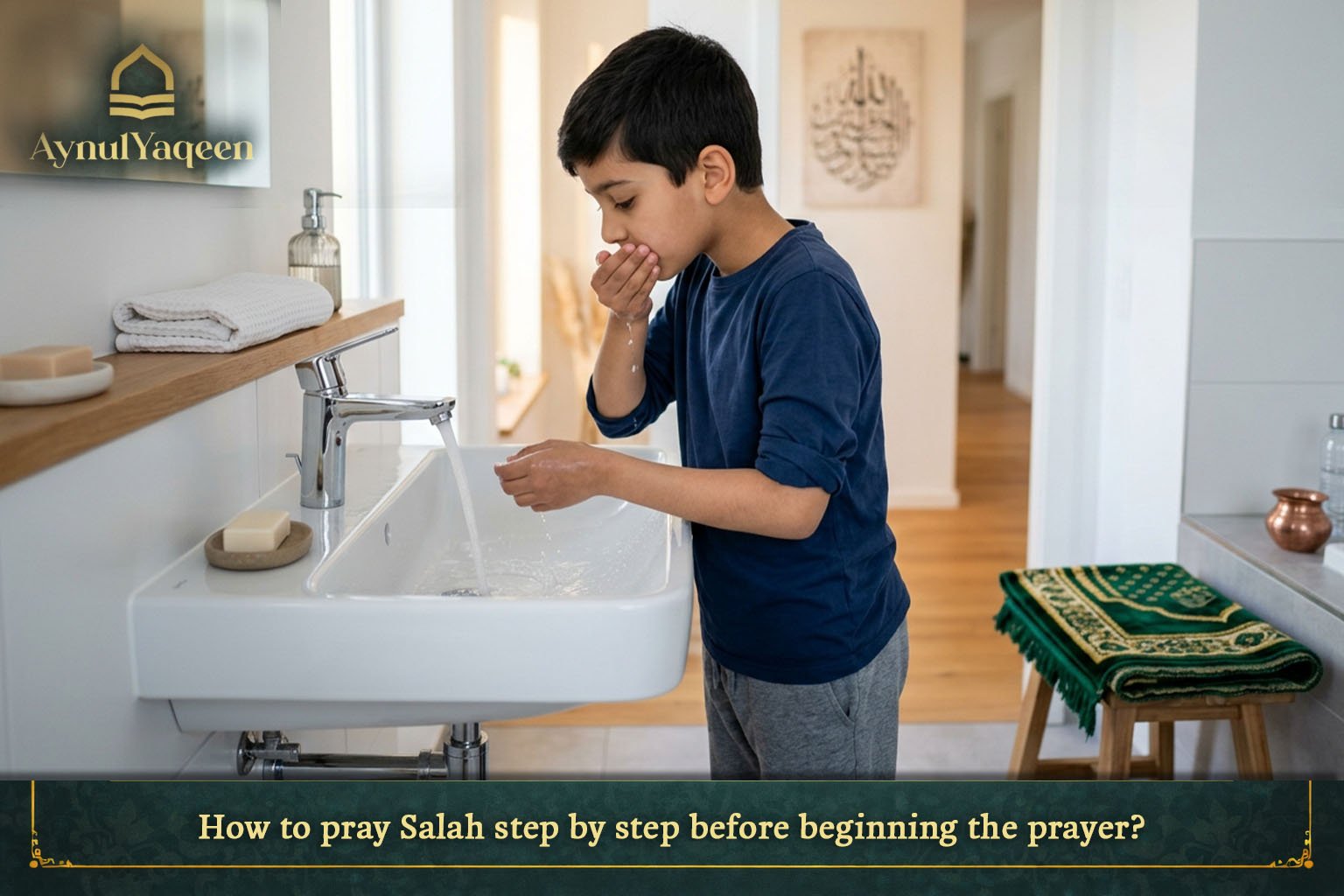
Before asking how to pray Salah step by step, a beginner should understand that preparation comes before the first takbir. Prayer has conditions and etiquette that help the worshipper enter Salah with physical and spiritual readiness.
The preparation normally includes:
- Performing wudu when purification is required.
- Making sure the body, clothes, and prayer place are clean.
- Covering the parts of the body that must be covered during Salah.
- Facing the Qiblah.
- Ensuring that the prayer time has begun.
- Forming the intention to perform the specific prayer.
These points create the foundation for learning how to pray Salah step by step correctly. A person does not need to memorize everything in one sitting. Instead, learning can happen progressively, especially for someone who is new to Islam or has only recently started praying.
At Aynulyaqeen Quran Academy, beginners can benefit from learning the movements and recitations in an ordered sequence. This approach reduces confusion because every part of the prayer has a specific place.
Learn Online with Aynulyaqeen Quran Academy
Choosing the right online Quran academy can make a significant difference in your learning journey. Aynulyaqeen Quran Academy provides structured Quran courses for beginners and advanced learners, focusing on accurate Quran reading, Tajweed, memorisation, and Islamic studies.
With qualified teachers, flexible class schedules, and personalised one-on-one lessons, students of all ages can learn at their own pace while building confidence in reciting and understanding the Holy Quran from anywhere in the world.

How to pray Salah step by step: Understanding the rakah?
The easiest way to understand how to pray Salah step by step is to first understand what a rakah means. A rakah is one complete unit of prayer containing a specific sequence of standing, recitation, bowing, standing again, prostration, sitting, and another prostration.
The five obligatory daily prayers contain different numbers of rakahs:
- Fajr: 2 obligatory rakahs.
- Dhuhr: 4 obligatory rakahs.
- Asr: 4 obligatory rakahs.
- Maghrib: 3 obligatory rakahs.
- Isha: 4 obligatory rakahs.
Although the number of rakahs changes, the fundamental movements remain recognizable. Therefore, a beginner who understands one rakah has already learned an important part of how to pray Salah step by step.
The main movements include standing, reciting, ruku, rising from ruku, sujud, sitting between the prostrations, and completing the prayer with tashahhud and tasleem.
How to pray Salah step by step: Make the intention?
The first practical point in How to pray Salah step by step is the intention, known as niyyah. The intention belongs to the heart. A Muslim intends to perform the particular prayer for the sake of Allah.
For example, a person preparing to perform Fajr knows internally that they are praying the obligatory Fajr prayer. The same principle applies to Dhuhr, Asr, Maghrib, and Isha.
There is no need to make the intention complicated. The essential point is knowing which prayer you are performing and intending to worship Allah through it.
This step is especially important for beginners because it establishes the purpose of the worship before the physical movements begin.
How to pray Salah step by step with the opening Takbir?
After forming the intention, the prayer begins with Takbirat al-Ihram, when the worshipper says:
Allahu Akbar
The phrase means that Allah is greater. With this opening takbir, the person formally enters Salah and begins focusing on the worship.
When learning how to pray Salah step by step, beginners should understand that this is more than a phrase said automatically. It marks the transition from ordinary activities into prayer.
The hands are raised according to the established practice being followed, and then the hands are placed while standing. The exact placement can vary according to recognized schools of Islamic jurisprudence, so beginners should avoid becoming distracted by minor differences.
What matters most at this stage is learning the sequence correctly and developing concentration.
How to pray Salah step by step while standing?
Standing, or qiyam, is an essential part of the obligatory prayer for someone who is physically able to stand.
While standing, the worshipper maintains a calm posture and prepares for Quranic recitation. The eyes are generally directed toward the place of prostration rather than wandering around the room.
Learning how to pray Salah step by step requires more than memorizing movements. The worshipper should also learn how to remain composed. Excessive movement can make it harder to maintain concentration.
A useful beginner approach is to focus on three things:
- Keep the body stable.
- Listen carefully to the recitation.
- Remember that you are standing before Allah.
The physical position should therefore support khushu rather than become a source of unnecessary anxiety.
How to pray Salah step by step with Surah Al-Fatihah?
One of the central parts of how to pray Salah step by step is Quranic recitation. Surah Al-Fatihah occupies a fundamental position in Salah.
The worshipper begins the recitation according to the established prayer practice, including seeking refuge in Allah and saying the basmalah before reciting Al-Fatihah.
Surah Al-Fatihah contains praise of Allah, recognition of His mercy and authority, a declaration of worship, a request for help, and a supplication for guidance to the straight path.
For someone learning how to pray Salah step by step, memorizing Al-Fatihah is therefore one of the most useful priorities.
A beginner can divide the surah into smaller portions, repeat each verse regularly, and gradually improve pronunciation. There is no need to rush the learning process.
At Aynulyaqeen Quran Academy, Quran learning can be approached in a structured way so that beginners become more comfortable with Arabic pronunciation and recitation.
How to pray Salah step by step with additional Quran recitation?
After Al-Fatihah, an additional portion of the Quran is recited in the rakahs where such recitation is prescribed or practiced according to the prayer.
For beginners, a short surah can make the learning process easier. Surahs such as Al-Ikhlas, Al-Falaq, and An-Nas are commonly memorized by learners because they are relatively short.
The important point is not to turn the prayer into a memorization competition. Instead, learners should aim for accurate and calm recitation.
When studying how to pray Salah step by step, it is helpful to separate two goals: first, learning the movements; second, improving Quranic recitation. These goals can then be combined through regular practice.
How to pray Salah step by step during Ruku?
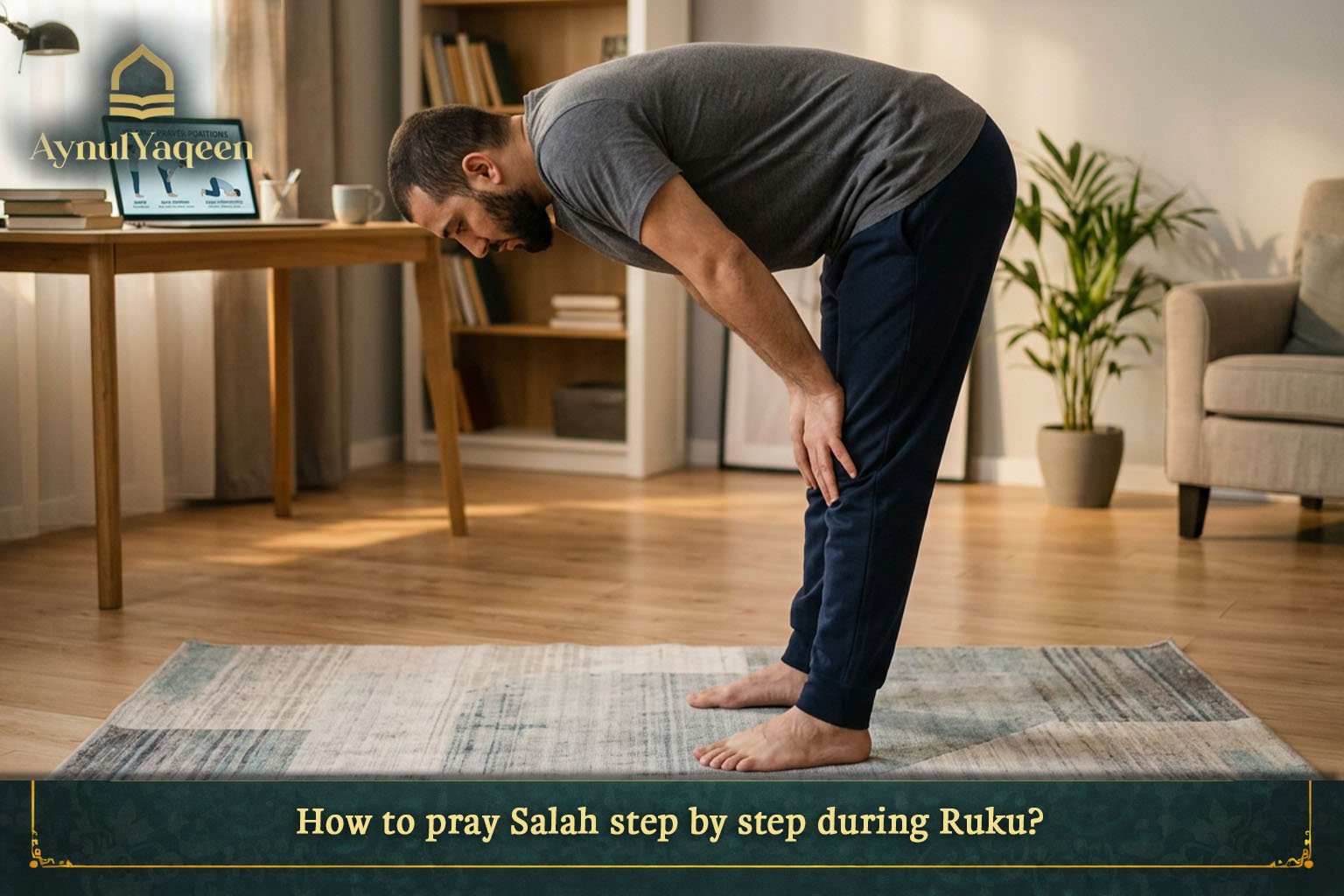
The next major movement in how to pray Salah step by step is ruku, the bowing position.
The worshipper says Allahu Akbar while moving into ruku. The back is kept reasonably straight, the hands rest on the knees, and the body remains calm.
A well-known remembrance said during ruku is:
Subhana Rabbiyal Adheem
It praises Allah as the Magnificent.
The remembrance may be repeated according to the established practice. Beginners should concentrate on learning the words correctly rather than rushing through them.
Ruku also has a deeper spiritual meaning. After standing and reciting the Quran, the worshipper physically bows in humility before Allah. Consequently, the movement combines physical submission with remembrance.
Returning to standing after Ruku
After completing ruku, the worshipper rises back to a standing position.A person praying alone says the established phrase while rising:
Sami’a Allahu liman hamidah
Then, after standing upright, the worshipper praises Allah with an established expression such as:
Rabbana wa lakal hamd
This transition is another important part of how to pray Salah step by step because the prayer is not a collection of disconnected movements. Each position leads naturally into the next.
The worshipper should pause sufficiently in the standing position rather than immediately moving downward.
How to pray Salah step by step with Sujud?
Sujud, or prostration, is one of the most recognizable positions in Salah. It is also a profound expression of humility and submission.
When moving into sujud, the worshipper says Allahu Akbar and assumes the prostration position.
The body is positioned so that the recognized points of prostration are placed on the ground. These include the forehead and nose, both hands, both knees, and the toes.
The remembrance commonly said during sujud is:
Subhana Rabbiyal A’la
This praises Allah as the Most High.
For someone studying how to pray Salah step by step, sujud deserves special attention because beginners sometimes move too quickly. Instead, the position should be performed calmly and with awareness.
The purpose is not simply to reach the floor. The worshipper is expressing humility before Allah.
How to pray Salah step by step between the two Sujud?
After the first prostration, the worshipper says Allahu Akbar while rising into a seated position. The person sits calmly between the two prostrations. A common supplication is:
Rabbighfir li
which means:
My Lord, forgive me.
This brief sitting is an important part of how to pray Salah step by step because it connects the two prostrations.
Beginners should learn not to skip this position or perform it without stillness. Salah contains moments of movement as well as moments of calm, and both are important for performing the prayer properly.
How to pray Salah step by step with the second Sujud?
After sitting between the two prostrations, the worshipper performs the second sujud.
Again, Allahu Akbar is said when moving into the position, followed by the appropriate remembrance.
The second prostration completes the core sequence of one rakah.
Therefore, when learning how to pray Salah step by step, beginners can remember the basic pattern as:
Standing → Recitation → Ruku → Standing → Sujud → Sitting → Sujud
Once this pattern becomes familiar, connecting several rakahs becomes much easier.
How to pray Salah step by step when moving to the next Rakah?
After the second sujud of the first rakah, the worshipper rises for the next rakah. The same fundamental pattern is repeated. The Quran is recited while standing, followed by ruku, rising, sujud, sitting, and another sujud.
However, the prayer changes slightly when the worshipper reaches the end of a required set of rakahs.
This is where understanding the number of rakahs in each prayer becomes useful. A beginner does not have to memorize every prayer independently because the underlying structure is closely related.
At Aynulyaqeen Quran Academy, learners can build their confidence by mastering one rakah first and then practicing how several rakahs connect.
How to pray Salah step by step with Tashahhud?
After completing the appropriate number of rakahs before the final standing or at the end of the prayer, the worshipper sits for tashahhud.
The tashahhud contains testimony of faith and greetings and praise directed to Allah. It also includes the testimony that there is no deity worthy of worship except Allah and that Muhammad is His servant and Messenger.
A commonly recited wording begins:
At-tahiyyatu lillahi was-salawatu wat-tayyibat
The worshipper continues with the established tashahhud.
Learning how to pray Salah step by step therefore requires gradual memorization of this section. Since the tashahhud is longer than some other prayer phrases, beginners can learn it in short portions.
It is also useful to listen to reliable Quran and Salah instruction while checking pronunciation with a qualified teacher.
How to pray Salah step by step in the final sitting?
When the sitting is the final sitting of the prayer, the worshipper continues beyond the basic tashahhud with blessings upon Prophet Muhammad.
This includes the well-known salawat asking Allah to bless Muhammad and his family, just as He blessed Ibrahim and his family.
The exact wording should be learned accurately and recited calmly.
For a person studying how to pray Salah step by step, the final sitting is particularly important because it prepares the worshipper for the completion of the prayer.
Rather than memorizing the entire passage in one attempt, divide it into manageable phrases. Repetition during daily practice will gradually make the words familiar.
How to pray Salah step by step and end the prayer with Tasleem?
The final action in How to pray Salah step by step is tasleem. The worshipper turns the head toward the right and says:
Assalamu alaikum wa rahmatullah
Then the greeting is repeated toward the left. With the tasleem, the prayer is completed. This ending is simple, but it should still be performed calmly. The worshipper should avoid immediately jumping into another activity before realizing that the Salah has finished.
For beginners, the complete sequence may initially feel long. Nevertheless, after consistent practice, the order becomes familiar and natural.
How to pray Salah step by step: The five daily prayers?
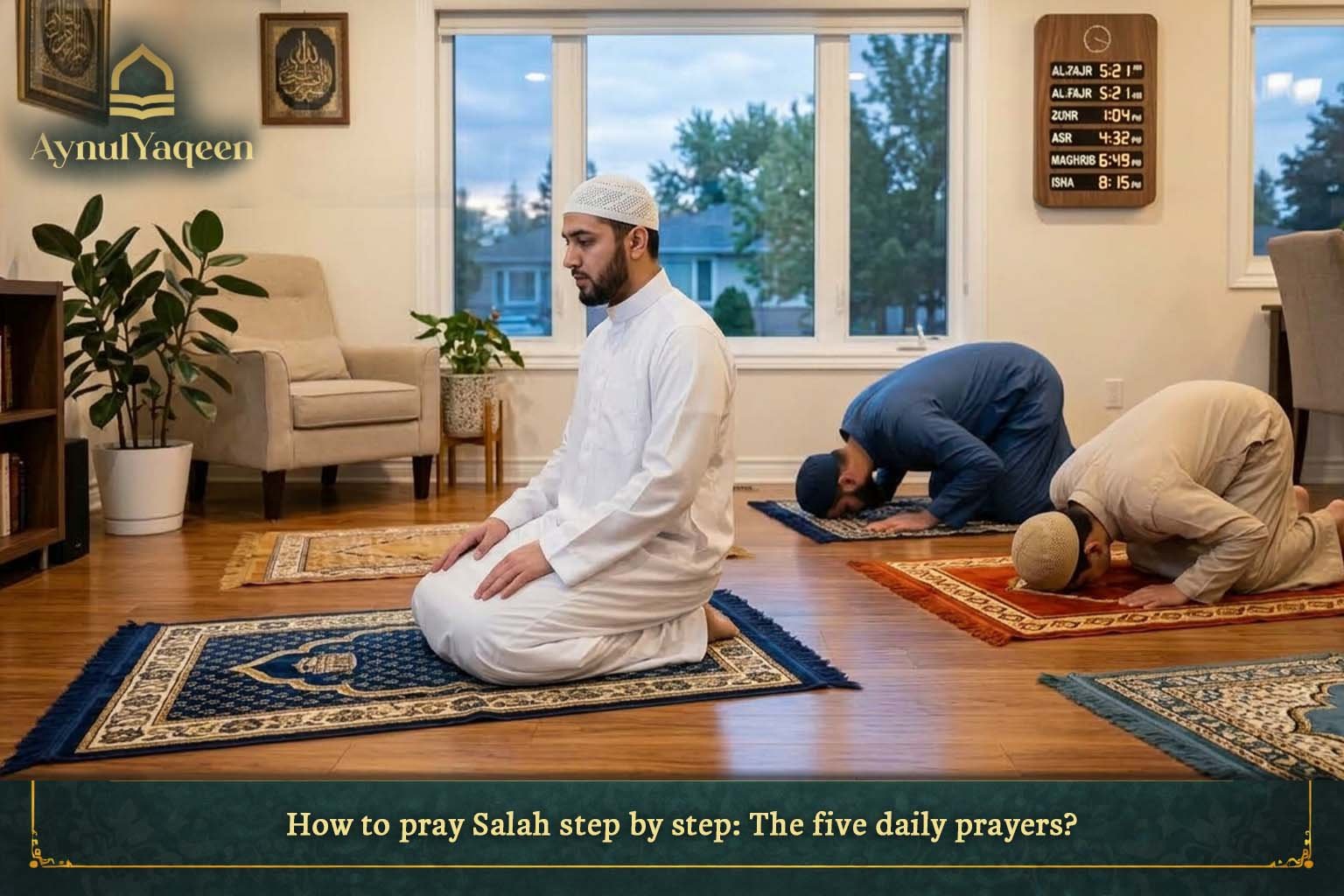
Knowing how to pray Salah step by step also means understanding how the five obligatory prayers differ in the number of rakahs.
Fajr
Fajr contains two obligatory rakahs and is the first obligatory prayer of the day. It is performed during the time that begins at dawn and ends before sunrise. Because it starts the daily cycle of prayer, learning its two rakahs is a useful way for beginners to practice the basic structure of Salah.
Dhuhr
Dhuhr contains four obligatory rakahs and is performed after midday begins. It gives Muslims an opportunity to pause during the daytime and turn their attention toward worship. Beginners can use the same basic rakah structure they have already learned while becoming familiar with the additional rakahs.
Asr
Asr contains four obligatory rakahs and is performed during the afternoon prayer period. Although it has the same number of obligatory rakahs as Dhuhr, it comes later in the day and forms an important part of maintaining the five daily prayers consistently.
Maghrib
Maghrib contains three obligatory rakahs and begins after sunset. Its structure is slightly different from Fajr, Dhuhr, and Asr because it has three obligatory rakahs. Therefore, beginners should pay attention to the point at which the second rakah ends and how the prayer continues into the final rakah.
Isha
Isha contains four obligatory rakahs and is performed during the night. It is the final obligatory prayer of the day. Learning Isha can help beginners review the complete structure of a longer prayer and become more confident in connecting several rakahs together.
Although these prayers differ in length, the basic movements learned through How to pray Salah step by step remain familiar.
How to pray Salah step by step without becoming overwhelmed?
New learners sometimes believe they must memorize every Arabic phrase immediately. That expectation can create unnecessary pressure. A better approach is to divide the learning process into stages.
- First, learn the physical sequence.
- Next, memorize the essential recitations gradually.
- Then, practice the complete rakah repeatedly.
- Finally, learn how two, three, and four rakahs are connected.
This method allows a beginner to make steady progress without feeling overwhelmed.
Furthermore, mistakes during the learning process should encourage further study rather than cause someone to abandon Salah. A qualified teacher can identify pronunciation problems, explain differences between prayer practices, and demonstrate the movements clearly.
Common mistakes when learning how to pray Salah step by step
Beginners often make mistakes because they concentrate so heavily on memorization that they forget the importance of calmness.
Some common difficulties include:
- Moving too quickly between positions.
- Forgetting the order of the movements.
- Confusing the number of rakahs.
- Pronouncing Arabic words incorrectly.
- Looking around repeatedly during prayer.
- Forgetting the final sitting.
- Mixing up the words of ruku and sujud.
- Trying to memorize too much at once.
- Becoming excessively concerned about minor differences in practice.
Fortunately, most of these difficulties can be reduced through repetition.
The goal of How to pray Salah step by step is not merely to memorize a list. The learner should eventually be able to perform the prayer with understanding, concentration, and confidence.
How to pray Salah step by step with better concentration?
Learning the movements is only one part of developing a strong prayer routine. Concentration also matters. Before Salah begins, reduce distractions whenever possible. Put away unnecessary devices, choose a clean and quiet place, and take a moment to remember the purpose of the prayer. Developing a stronger connection with the Quran can also deepen this experience, especially when learners understand the virtues of reciting Quran and appreciate the value of regular recitation.
During the prayer, pay attention to the meanings of the words being recited. Understanding Al-Fatihah, the tasbih of ruku, the words of sujud, and the tashahhud can make the worship feel more meaningful.
Another helpful practice is slowing down slightly. A calm prayer is easier to follow than one performed in a rush.
At Aynulyaqeen Quran Academy, learners who need additional support can focus on Quranic pronunciation and prayer-related Arabic gradually, allowing knowledge and practice to develop together.
How to pray Salah step by step for beginners: A simple practice plan?
A beginner can use the following weekly approach to learn Salah gradually and become more comfortable with its movements and recitations. Dividing the learning process into small daily goals makes the prayer easier to understand and remember.
Day one: Learn the structure
Focus on understanding the order of the main movements in one rakah. Learn how standing, recitation, ruku, standing again, sujud, and sitting are connected. At this stage, there is no need to worry about perfect memorization.
Day two: Learn the opening
Practice the intention for prayer and learn how to begin Salah with the opening takbir. Repeat Allahu Akbar several times and become familiar with the correct sequence of the opening movements.
Day three: Practice standing and Al-Fatihah
Spend time practicing the standing position and reciting Surah Al-Fatihah slowly. Divide the verses into small sections if necessary, and focus on improving pronunciation and remembering the correct order. Learners who are also working on memorization can benefit from practical tips for quran memorization to make their study routine more organized.
Day four: Practice Ruku and rising
Learn how to move from standing into ruku and how to return to the standing position. Memorize the appropriate remembrance gradually, while paying attention to performing each transition calmly and correctly.
Day five: Practice Sujud
Focus on learning the correct prostration position and the remembrance said during sujud. Also, practice sitting calmly between the two prostrations so that the complete sequence becomes easier to remember.
Day six: Learn Tashahhud
Divide the tashahhud into smaller sections instead of trying to memorize it all at once. Repeat each part several times and gradually connect the sections until you can recite the passage with greater confidence.
Day seven: Practice a complete prayer
Combine everything you have learned and practice a complete prayer from beginning to end. Notice which movements or recitations still need attention, then review those parts again rather than trying to relearn everything.
This gradual method makes How to pray Salah step by step easier to remember because every session has a specific goal.
How to pray Salah step by step while learning Quran pronunciation?
Correct Quranic pronunciation is valuable for anyone learning Salah because several central prayer recitations come directly from the Quran.
Al-Fatihah, in particular, deserves careful attention. A small pronunciation mistake can sometimes change the meaning of an Arabic word. Therefore, listening alone may not always be enough for learners who are struggling with pronunciation. Understanding Can I learn Quran with Tajweed by myself can also help learners decide whether independent practice is suitable for their current level.
A qualified Quran teacher can listen to the student’s recitation and provide corrections.
For that reason, Aynulyaqeen Quran Academy can be part of a learner’s broader Quran education journey, especially when the student wants guidance rather than relying entirely on self-study.
How to pray Salah step by step and build a daily habit?
Knowledge becomes stronger when it is connected to consistent practice. Once a beginner understands how to pray Salah step by step, the next challenge is maintaining the five daily prayers consistently.
A practical routine can help:
- Prepare for prayer before the exact prayer time becomes urgent.
- Keep prayer clothing and essential items ready.
- Use a reliable prayer timetable.
- Review difficult Arabic phrases regularly.
- Practice one section instead of restarting the entire learning process.
- Ask a qualified teacher about uncertainties.
- Avoid abandoning practice because of a small mistake.
Consistency is particularly important for beginners. The goal is to make Salah a stable part of daily life rather than something practiced only when there is enough free time. This regular approach can also support broader Islamic learning, including understanding What Are the Five Pillars of Islam?.
How to pray Salah step by step: What should a beginner memorize first?
A beginner should prioritize the words that are used repeatedly.
A useful learning order is:
- Allahu Akbar.
- Surah Al-Fatihah.
- The remembrance of ruku.
- The words said when rising from ruku.
- The praise after rising.
- The remembrance of sujud.
- The supplication between the two prostrations.
- Tashahhud.
- Salawat in the final sitting.
- Tasleem.
This order provides a logical route through the prayer.
Instead of memorizing all ten items in a single day, repeat each section until it becomes familiar. Consequently, how to pray Salah step by step becomes a practical skill rather than a collection of information. Learners who want to develop their Quran memorization alongside Salah can also explore how long does it take to memorize the Quran to understand why progress may differ from one student to another.
How to pray Salah step by step with a qualified teacher?
Self-study can introduce the basic sequence, but personal instruction can make learning more precise.
A teacher can help identify problems with Arabic pronunciation, demonstrate movements, answer questions about prayer positions, and explain recognized differences in practice.
For children and beginners, teacher support can be especially useful because visual demonstration often makes the sequence easier to remember.
Aynulyaqeen Quran Academy can provide a structured learning environment for students who want to develop their Quranic knowledge alongside their understanding of Salah. For learners who are building a regular Quran study routine, tips for quran memorization can also complement their wider learning goals.
The most important point is to choose instruction that emphasizes reliable Islamic knowledge, patient teaching, correct pronunciation, and practical guidance.
How to pray Salah step by step: A quick checklist?
Before starting:
- Make sure you are purified.
- Confirm that the prayer time has begun.
- Face the Qiblah.
- Ensure appropriate covering.
- Form the intention in your heart.
During the rakah:
- Begin with the opening takbir.
- Stand and recite.
- Perform ruku.
- Return to standing.
- Perform the first sujud.
- Sit between the two prostrations.
- Perform the second sujud.
- Continue to the next rakah when required.
At the appropriate point:
- Sit for tashahhud.
- Complete the final recitations.
- End with tasleem.
This checklist summarizes how to pray Salah step by step without replacing the detailed explanation above.
How to pray Salah step by step: Understanding the purpose?
A beginner may initially focus almost entirely on whether every movement is correct. That is understandable, but Salah has a deeper purpose.
Prayer gives Muslims regular opportunities to remember Allah, express gratitude, seek guidance, ask forgiveness, and renew their connection with their Creator.
The movements themselves also carry meaning. Standing reflects readiness and worship. Ruku expresses humility. Sujud represents profound submission. The final sitting contains testimony and supplication before the prayer concludes.
Therefore, how to pray Salah step by step should ultimately lead to understanding not only what to do but also why the worship matters.
How to pray Salah step by step: Final guidance for new learners?

Learning Salah does not have to happen overnight. The most effective approach is usually gradual, consistent, and supported by trustworthy instruction.
Start with the structure of one rakah. Then learn the essential recitations. After that, practice connecting multiple rakahs according to each obligatory prayer. Meanwhile, continue improving Quranic pronunciation and your understanding of the meanings.
If you are still learning, do not let the amount of information discourage you. Every familiar phrase and every correctly practiced movement represents progress.
At Aynulyaqeen Quran Academy, learners can continue developing their Quranic and Islamic knowledge through structured guidance and regular practice.
Ultimately, how to pray Salah step by step is a question whose answer becomes much easier when the prayer is broken into small, understandable parts. With patience, repetition, and qualified guidance, a beginner can move from memorizing individual movements to performing Salah with greater confidence and concentration.
Frequently Asked Questions About How to pray Salah step by step
In this section, we answer the most common questions beginners may have about How to pray Salah step by step, including learning the prayer, understanding its movements, and improving confidence in daily Salah.
1. How long does it usually take a beginner to learn Salah?
The time varies from one learner to another. Someone who already knows Arabic may progress quickly, while a new Muslim or complete beginner may need additional time for pronunciation and memorization. Regular short practice sessions are generally more manageable than trying to memorize everything at once.
2. Can someone learn Salah if they do not speak Arabic?
Yes. Many Muslims learn to perform Salah without speaking Arabic fluently. The prayer includes specific Arabic recitations, but learning those passages does not require becoming fluent in the entire language. A teacher can help with pronunciation and explain the meanings in the learner’s native language.
3. What should a beginner do if they forget part of a prayer?
The appropriate response depends on what was forgotten and at which point it happened. Because rulings can differ according to the type of omission and the school of jurisprudence being followed, a beginner should ask a qualified scholar or teacher about the specific situation rather than guessing.
4. Is it better to learn Salah alone or with a teacher?
Self-study can help a learner understand the general sequence, especially with reliable educational material. However, working with a qualified teacher can make pronunciation, posture, recitation, and questions about prayer much easier to address. For learners who are uncertain about their performance, guided instruction can provide valuable reassurance.
In conclusion, learning how to pray Salah step by step is a gradual journey that combines preparation, intention, Quranic recitation, physical movements, remembrance, and supplication. The five daily prayers differ in the number of obligatory rakahs, yet they share the same essential structure.
For a beginner, the best strategy is to learn one part at a time. Start with the basic rakah, become comfortable with standing and recitation, practice ruku and sujud, and then learn tashahhud and tasleem. With regular repetition, the sequence becomes easier to remember.
Most importantly, do not allow minor difficulties to prevent you from continuing to learn. Salah is an act of worship that deserves patience and sincere effort. Aynulyaqeen Quran Academy can support learners who want structured Quranic education and guidance as they develop their understanding and practice.
In conclusion, how to pray Salah step by step becomes much less complicated when the prayer is divided into clear stages. Learn gradually, practice consistently, seek qualified guidance when needed, and focus not only on completing the movements but also on understanding the worship and maintaining sincere attention before Allah.
