


What is the importance of tajweed is a question many Muslims ask when they begin paying closer attention to the way they recite the Quran. Tajweed is not simply about making the voice sound beautiful or following a collection of technical rules. Rather, it is a practical discipline that helps Muslims pronounce the letters of the Quran correctly, observe their characteristics, respect appropriate pauses, and recite the words of Allah ﷻ with greater accuracy.
For someone who is learning to read the Quran, understanding what is the importance of tajweed can make the learning process much more meaningful. Instead of viewing Tajweed as a difficult subject filled with unfamiliar terminology, the learner can understand why each rule exists and how it contributes to accurate Quranic recitation.
Moreover, Tajweed connects correct pronunciation with careful listening and regular practice. It helps beginners identify sounds that may not exist in their native language, while experienced readers can use it to refine their recitation. Therefore, learning Tajweed can benefit children, adults, beginners, Quran memorization students, and anyone who wants to improve the quality of their reading.
At Aynulyaqeen Quran Academy, students can approach Tajweed as a gradual learning journey. The focus can begin with pronunciation and articulation before moving toward more advanced rules and practical application.
Why Is Understanding the Importance of Tajweed Important?

Before learning individual rules, it is useful to understand the larger purpose behind Tajweed. The Quran was revealed in Arabic, and its letters have specific sounds, articulation points, and characteristics. A reader who changes these sounds may unintentionally pronounce a word incorrectly.
So, what is the importance of Tajweed in everyday Quran reading? At its core, Tajweed helps the reader preserve the pronunciation of the revealed words as accurately as possible.
It also gives the learner a practical framework for improving recitation. Instead of correcting random mistakes without understanding their causes, students can learn:
- Where each Arabic letter comes from.
- How different letters should sound.
- Which letters are heavy or light.
- When sounds should be prolonged.
- When nasalization should be applied.
- Where stopping and continuation require attention.
- How letters interact when they occur next to one another.
Consequently, Tajweed turns Quran reading into a more conscious and structured practice.
Learn Online with Aynulyaqeen Quran Academy
Choosing the right online Quran academy can make a significant difference in your learning journey. Aynulyaqeen Quran Academy provides structured Quran courses for beginners and advanced learners, focusing on accurate Quran reading, Tajweed, memorisation, and Islamic studies.
With qualified teachers, flexible class schedules, and personalised one-on-one lessons, students of all ages can learn at their own pace while building confidence in reciting and understanding the Holy Quran from anywhere in the world.

What Is the Importance of Tajweed in Correct Quran Recitation?
One of the clearest answers to what the importance of Tajweed is is that it helps protect the accuracy of Quranic pronunciation.
Arabic contains several letters that can sound similar to learners who are unfamiliar with the language. For example, distinguishing between ح and هـ, ع and ء, or ق and ك can require focused instruction and repeated practice.
A small pronunciation difference can sometimes produce a different Arabic word. For this reason, students should not rely entirely on transliteration or approximate Arabic sounds based on their native language.
Tajweed provides rules that help the reader recognize these distinctions. Once the learner understands the correct articulation point and characteristics of a letter, pronunciation becomes easier to monitor.
Furthermore, correct recitation is not achieved by memorizing terminology alone. A student may know the definition of a rule yet still pronounce a letter incorrectly. That is why practical listening, repetition, correction, and feedback are essential parts of effective Tajweed learning.
What Is the Importance of Tajweed for Protecting Letter Sounds?
Every Arabic letter has an articulation point known as a makhraj. Learning makharij helps the reader understand where a sound is produced.
For example, some letters originate from the throat, others from the tongue, and others involve the lips or nasal passage. These distinctions are especially important for learners whose first language does not contain equivalent Arabic sounds.
A strong Tajweed foundation therefore starts with the letters themselves. Students learn to hear the difference, reproduce the sound, and then use it within Quranic words.
This approach also makes later Tajweed rules easier because the learner has already developed awareness of Arabic pronunciation.
What Is the Importance of Tajweed According to the Quran?
The Quran itself directs believers toward measured and careful recitation. Allah ﷻ says in Surah Al-Muzzammil:
وَرَتِّلِ ٱلْقُرْءَانَ تَرْتِيلًا
“And recite the Quran with measured recitation.”
Quran 73:4
The concept of tarteel emphasizes deliberate and measured Quranic recitation. Classical explanations of the verse connect this approach with reading clearly and carefully rather than rushing through the words.
Therefore, when someone asks what the importance of tajweed is, the answer is closely connected to the Quranic instruction to recite with care.
Tajweed provides practical guidance for achieving that careful recitation. It teaches the reader how to pronounce letters, maintain appropriate elongations, apply relevant rules, and observe suitable stopping points.
However, Tajweed should not make a Muslim afraid to recite. Beginners naturally make mistakes while learning. The important step is to recognize mistakes, seek correction, and continue practicing.
What Is the Importance of Tajweed in Following the Prophetic Example?
The Sunnah also encourages beautiful and proficient Quran recitation. The Prophet Muhammad ﷺ taught the virtue of proficiency in reciting the Quran and encouraged Muslims who struggled with recitation to continue their efforts.
This is important because Quran learning is a process. A beginner should not assume that difficulty means they should stop reading. Instead, difficulty can become a reason to practice more consistently.
In this context, what is the importance of tajweed becomes more than a technical question. Tajweed can help a learner approach Quran recitation with attention, patience, and respect.
The goal is not to compete with other reciters. Instead, students should aim to improve their own pronunciation gradually.
At Aynulyaqeen Quran Academy, a structured Tajweed program can help learners move from basic letter pronunciation toward more confident Quran reading while receiving regular correction.
What Is the Importance of Tajweed for Avoiding Pronunciation Errors?
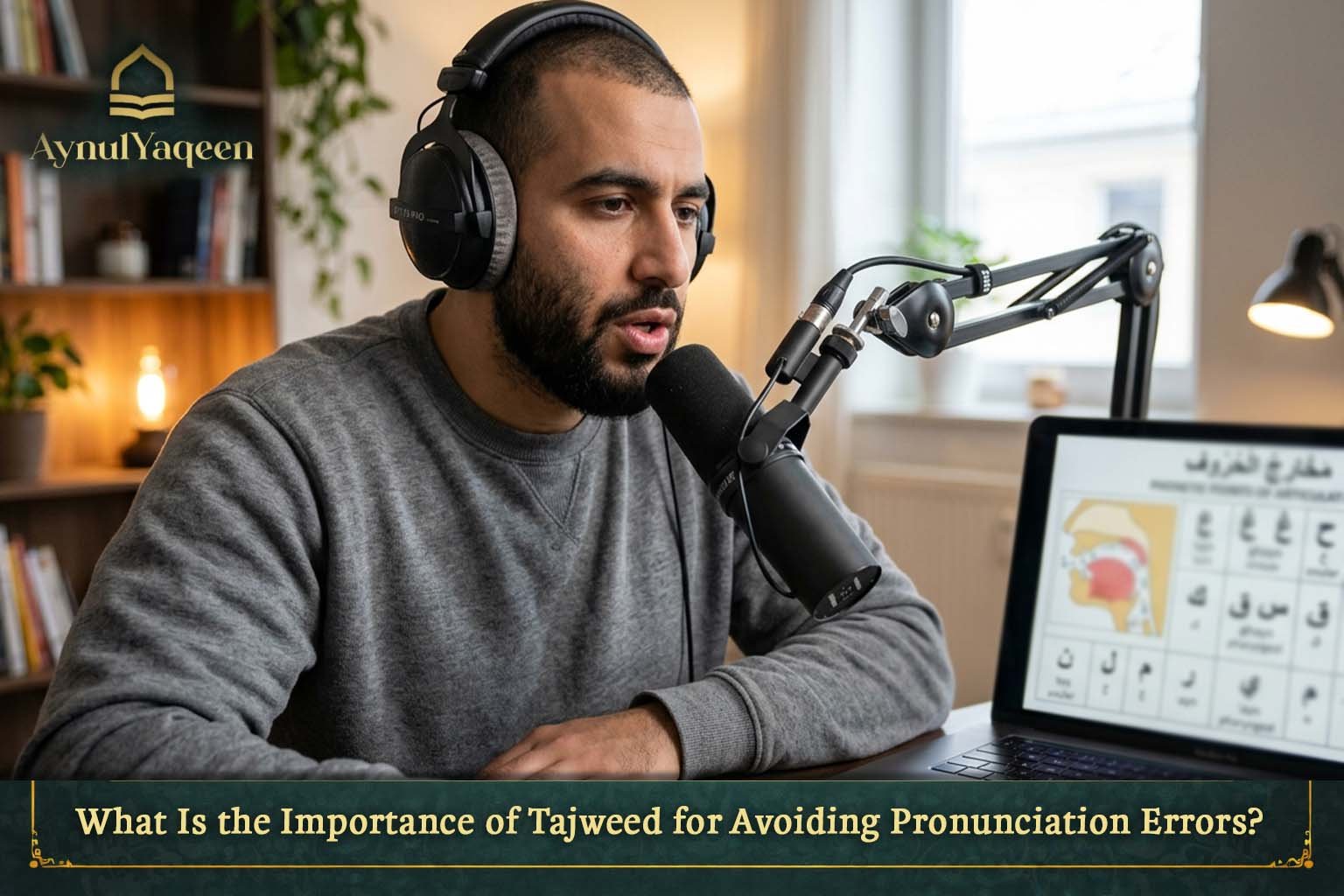
Pronunciation mistakes in Quran reading are not all identical. Some are obvious, while others are subtle and may only become noticeable to an experienced teacher.
Traditional Tajweed discussions often distinguish between Lahn Jaliyy, meaning an obvious error, and Lahn Khafiyy, meaning a less apparent error.
An obvious mistake may involve changing a letter or vowel in a way that affects the word. A subtle error may involve failing to apply a particular recitation rule correctly, such as an appropriate ghunnah or elongation.
Understanding this distinction helps students recognize that accuracy develops in stages.
How Does Tajweed Help Correct Lahn Jaliyy?
Lahn Jaliyy can involve mistakes that are immediately noticeable in the pronunciation of Quranic words. For example, confusing one Arabic letter with another can change the sound of the word and potentially affect its meaning.
The first priority for a beginner should therefore be accurate letter recognition and articulation.
Students can work on this through:
- Listening to a qualified Quran teacher.
- Repeating individual letters.
- Practicing difficult letter pairs.
- Reading short Quranic passages.
- Recording their own recitation for review.
- Receiving direct pronunciation correction.
As these habits become consistent, many common mistakes become easier to identify.
How Does Tajweed Address Subtle Recitation Mistakes?
Subtle mistakes may not change the written word, yet they can affect the quality and correctness of recitation. Examples include incorrect ghunnah duration, inappropriate elongation, or failure to apply certain letter characteristics.
For that reason, advanced learners should continue receiving feedback even after they become comfortable reading the Quran.
In other words, what is the importance of tajweed cannot be reduced to correcting beginners. Tajweed remains useful throughout the learner’s development.
What Is the Importance of Tajweed for Preserving Quranic Recitation?
The Quran has been transmitted through both written and oral traditions. Recitation has historically been learned directly from teachers, allowing students to hear pronunciation rather than relying only on written symbols.
Tajweed contributes to this oral learning tradition by providing a framework for describing how Quranic sounds are produced.
Rules involving makharij, sifat, ghunnah, madd, qalqalah, tafkhim, tarqiq, and waqf help students pay attention to specific aspects of recitation.
This does not mean that Tajweed itself is the only reason for the preservation of the Quran. Rather, Tajweed is one part of the broader scholarly and educational tradition through which Quranic recitation has been taught and practiced.
Tajweed Rules and What They Help Protect
| Tajweed area | Main purpose |
|---|---|
| Makharij | Helps identify correct articulation points |
| Sifat al-Huruf | Describes characteristics of Arabic letters |
| Ghunnah | Guides nasal sound application |
| Madd | Regulates appropriate elongation |
| Qalqalah | Helps produce the characteristic echoing sound |
| Tafkhim | Helps maintain required heaviness |
| Tarqiq | Helps maintain required lightness |
| Waqf | Guides appropriate stopping and continuation |
Learning these areas progressively gives students a clearer understanding of how different elements of recitation work together.
What Is the Importance of Tajweed for Understanding Quranic Words?
Correct pronunciation and understanding are closely connected when reading Arabic. A learner who repeatedly mispronounces a word may also struggle to recognize it when hearing the Quran.
Tajweed does not replace Quranic Arabic studies, but it can support the learner’s familiarity with Quranic vocabulary and sounds.
For instance, when students repeatedly hear and correctly pronounce a particular word, they become more comfortable recognizing its sound pattern. Over time, this can make listening and reading feel more natural.
Therefore, what is the importance of tajweed for Quran learners is not limited to pronunciation. It can also contribute to stronger familiarity with the sound structure of Quranic Arabic.
Still, students should distinguish between Tajweed and Arabic language comprehension. A person can learn correct Quran recitation without becoming fluent in Arabic, while Arabic fluency does not automatically guarantee accurate Tajweed.
What Is the Importance of Tajweed for Khushu’ During Recitation?
Quran recitation is not merely a reading exercise. For Muslims, it is an act of worship and an opportunity to reflect upon Allah’s words.
When a reader struggles with basic pronunciation, attention can become focused on individual sounds rather than the meaning and spiritual experience of the verses. As pronunciation becomes more comfortable, the reader may find it easier to concentrate.
This provides another perspective on what is the importance of tajweed. Tajweed can help reduce uncertainty during recitation and allow the learner to read with greater confidence.
Careful recitation also encourages the reader to slow down instead of rushing through verses. That measured approach can create more space for reflection and attentiveness.
Nevertheless, spiritual concentration depends on more than pronunciation alone. Understanding the meaning of the Quran, sincerity, reflection, and presence of heart all contribute to a meaningful recitation experience.
What Is the Importance of Tajweed During Salah?
Tajweed knowledge is particularly relevant to Muslims who recite Quranic passages during Salah.
The verses recited in prayer should be pronounced carefully. This is especially important when a pronunciation mistake could alter the intended word.
For that reason, someone who regularly recites Al-Fatihah and other surahs in Salah can benefit from studying correct articulation and common pronunciation errors.
Learning Tajweed can also increase confidence. Instead of wondering whether a particular letter or elongation is being pronounced correctly, the student can rely on learned principles and teacher feedback.
At Aynulyaqeen Quran Academy, learners can connect their Tajweed practice with the Quranic passages they already use in daily worship. This practical approach can make the lessons more relevant and easier to apply.
What Is the Importance of Tajweed for Quran Memorization?
Tajweed is particularly valuable for students who are memorizing the Quran. Memorization is not simply the ability to remember the sequence of words. The student also needs to develop accurate recitation habits.
If a learner memorizes a passage while repeatedly making the same pronunciation mistake, correcting that mistake later can require considerable effort.
Therefore, a useful memorization routine combines:
- Correct reading before memorization.
- Careful listening to the passage.
- Repetition with a qualified teacher.
- Memorization in manageable portions.
- Regular review.
- Correction of mistakes during revision.
This explains what is the importance of tajweed for Hifz students: accurate recitation should be developed alongside memorization rather than treated as an unrelated skill.
Why Should Tajweed Be Learned Before Memorizing Large Portions?
Starting memorization with a strong pronunciation foundation can prevent incorrect patterns from becoming deeply established.
For beginners, that may mean spending additional time on Arabic letters and basic rules before attempting large portions of the Quran.
Once the student becomes comfortable with the sounds, memorization can proceed with greater confidence.
At Aynulyaqeen Quran Academy, learners interested in Hifz can benefit from combining memorization goals with ongoing recitation correction.
What Is the Importance of Tajweed for Children?
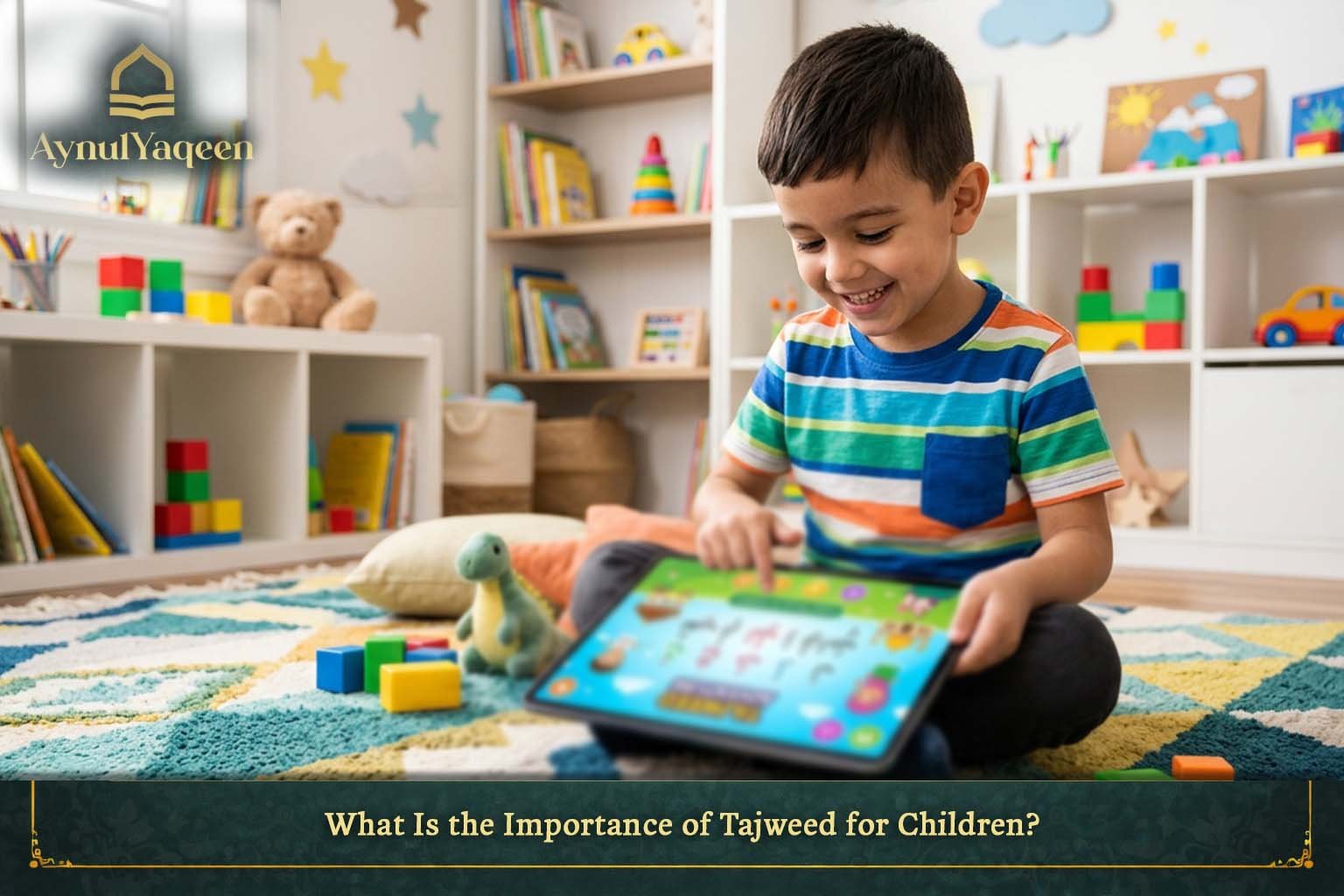
Children can benefit from Tajweed because pronunciation habits often develop through repetition. When correct sounds are introduced early, children have more opportunities to practice them before incorrect patterns become difficult to change.
However, teaching Tajweed to children should not feel like an overwhelming grammar lesson. Young learners usually respond better when lessons are short, interactive, and appropriate for their age.
A child may begin with:
- Arabic letter recognition.
- Correct pronunciation.
- Simple vowel sounds.
- Short Quranic words.
- Basic elongation.
- Simple stopping rules.
- Gradual Quran reading practice.
Parents should also understand that every child develops at a different pace. Some children quickly distinguish difficult letters, while others need more repetition.
The answer to what is the importance of tajweed for children is therefore includes both accuracy and habit formation.
What Is the Importance of Tajweed for Adult Learners?
Adults sometimes hesitate to study Tajweed because they believe they are too old to improve their pronunciation. In reality, adults can develop better Quran reading habits through structured practice.
The learning process may take longer for some sounds because adults already have established pronunciation patterns. Nevertheless, consistent repetition can gradually improve articulation and fluency.
Adult learners may also have different goals. One person may want to correct Al-Fatihah, while another may want to prepare for Hifz or improve an already advanced recitation.
A personalized learning plan can therefore be more effective than forcing every student through exactly the same sequence.
For learners asking what the importance of tajweed is, the practical answer is especially clear: it gives adults a structured method for identifying and correcting pronunciation problems instead of trying to improve randomly.
What Is the Importance of Tajweed for Non-Arabic Speakers?
Non-Arabic speakers often face pronunciation challenges because their native languages may not contain some Arabic sounds.
Letters such as ع, ح, خ, ق, ص, ض, ط, and ظ can require focused practice. Transliteration can also create problems because English or another language may represent an Arabic sound using a letter that does not reproduce the exact pronunciation.
Tajweed helps overcome this challenge by teaching sound production directly.
Common Difficulties for Non-Arabic Quran Learners
Some frequent challenges include:
- Confusing ح with ه.
- Replacing ع with a familiar sound.
- Pronouncing ق too similarly to ك.
- Making heavy letters too light.
- Shortening required elongations.
- Missing ghunnah.
- Stopping at unsuitable points.
- Reading too quickly.
Rather than becoming discouraged, learners can work on these challenges one at a time.
A qualified teacher can listen carefully, identify the exact issue, demonstrate the correct sound, and allow the student to repeat it.
That is another important answer to what the importance of tajweed is: it provides a practical system for solving pronunciation problems that may otherwise remain unnoticed.
What Is the Importance of Tajweed for Building Confidence?
Confidence is often overlooked when discussing Quran education. A student who worries about making mistakes may avoid reading aloud or hesitate when asked to recite.
Tajweed lessons can provide a safe environment for making mistakes and correcting them.
Instead of expecting perfection immediately, learners can measure progress through small improvements. Perhaps a difficult letter becomes clearer this week. Next week, the student may improve a Madd rule. Later, correct application becomes more automatic.
This gradual progress can make Quran reading less intimidating.
At Aynulyaqeen Quran Academy, students can use regular guided practice to develop greater familiarity with Tajweed principles while working according to their individual level.
What Is the Importance of Tajweed in Developing a Consistent Learning Routine?
Learning Tajweed is most effective when practice becomes part of a regular routine.
Studying once and then stopping for several weeks makes it difficult to build pronunciation habits. On the other hand, even a short practice session repeated consistently can reinforce what was learned.
A simple routine may include:
- Five minutes of listening.
- Ten minutes of focused pronunciation.
- Ten minutes of Quran reading.
- A short review of one Tajweed rule.
- A final repetition of previously corrected mistakes.
The exact schedule can vary according to the learner’s circumstances. What matters most is consistency.
Additionally, students should avoid trying to master every rule simultaneously. A focused approach makes it easier to recognize progress and identify areas that need additional attention.
What Is the Importance of Tajweed When Learning Through an Online Teacher?
Online Tajweed learning can provide direct access to qualified teachers without requiring students to travel to a physical classroom.
However, the quality of the learning experience depends heavily on the teaching method. Tajweed requires more than watching recorded explanations because pronunciation correction is personal.
A useful online lesson should give the learner opportunities to:
- Hear the correct pronunciation.
- Repeat the sound.
- Read Quranic examples.
- Receive immediate correction.
- Ask questions.
- Review previous mistakes.
- Practice independently between lessons.
This is why what is the importance of tajweed should also be considered when selecting an online Quran learning program. The right environment should make practical recitation a central part of the learning experience.
Aynulyaqeen Quran Academy can position its Tajweed instruction around guided learning, regular practice, and individualized pronunciation feedback.
How Can You Start Learning Tajweed Step by Step?
Once you understand what is the importance of Tajweed, the next question is how to begin.
There is no need to memorize an advanced list of rules on the first day. A gradual approach is usually easier to maintain.
Step 1: Check Your Quran Reading Level
Begin by reading a short passage aloud. This helps identify whether the main challenge is letter recognition, pronunciation, fluency, or rule application.
Step 2: Study Makharij
Learn where Arabic letters are articulated. This foundation helps distinguish letters that may initially sound similar.
Step 3: Practice Sifat
After understanding articulation points, study important letter characteristics. This helps learners understand why certain letters sound heavy, light, strong, or soft.
Step 4: Learn Core Tajweed Rules
Gradually study rules involving Noon Sakinah, Tanween, Meem Sakinah, Madd, Ghunnah, Qalqalah, and other relevant topics.
Step 5: Apply Rules to Real Quranic Verses
Rules become meaningful when they are applied during actual Quran reading. Each lesson should therefore include practical recitation.
Step 6: Review and Correct
Regular revision prevents old mistakes from returning. Recording difficult passages and reviewing teacher feedback can also be useful.
What Is the Importance of Tajweed in Making Quran Learning More Structured?
Without a clear plan, Quran learners may jump from one rule to another without understanding how the topics connect.
Tajweed creates a progression from basic pronunciation to more advanced recitation.
For example, students usually need to recognize letters before they can reliably apply rules involving those letters. Similarly, they need to understand basic vowel sounds before more complex elongation topics become comfortable.
A structured curriculum can therefore prevent information overload.
At Aynulyaqeen Quran Academy, students can follow a progressive path that connects theoretical explanations with practical Quran reading.
The purpose is not to make the learner memorize technical terms simply for the sake of memorizing them. Instead, each rule should answer a practical question: How should I pronounce this part of the Quran correctly?
What Is the Importance of Tajweed Beyond Beautiful Recitation?
Beautiful recitation is often associated with Tajweed, but beauty should not be the only reason to study it. The real value of Tajweed lies in accurate pronunciation, proper articulation, and careful application of recitation rules.
A melodious voice does not automatically mean that every letter and rule is being applied correctly. Conversely, a beginner does not need a naturally beautiful voice to benefit from Tajweed. Accuracy should come first, while fluency and confidence can develop through regular practice.
Students who are beginning their Quran journey may also benefit from guidance such as an Egyptian quran teacher online when they need structured instruction and pronunciation correction.
This distinction is important because some students compare their voices with famous reciters and become discouraged. Quran learning should instead focus on correctness, sincerity, improvement, and respect for the words being recited.
Thus, what is the importance of tajweed goes far beyond vocal performance. It is primarily about disciplined and accurate Quran recitation.
What Is the Importance of Tajweed for Long-Term Quran Reading?
Tajweed is not something that becomes irrelevant once a student completes a course. The rules continue to support Quran reading throughout life. As learners become more experienced, they can revisit difficult passages, refine their articulation, and improve their awareness of subtle pronunciation details.
Long-term practice also helps make correct recitation more natural. Instead of consciously thinking about every rule, experienced readers can gradually apply many principles more comfortably.
For learners who are also interested in understanding their broader Islamic studies, exploring What Are the Five Pillars of Islam? can provide useful context alongside Quran learning.
Nevertheless, occasional review remains valuable. Even advanced students can benefit from listening to qualified reciters and receiving feedback.
For that reason, understanding what is the importance of tajweed can change the way a person approaches lifelong Quran learning. Tajweed becomes an ongoing practice rather than a short-term academic requirement.
Choosing the Right Tajweed Learning Environment
A good Tajweed program should match the learner’s level, goals, schedule, and learning needs.
Before joining a course, students can consider several practical questions:
- Does the teacher correct pronunciation directly?
- Is the course suitable for beginners?
- Can lessons be adapted to the student’s level?
- Is there enough practical Quran reading?
- Does the program include revision?
- Can students ask questions during lessons?
- Is progress monitored over time?
- Are children and adults taught according to their different needs?
These questions are more useful than choosing a program based solely on its course title.
Students who are unsure whether they need a native-speaking instructor can also explore Do I need a native Arabic tutor to learn Quran when considering different Quran learning options.
For someone researching what is the importance of tajweed, the learning environment matters because Tajweed is a practical skill. The student needs opportunities to hear, pronounce, receive correction, and repeat.
Learning Tajweed with Aynulyaqeen Quran Academy
Aynulyaqeen Quran Academy can serve learners who want to develop more accurate and confident Quran recitation through structured online instruction.
A practical Tajweed program can support different types of students, including beginners who are still working on Arabic letters, Quran readers who want to correct recurring mistakes, children developing their first recitation habits, and Hifz students who need accurate pronunciation during memorization.
The learning process should remain gradual. Students can start with their current reading ability rather than feeling pressured to begin at an advanced level.
For many learners, individualized feedback is particularly valuable because pronunciation mistakes are not always easy to identify independently. A teacher can notice whether a letter is coming from the correct articulation point, whether a sound is too heavy or too light, and whether a rule is being applied consistently.
Students who prefer independent practice may also find Can I learn Quran with Tajweed by myself useful when deciding how much of their learning can be completed through self-study.
As students continue practicing, they can gradually build stronger Quran reading habits. The ultimate purpose is not simply to complete a Tajweed curriculum. Instead, the goal is to help students recite the Quran more accurately, confidently, and attentively.
A Simple Daily Tajweed Practice Plan
After learning what is the importance of tajweed, students often wonder how they can practice outside their lessons.
A simple routine can make a significant difference. You do not necessarily need a long study session every day. What matters is focused repetition and consistent application.
Try dividing your practice into the following stages:
- Listen: Choose a short Quranic passage and listen carefully to a qualified reciter.
- Observe: Pay attention to difficult letters, elongations, nasal sounds, and stopping points.
- Repeat: Recite the passage slowly while concentrating on the target rule.
- Record: If possible, record your voice and compare it with your teacher’s correction.
- Review: Repeat the same passage later rather than immediately moving to something new.
- Apply: Use the rule in another verse to make sure you understand it in context.
Gradually, these steps can turn Tajweed from a theoretical subject into a natural part of Quran reading. Students who combine Tajweed with memorization can also benefit from understanding how long does it take to memorize the Quran and creating realistic practice expectations.
Key Benefits of Learning Tajweed
The answer to what the importance of Tajweed is can be summarized through several practical benefits:
- It supports accurate pronunciation.
- It helps distinguish Arabic letters with similar sounds.
- It reduces common Quran reading errors.
- It teaches students how recitation rules work.
- It supports careful and measured Quran reading.
- It can strengthen confidence when reciting.
- It is valuable for Quran memorization students.
- It helps non-Arabic speakers handle unfamiliar sounds.
- It encourages attentive reading.
- It provides a structured path for continuous improvement.
- It can help learners become more conscious of their recitation.
- It supports better application of rules during practical Quran reading.
These benefits work together rather than existing separately. A student who improves pronunciation may become more confident, while increased confidence may encourage more frequent practice. Over time, consistent application can make Tajweed an established part of the learner’s Quran reading routine.
Common Mistakes to Avoid While Learning Tajweed
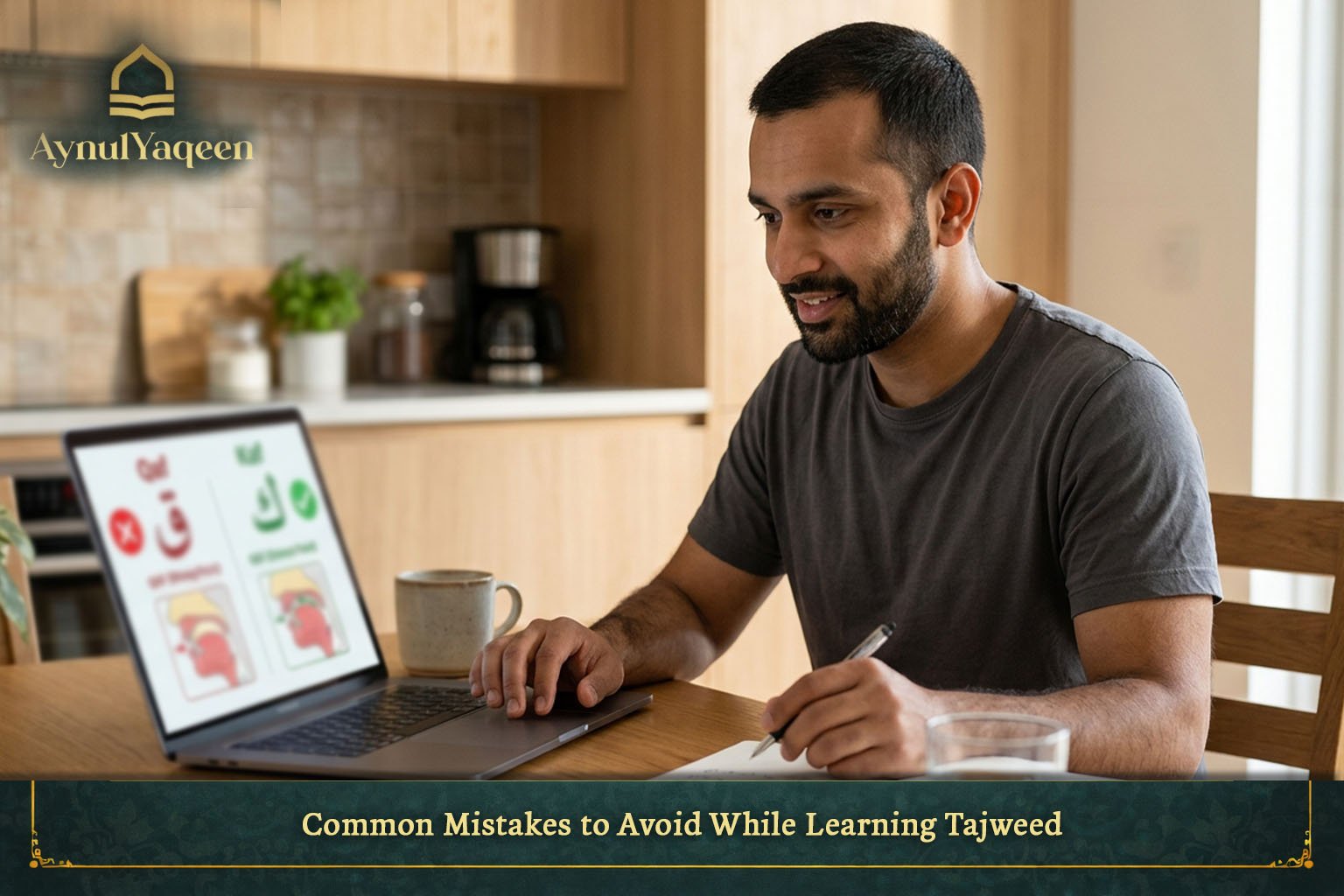
Understanding what is the importance of Tajweed is only the beginning. Learners also need patience, consistent practice, and a practical approach to avoid common mistakes.
Trying to Learn Every Rule at Once
When learning what the importance of Tajweed is, avoid trying to memorize every rule immediately. Focus on one principle at a time, then practice it with Quranic words and verses before moving forward.
Depending Only on Transliteration
Understanding what is the importance of tajweed also means recognizing that transliteration cannot fully represent Arabic pronunciation. Beginners may use it temporarily, but direct Arabic reading and listening practice should remain the main focus.
Practicing Without Feedback
One part of what is the importance of tajweed is learning to recognize and correct pronunciation errors. Some mistakes are difficult to hear independently, so feedback from a qualified teacher can help identify problems and improve accuracy.
Rushing Through Verses
Knowing what is the importance of tajweed should encourage learners to prioritize accuracy over speed. Reading too quickly can lead to missed pauses, incorrect pronunciation, and poor application of Tajweed rules. Practice slowly until accuracy becomes more natural.
Focusing Only on Theory
Learning what is the importance of tajweed requires practical application, not just memorizing definitions. After studying a rule, practice it in actual Quranic passages and repeat the examples until the rule becomes easier to apply.
Ignoring Consistency
Another important part of what is the importance of tajweed is understanding the value of regular practice. Short, consistent sessions can be more useful than occasional long lessons. Review previous rules and work on one pronunciation challenge at a time.
Comparing Your Progress With Others
Understanding what is the importance of tajweed should encourage personal progress rather than comparison. Every learner develops at a different pace. Focus on your own improvement in pronunciation, fluency, and confidence.
Neglecting Listening Practice
Listening also supports what is the importance of Tajweed because it helps learners recognize how Tajweed rules sound during real Quran recitation. Listen to short passages carefully, then repeat them while paying attention to pronunciation and pauses.
Frequently Asked Questions About What Is the Importance of Tajweed
This section answers common questions about Tajweed, its benefits, and how learners can improve their Quran recitation through consistent practice.
Can Tajweed Improve My Quran Listening Skills?
Yes. Studying the importance of tajweed is can help you recognize Arabic sounds, elongations, nasalization, and other recitation features more accurately. Regular listening can strengthen your ability to notice these details.
Should I Practice Tajweed With the Same Surahs?
When learning what is the importance of tajweed, familiar surahs can make practice easier because you already know the words. However, gradually practicing new passages helps you apply the same rules in different Quranic contexts.
Can I Record My Own Recitation?
Yes. Recording yourself can support what is the importance of tajweed by helping you notice pronunciation, rhythm, pauses, and fluency. However, recordings should complement teacher feedback rather than replace it.
How Can Parents Encourage Children to Practice Tajweed?
Parents can reinforce what is the importance of tajweed by keeping practice short, positive, and consistent. Listening together, encouraging gradual improvement, and practicing familiar surahs can make Quran learning more enjoyable and manageable.
In conclusion, Understanding what is the importance of tajweed helps Quran learners recognize the value of accurate pronunciation, proper articulation, and careful recitation. Tajweed is not simply about memorizing a list of rules; it is a practical skill that develops through regular reading, listening, repetition, and correction.
When learners understand what is the importance of tajweed, they can approach their Quran studies with clearer goals and greater confidence. Small, consistent practice sessions can gradually improve pronunciation and make difficult rules easier to apply.
For beginners, children, adults, and non-Arabic speakers, learning what the importance of tajweed is can provide a structured path toward better Quran recitation. With guidance from a qualified teacher and regular practice, learners can identify mistakes and work on them step by step.
Ultimately, what is the importance of tajweed is reflected in developing a more accurate, confident, and mindful approach to reading the Quran. By understanding what is the importance of tajweed, learners can make Tajweed a meaningful part of their ongoing Quran learning journey.
