

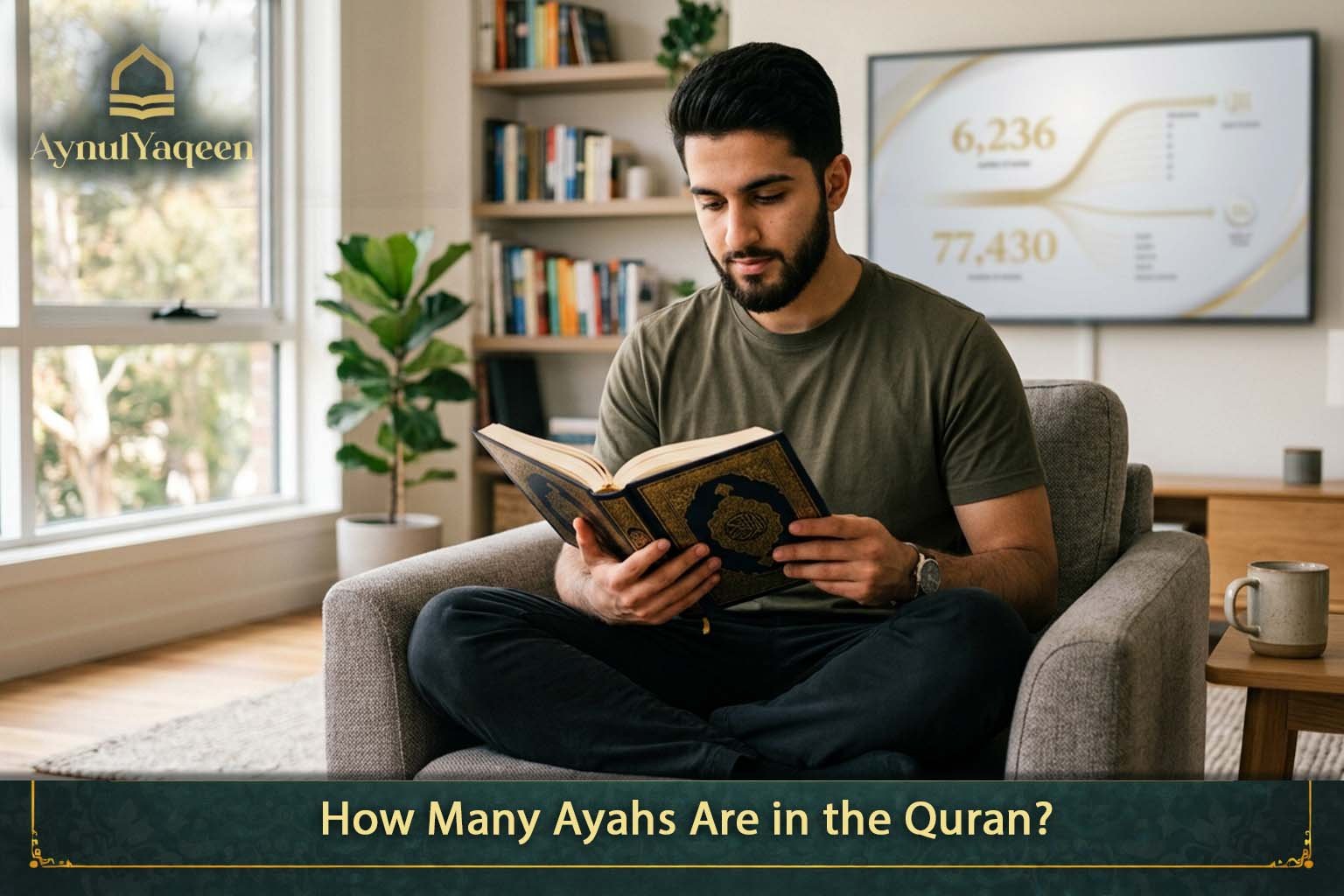
How many ayahs are in the Quran is one of the most common questions asked by Muslims, Quran students, and anyone beginning to explore the structure of the Holy Quran. The commonly used Kufan enumeration counts 6,236 ayahs, and this is the numbering followed by the widely used Madinah Mushaf.
However, the question has a little more depth because classical Quranic scholarship recognizes different systems for determining where one ayah ends and another begins. These variations do not mean that Muslims have different Qurans or that the wording of the Quran changes. Instead, they concern the traditional division of the same revealed text into numbered verses.
For a learner asking how many ayahs are in the Quran, the simplest answer is 6,236 according to the Kufan system. Nevertheless, understanding why other numbers sometimes appear can prevent confusion. It also helps students distinguish between the number of surahs, the number of ayahs, and the different traditional methods of counting them.
A clear explanation is especially useful for anyone studying the Quran regularly. At Aynulyaqeen Quran Academy, learners can use this kind of background knowledge to understand the structure of the Quran while developing their reading, recitation, and memorization skills.
How Many Ayahs Are in the Quran According to the Common Mushaf?
So, how many ayahs are in the Quran according to the Quran numbering most readers see today? The answer is 6,236 ayahs in the Kufan enumeration. This is the system associated with the traditional Kufan count and is used in the widely circulated Madinah Mushaf.
That number refers to the numbered verses of the Quran. It should not be confused with the number of words or letters in the Quran. It also does not mean that every historical system of verse enumeration gives exactly the same total.
The Quran contains 114 surahs, while the number of numbered ayahs depends on the traditional counting system being referenced. Modern Quran resources commonly display the familiar verse numbering used by millions of readers around the world. For example, Quran.com lists Al-Baqarah as containing 286 ayahs and Al-Fatihah as containing seven.
Therefore, when someone asks how many ayahs are in the Quran, 6,236 is the practical answer for the commonly used Kufan numbering system.
Learn Online with Aynulyaqeen Quran Academy
Choosing the right online Quran academy can make a significant difference in your learning journey. Aynulyaqeen Quran Academy provides structured Quran courses for beginners and advanced learners, focusing on accurate Quran reading, Tajweed, memorisation, and Islamic studies.
With qualified teachers, flexible class schedules, and personalised one-on-one lessons, students of all ages can learn at their own pace while building confidence in reciting and understanding the Holy Quran from anywhere in the world.

Why Is 6,236 the Number Most Readers See?
The number 6,236 is not an arbitrary calculation made by adding up lines in a modern printed book. Rather, it belongs to the traditional science of counting Quranic verses, known as ʿadd al-āy.
This discipline deals with identifying the boundaries of individual ayahs. Traditional scholars transmitted information about where verses begin and end, and different regional traditions preserved slightly different enumerations. The Kufan system eventually became the numbering used in the standard Mushaf editions familiar to many readers today.
Consequently, the answer to how many ayahs are in the Quran can be stated simply while still acknowledging the history behind the number.
For students, this distinction is valuable. It prevents the mistaken idea that different verse totals represent different versions of the Quran. They are better understood as differences in traditional verse division.
How Many Ayahs Are in the Quran If Different Counting Systems Are Considered?
A more advanced answer to how many ayahs are in the Quran requires looking at the traditional schools of verse enumeration.
Classical Quranic scholarship recognized regional counting traditions associated with places such as:
- Kufa
- Basra
- Damascus
- Makkah
- Madinah
These traditions sometimes identify a verse boundary in a different location. As a result, a passage that is numbered as one ayah under one system may be divided differently under another.
This is important because the word ayah can refer both to a verse as a textual unit and to the numbered divisions used in a particular Mushaf. The underlying Quranic wording does not become longer or shorter simply because the numbering changes.
For that reason, asking how many ayahs are in the Quran without specifying the counting tradition can produce different historical answers.
Modern readers normally do not need to memorize every enumeration. However, knowing that these traditions exist makes it much easier to understand why scholarly references may occasionally show a different number.
How Many Ayahs Are in the Quran in the Kufan Enumeration?
For the Kufan enumeration, how many ayahs are in the Quran has a standard answer: 6,236.
This count is particularly important because it is the numbering used in the widely circulated Madinah Mushaf. Islamic Awareness notes that the numbering system of the Mushaf follows the Kufan system and gives a total of 6,236 verses.
The same source explains that this traditional numbering ultimately traces through an established scholarly transmission rather than being a modern editorial invention.
As a result, when a learner opens a standard printed Quran and sees verse numbers throughout the pages, those numbers generally correspond to this system.
For everyday Quran study, therefore, how many ayahs are in the Quran can be answered with 6,236 without needing a long qualification. The historical explanation becomes relevant when comparing different Mushaf traditions or studying Quranic sciences.
Why Do Some Sources Give Different Numbers?
If you search for how many ayahs are in the Quran, you may encounter totals that differ from 6,236. At first, this can seem confusing. However, the explanation is connected to the traditional science of verse counting.
The boundary between two ayahs is not always represented in exactly the same way by every historical counting tradition. Quran.com, for instance, notes that Al-Fajr has 30 ayahs in the Kufan and Shami counts, while other traditional counts give it 32 or 29.
Similarly, Al-Naba is described as having 40 ayahs according to the people of Madinah, Syria, and Basra, while the people of Makkah and Kufa count it as 41.
These examples demonstrate an important principle: a difference in verse numbering does not automatically indicate a difference in Quranic wording.
Therefore, when researching how many ayahs are in the Quran, it is better to ask which traditional enumeration a source is using before comparing numbers.
Does a Different Ayah Count Mean a Different Quran?
No. A different verse count does not by itself indicate a different Quranic text.
The issue concerns the placement of verse boundaries and numbering. A reader following one enumeration may encounter a passage numbered as one ayah, while another enumeration may divide that same passage differently.
This distinction is particularly important for beginners. Someone who sees a Quranic reference written with a different verse number should not immediately assume that the text itself has changed.
The traditional verse-counting systems belong to the scholarly history of Quranic transmission and notation. The written text, recitation traditions, and verse numbering are related subjects, but they should not be treated as identical.
That is why the question how many ayahs are in the Quran has both a simple answer for everyday readers and a more detailed answer for students of Quranic sciences.
How Many Ayahs Are in the Quran and How Many Surahs Does It Have?
Another common source of confusion is the difference between surahs and ayahs. The Quran has 114 surahs, while the commonly used Kufan enumeration contains 6,236 ayahs. Quran.com lists all 114 surahs and their commonly used verse counts.
A surah is a chapter of the Quran, while an ayah is a verse within a surah. Consequently, one surah can contain only a few ayahs, while another can contain hundreds.
For example:
- Al-Fatihah contains 7 ayahs.
- Al-Baqarah contains 286 ayahs.
- Al-Kawthar contains 3 ayahs.
- Al-Ikhlas contains 4 ayahs.
- An-Nas contains 6 ayahs.
Quran.com confirms the commonly used counts for these surahs in its complete surah listing.
Thus, how many ayahs are in the Quran is a question about the complete collection of Quranic verses, whereas 114 is the number of chapters.
How Many Ayahs Are in the Quran’s Longest Surah?
When exploring how many ayahs are in the Quran, many learners naturally ask which surah contains the largest number of verses.
Surah Al-Baqarah is the longest surah by verse count in the standard enumeration, with 286 ayahs. Quran.com identifies Al-Baqarah as the second surah and records 286 ayahs.
Its length makes it an important part of Quran study, particularly for learners working on structured reading or memorization plans.
However, the number of ayahs in a surah does not determine its importance. Each surah has its own themes, lessons, language, and guidance. A student should therefore avoid treating verse count as a measure of spiritual or educational value.
For someone researching how many ayahs are in the Quran, Al-Baqarah provides a useful reference point because its 286 verses make up a substantial portion of the total.
How Many Ayahs Are in the Quran’s Shortest Surahs?
The other side of the question involves the shortest surahs.
Surah Al-Kawthar contains only three ayahs in the standard numbering. Quran.com lists it as surah 108 with three ayahs.
Several other short surahs contain only a handful of verses. This wide variation makes the Quran structurally diverse. Some surahs extend across many pages, while others can be recited within a very short period.
This range is useful for Quran learners because it allows study plans to be adapted to different goals. A beginner may start with shorter surahs, while an advanced learner may work through longer passages.
Consequently, understanding how many ayahs are in the Quran can be the beginning of a broader exploration of how the Quran is organized.
How Many Ayahs Are in the Quran and What Is the Role of Basmalah?
The question of the basmalah, or Bismillāh al-Raḥmān al-Raḥīm, requires careful wording because scholars differed about its status as an ayah in different contexts.
For example, Quran.com explains that Al-Fatihah is regarded as seven ayahs, while the details of how the basmalah is counted differ among the Madinan, Makkan, and Kufan enumerations.
This means it is not accurate to explain the issue simply by saying that every basmalah outside Al-Fatihah is universally treated in exactly the same way by every scholarly tradition.
For readers asking how many ayahs are in the Quran, the practical point is that the standard Mushaf numbering already reflects a specific traditional enumeration. There is no need for an individual reader to add every written basmalah to the displayed verse total.
The question becomes more significant when studying ʿadd al-āy and the history of Quranic notation.
How Many Ayahs Are in the Quran Without Counting Every Basmalah as a Separate Verse?
A common internet calculation attempts to add the basmalah appearing at the beginning of surahs to the standard verse count. This can produce another number, but it does not represent the standard verse numbering used in the commonly circulated Mushaf.
Therefore, if the purpose is to answer how many ayahs are in the Quran according to the numbering printed in a standard Mushaf, the appropriate answer remains 6,236 under the Kufan enumeration.
It is better to distinguish between written elements that appear in the Mushaf and numbered ayahs. Not every visual division on a Quran page should automatically be treated as a separately numbered verse.
This distinction also helps explain why different calculations found online should not be compared without checking their methodology.
Is 6,666 the Number of Ayahs in the Quran?
The number 6,666 is sometimes repeated when people ask how many ayahs are in the Quran. However, it should not be presented as the standard verse count used in the commonly circulated Mushaf.
The commonly used Kufan enumeration gives 6,236 verses.
Therefore, a learner who encounters 6,666 should understand that this is not the verse number shown by the standard Kufan-based numbering of the Mushaf.
The safest approach is to identify the counting system being used rather than relying on a popular number repeated without a source.
For educational content, this distinction matters because readers often search the exact question How many ayahs are in the Quran and expect a clear answer. Giving multiple numbers without explaining their origins can create more confusion instead of solving the question.
How Many Ayahs Are in the Quran According to Modern Quran Resources?
Modern digital Quran resources generally make the verse numbering easy to verify.Quran.com, for example, provides a complete list of the 114 surahs with their verse counts and displays individual ayahs using their established numbering.
The platform also provides complete Quran text, translations, tafsir resources, recitations, and study features.
For someone researching how many ayahs are in the Quran, these resources are useful because they allow the reader to move from a general total to the exact number of verses in each surah.
A learner can therefore verify that the Quran is divided into 114 surahs and can explore how those surahs differ in length.
How Many Ayahs Are in the Quran for Someone Planning Memorization?
Knowing how many ayahs are in the Quran can also help students understand the scale of a memorization project. However, verse count alone is not always the best way to measure memorization progress. For learners who are beginning their memorization journey, understanding what is the best age for Quran memorization is can also help families choose a suitable learning approach.
An ayah can be very short or quite long. Two students who memorize the same number of ayahs may therefore have studied very different amounts of Quranic text.
A practical memorization plan may instead consider:
- The number of lines memorized.
- The amount of new material learned each week.
- Daily revision requirements.
- The student’s reading ability.
- The difficulty of the selected passages.
- Accuracy in pronunciation and recitation.
- The ability to retain previously memorized portions.
At Aynulyaqeen Quran Academy, learners can approach Quran study as a structured process rather than treating the total number of ayahs as the only measure of progress.
This makes the answer to how many ayahs are in the Quran useful as background information without turning the number into a rigid memorization target.
How Many Ayahs Are in the Quran and Why Does Verse Numbering Matter?
Verse numbering is useful for many practical reasons. First, it makes it easier to locate a particular passage. Instead of describing an entire paragraph of Quranic text, a teacher can refer to a surah and ayah number. Understanding how many surahs are in the Quran also gives beginners a clearer picture of how the Quran is organized.
Second, numbering helps students organize lessons and revision schedules. A teacher might assign a particular group of ayahs for reading, memorization, Tajweed practice, or reflection.
Third, verse numbers make Quranic references easier to communicate across books, websites, classrooms, and digital applications.
That is why understanding how many ayahs are in the Quran is more than memorizing one number. It introduces the learner to the organizational system used to navigate the Quran.
How Many Ayahs Are in the Quran and What Should Beginners Remember?
A beginner does not need to study every historical detail before starting Quran lessons. The most useful points are straightforward. Learners who are also working on correct recitation can explore what is the importance of tajweed to understand why pronunciation and Quranic recitation rules matter.
Remember these facts:
- The Quran contains 114 surahs.
- The commonly used Kufan enumeration contains 6,236 ayahs.
- Traditional verse-counting systems can differ in some verse boundaries.
- Differences in numbering do not mean that the Quranic text itself has changed.
- Al-Baqarah has 286 ayahs in the standard numbering.
- Al-Fatihah has 7 ayahs.
- Al-Kawthar has 3 ayahs.
Once these basics are clear, the learner can move on to more important practical goals, such as improving recitation, understanding meanings, learning Tajweed, and developing a consistent study routine.
In other words, the question of how many ayahs are in the Quran is a useful starting point, but it is not the end of Quran learning.
How Aynulyaqeen Quran Academy Can Support Quran Learning
Learning about the structure of the Quran can make a student’s study journey more organized. Aynulyaqeen Quran Academy can be naturally relevant for learners who want to move from general Quran knowledge toward regular study and guided learning.
A structured learning environment can help students work on several areas, including Quran reading, pronunciation, memorization, and recitation. Families looking for an online option for younger learners may also consider how can a girl child learn Quran online when planning a suitable learning routine.
Instead of focusing only on completing a certain number of ayahs, students can develop habits that support long-term progress.
For beginners, this approach can make Quran learning less overwhelming. For students who already read the Quran, structured lessons can provide an opportunity to strengthen accuracy and consistency.
The answer to how many ayahs are in the Quran therefore becomes part of a larger learning journey. Knowing that there are 6,236 verses in the common Kufan enumeration gives the learner a sense of the Quran’s overall structure, while a teacher can help translate that knowledge into a realistic study plan.
How Many Ayahs Are in the Quran? The Answer in Simple Terms
If you need a short answer to how many ayahs are in the Quran, the commonly used answer is 6,236 ayahs according to the Kufan enumeration. This is the verse numbering followed by the widely used Madinah Mushaf.
At the same time, historical Quranic scholarship recognizes other systems of verse enumeration. These systems differ in some places because scholars and reciters inherited different traditions concerning where certain ayahs end.
Therefore, seeing another verse total in a scholarly source does not automatically indicate a contradiction or a different Quran. The key is to identify the counting tradition behind the number.
For everyday Quran reading, the 6,236 figure is the most useful answer. For deeper study, the differences in enumeration provide an opportunity to learn more about the scholarly tradition surrounding the Quran.
What Should You Check When You See a Different Quran Verse Count?
When a website, book, or teacher gives a number other than 6,236, do not compare the figures immediately. Instead, check several details.
1. Identify the counting system.
Ask whether the source is referring to the Kufan, Makkan, Madinan, Basran, or another traditional enumeration.
2. Check the Mushaf edition.
Different printed editions can use different conventions for verse numbering.
3. Separate numbering from wording.
A different ayah boundary does not necessarily mean that different words have been added or removed.
4. Look for a reliable scholarly source.
Quranic verse counts should be checked against established Quran resources or works dealing with the science of verse enumeration.
This approach gives a much more accurate way to investigate how many ayahs are in the Quran than relying on a number copied from an unsourced website.
Why does Learning About Quran Structure Help Students?
Understanding Quran structure can improve the learning experience in several ways.
A student who knows the difference between surahs, ayahs, juz, and other organizational divisions can follow lessons more easily. References become clearer, assignments become easier to track, and revision can be organized more systematically.
Moreover, knowing how many ayahs are in the Quran can provide useful context when planning a long-term reading schedule. Someone who wants to complete the Quran within a particular period can divide the reading into manageable portions.
Still, the goal should not be to rush through the text simply to reach a numerical target. Reading with correct pronunciation, understanding the meaning, revising regularly, and maintaining consistency can all be important parts of Quran study.
A thoughtful learning plan can therefore use verse numbers as a practical organizational tool without reducing Quran learning to numbers alone.
Why Does the Number of Quran Ayahs Differ?
The most direct answer to how many ayahs are in the Quran is 6,236 ayahs according to the Kufan enumeration, which is used by the widely circulated Madinah Mushaf.
However, the complete answer requires one important qualification: traditional Quranic scholarship includes different systems for counting verse boundaries. These systems can produce slightly different totals because the location of certain verse endings is counted differently. Quran.com provides examples of individual surahs where regional counting traditions differ.
The Quran itself remains the same revealed text; the variation concerns the traditional numbering of some verse boundaries.
For a beginner, remembering 6,236 is sufficient for everyday reference. For a student of Quranic sciences, the differences in enumeration offer a deeper subject worth studying.
At Aynulyaqeen Quran Academy, this type of foundational knowledge can complement practical Quran education. Once learners understand how the Quran is organized, they can focus more confidently on reading, Tajweed, memorization, revision, and understanding.
Ultimately, asking how many ayahs are in the Quran is not merely a search for a number. It opens the door to understanding how to read the quran for beginners Quran has been organized, referenced, taught, and studied across generations.
Frequently Asked Questions
Find clear answers to common questions about the number, counting, and organization of the Quran’s ayahs.
1. How long would it take to read all 6,236 ayahs?
The time depends on reading speed, pauses, recitation style, and whether the reader is studying meanings at the same time. A fluent reader may complete the Quran much faster than someone who stops frequently for pronunciation or reflection.
2. Are all Quran ayahs approximately the same length?
No. Ayahs vary greatly in length. Some consist of only a few words, while others contain much longer passages. Therefore, counting ayahs alone does not accurately represent the amount of text a student has read or memorized.
3. Do Quran translations keep the same ayah numbering?
Most reputable Quran translations preserve the numbering of the Arabic Quran so readers can connect a translated passage with its corresponding Arabic ayah. However, the presentation may vary slightly between editions and digital platforms.
4. Can a student study the Quran by ayah instead of by page?
Yes. Studying by ayah can be useful for memorization, pronunciation practice, vocabulary work, and detailed reflection. Teachers may also combine ayah-based study with pages, surahs, or other Quran divisions depending on the student’s goals.
In conclusion, the answer to how many ayahs are in the Quran is commonly given as 6,236 ayahs according to the Kufan enumeration used in the widely circulated Madinah Mushaf. At the same time, traditional Quranic scholarship recognizes other systems of verse enumeration, which may produce slightly different totals because of differences in identifying verse boundaries.
Understanding these counting traditions helps learners read Quran references more accurately and recognize that differences in numbering do not mean differences in the Quranic text. At Aynulyaqeen Quran Academy, this foundational knowledge can support learners as they develop their Quran reading, Tajweed, memorization, and revision skills.
Ultimately, knowing how many ayahs are in the Quran is a useful starting point for understanding how the Quran is organized and studied.
