


The six pillars of iman are the six fundamental beliefs that shape a Muslim’s understanding of Allah, revelation, prophethood, the Hereafter, and divine decree. Together, they form the foundation of Islamic faith, known as Iman, and help Muslims understand their purpose, responsibilities, and relationship with their Creator.
However, learning these beliefs involves more than memorizing their names. Muslims also benefit from understanding what each pillar means, how it relates to the Quran and Sunnah, and how it influences everyday decisions. For example, belief in Allah encourages sincere worship, while belief in the Day of Judgment reminds believers to act responsibly and treat others fairly.
This guide explains the six essential beliefs in clear language, explores their significance, and offers practical ways to strengthen Islamic understanding. Furthermore, it introduces how structured Islamic studies with Aynulyaqeen Quran Academy can help learners study foundational concepts at a suitable pace.
Understanding the Six Pillars of Iman and Their Meaning
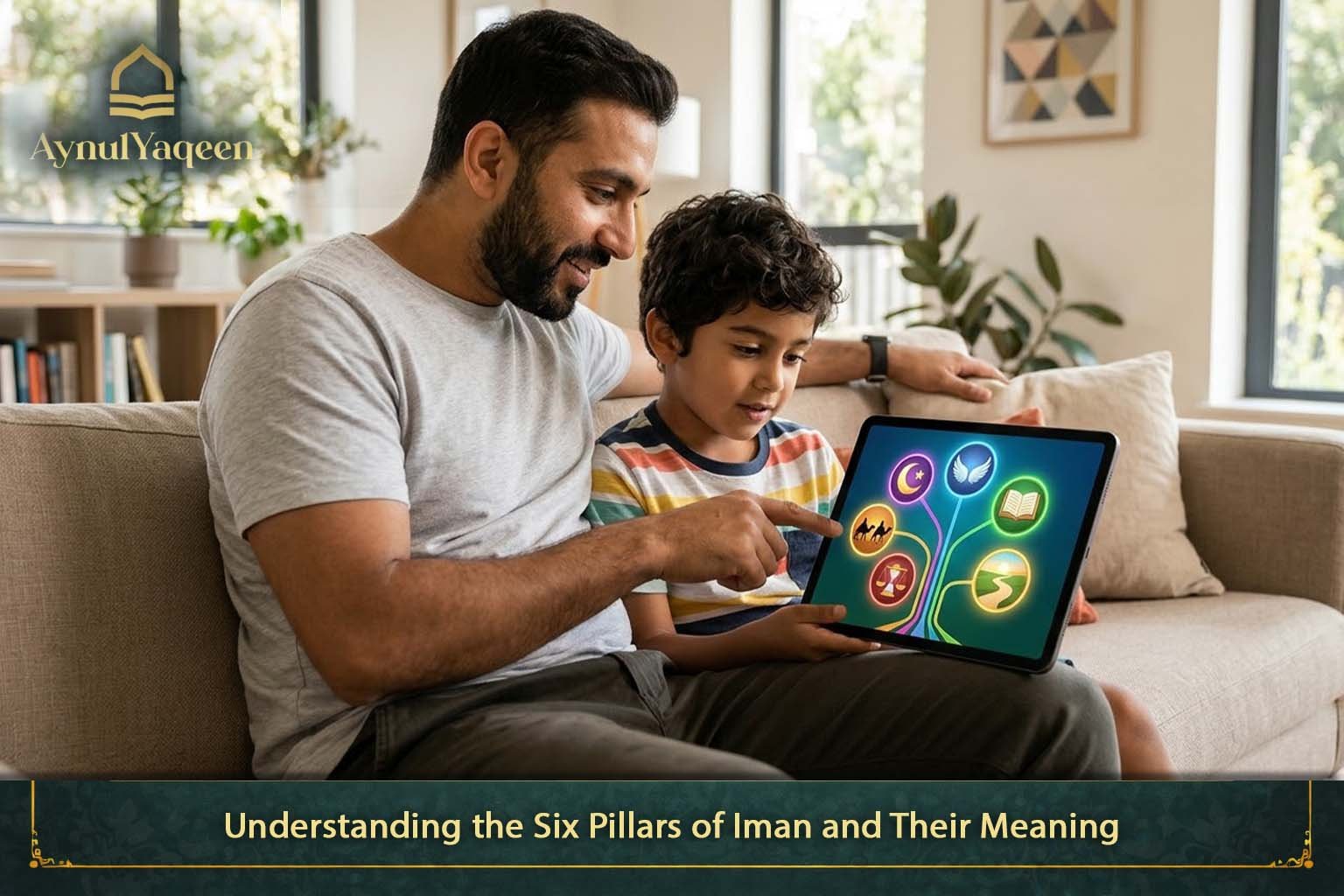
The six pillars of iman are the essential beliefs that Muslims affirm as part of their faith. They are established in the famous Hadith of Jibreel, in which Angel Jibreel asked Prophet Muhammad (peace be upon him) about the meaning of Iman. The Prophet explained that faith includes believing in:
- Allah.
- His angels.
- His revealed books.
- His messengers.
- The Last Day.
- Divine decree, both its good and what people perceive as its evil.
These beliefs address different aspects of Islamic understanding. Belief in Allah establishes the foundation of worship, while belief in angels and revealed books explains important elements of divine revelation. Similarly, belief in messengers clarifies how Allah communicated guidance to humanity.
The remaining pillars connect worldly life with accountability in the Hereafter and an understanding of divine decree. Consequently, the six beliefs form a connected framework rather than six unrelated ideas.
When studying the six pillars of iman, learners should understand the meaning of each belief and its place within Islam. Memorization is useful, but comprehension makes the knowledge easier to apply and explain.
Learn Online with Aynulyaqeen Quran Academy
Choosing the right online Quran academy can make a significant difference in your learning journey. Aynulyaqeen Quran Academy provides structured Quran courses for beginners and advanced learners, focusing on accurate Quran reading, Tajweed, memorisation, and Islamic studies.
With qualified teachers, flexible class schedules, and personalised one-on-one lessons, students of all ages can learn at their own pace while building confidence in reciting and understanding the Holy Quran from anywhere in the world.

Why Are the Six Pillars of Iman Important?
Understanding the six pillars of iman helps Muslims develop a clearer foundation for worship, personal conduct, and religious learning. Each belief offers a different perspective on the relationship between human beings and Allah.
For instance, belief in Allah encourages sincerity because worship is directed toward Him alone. Belief in angels reminds Muslims that the unseen is part of Islamic teaching, even when it cannot be observed through ordinary human senses.
Moreover, belief in revelation and messengers explains how divine guidance reached humanity. Belief in the Last Day encourages accountability, while belief in divine decree teaches Muslims to recognize Allah’s knowledge and power without abandoning their own responsibilities. These beliefs can influence everyday life in several ways:
- Worship: Understanding why Muslims worship Allah alone and seek His guidance.
- Character: Encouraging honesty, patience, compassion, and responsibility.
- Decision-making: Helping believers consider the moral consequences of their actions.
- Perseverance: Supporting patience during hardship without discouraging practical effort.
- Religious learning: Providing a foundation for studying the Quran, Hadith, and Islamic teachings.
Therefore, learning the six pillars of iman is relevant to children, teenagers, adults, and anyone seeking a stronger understanding of Islamic beliefs.
Belief in Allah: The First of the Six Pillars of Iman
Belief in Allah is the foundation of Islamic faith. Muslims believe that Allah is the Creator and Sustainer of everything, that He has no partner, and that He alone deserves worship.
This belief is commonly discussed through the concepts of Tawhid, Allah’s Lordship, and His exclusive right to worship. Although these concepts are closely connected, understanding their distinctions helps learners develop a clearer understanding of Islamic theology.
Understanding Tawhid and the Oneness of Allah
Tawhid means affirming the oneness of Allah. Muslims believe that He is unique and that nothing resembles Him in the way described by His revelation.
The Quran states in Surah Al-Ikhlas, verse 1: “Say, He is Allah, [who is] One.”
This short surah expresses a central principle of Islamic belief. Allah is not one among several gods, nor does He depend on another creator or partner.
Belief in Tawhid also shapes worship. Muslims direct their prayers, supplications, and other acts of worship to Allah alone. Consequently, sincerity becomes an important part of religious practice.
Allah’s Lordship and Right to Worship
Allah’s Lordship, commonly called Rububiyah, concerns His role as Creator, Sustainer, and Controller of creation. Muslims recognize that their existence and the world around them depend on Him.
Uluhiyah concerns directing worship exclusively to Allah. In practical terms, believers seek His help, obey His commands, and avoid directing acts of worship toward anyone else.
These concepts help explain why belief in Allah is more than simply acknowledging that a Creator exists. It also involves recognizing His authority and responding through sincere worship.
Learning Allah’s Names and Attributes
The Quran and authentic Sunnah teach Muslims about Allah’s names and attributes. For example, Ar-Rahman refers to His vast mercy, while Al-Alim refers to His complete knowledge.
Studying these names can deepen religious understanding. When Muslims learn about Allah’s mercy, they are reminded to seek His forgiveness and show compassion to others. Likewise, understanding His knowledge encourages sincerity because actions and intentions are not hidden from Him.
However, believers should approach these teachings according to the Quran and authentic Sunnah rather than inventing descriptions of Allah.
How Belief in Allah Influences Daily Life
The first of the six pillars of iman can influence ordinary decisions as well as formal worship. A Muslim who remembers Allah’s knowledge and justice has reasons to avoid dishonesty, fulfill commitments, and treat people fairly.
Furthermore, recognizing Allah as the Provider encourages gratitude for blessings without making a person passive. Muslims can work, seek treatment when ill, plan responsibly, and ask Allah for help while acknowledging their dependence on Him.
Belief in Angels: Understanding the Unseen
Belief in angels is the second of the six pillars of iman. Muslims affirm that angels are real creations of Allah who perform the duties He assigns to them.
Angels belong to the unseen world, which means their existence is known through divine revelation rather than ordinary observation. The Quran and Sunnah describe aspects of their nature and responsibilities, although human knowledge of the unseen remains limited to what Allah has revealed.
What Do Muslims Believe About Angels?
Islamic teachings describe angels as creations who obey Allah and carry out His commands. The Quran mentions their worship, their duties, and their role in matters connected with revelation and the human experience.
Belief in angels does not mean treating them as independent divine beings. Instead, Muslims understand that their existence and activities remain subject to Allah’s command.
The following examples illustrate several roles associated with angels in Islamic sources:
- Jibreel: The angel who conveyed revelation to Allah’s prophets.
- Mika’il: Associated in Islamic teachings with rain and provision.
- Israfil: Traditionally identified as the angel who will blow the Trumpet.
- The Angel of Death: Entrusted with taking souls by Allah’s command.
- The recording angels: Associated with recording human deeds.
These examples introduce familiar aspects of angelic duties. Nevertheless, learners should distinguish information established in authentic sources from popular stories that may not have reliable evidence.
How Does Belief in Angels Affect a Muslim?
Belief in angels reinforces the understanding that reality includes matters beyond what people can see. It also reminds Muslims that their actions have significance within the moral framework taught by Islam.
For example, remembering the recording of deeds may encourage a believer to avoid gossip, fulfill promises, and speak truthfully. Similarly, understanding that revelation was conveyed through Jibreel highlights the importance of learning the Quran through reliable teaching and interpretation.
Parents can introduce this pillar to children through age-appropriate explanations, familiar examples, and questions about the duties mentioned in Islamic sources.
Teaching the Second Pillar Clearly
When explaining the six pillars of iman to beginners, teachers should avoid presenting every detail about angels as equally established. Instead, they can begin with the essential belief and introduce specific duties using reliable Quranic and Hadith evidence.
A structured Islamic studies lesson can also distinguish between what Muslims must believe and details that require further explanation. This approach supports understanding without overwhelming learners with unnecessary information.
Belief in Revealed Books: Following Divine Guidance
Belief in Allah’s revealed books is the third pillar of iman. Muslims believe that Allah sent revelation to guide humanity through His messengers, providing guidance about worship, morality, and the responsibilities of human life.
The Quran teaches that Allah revealed scriptures before the final revelation given to Prophet Muhammad (peace be upon him). Therefore, belief in divine books includes acknowledging their original divine source and recognizing the special position of the Quran in Islam.
Which Revealed Books Are Mentioned in Islamic Teachings?
Islamic sources mention several earlier revelations and scriptures. These include:
- Suhuf: The scriptures or scrolls associated with Ibrahim and other recipients mentioned in Islamic tradition.
- Tawrat: The revelation given to Musa.
- Zabur: The revelation given to Dawud.
- Injil: The revelation given to Isa.
- The Quran: The final revelation given to Prophet Muhammad (peace be upon him).
Muslims believe in the divine origin of the revelations Allah sent to His messengers. However, this belief should not be confused with claiming that every present-day manuscript or interpretation of earlier scriptures remains identical to its original revelation.
Why Does the Quran Hold a Special Position?
The Quran is the final revelation in Islamic belief and the central scripture for Muslim worship and guidance. Muslims recite it in prayer, study its meanings, and use it as a primary source for understanding Islamic teachings.
Its guidance addresses worship, family relationships, honesty, justice, charity, patience, and other aspects of human conduct. Nevertheless, understanding Quranic passages often requires attention to their context, Arabic language, and explanations from reliable scholarship.
For this reason, Quran learning should involve both accurate recitation and an appropriate understanding of meaning. Memorizing verses can be valuable, while learning their message helps students connect recitation with religious knowledge.
Applying the Third Pillar in Everyday Life
Belief in revealed books encourages Muslims to value divine guidance when making decisions. For example, a believer can study Quranic teachings about honesty before considering how to respond to a difficult situation.
Additionally, regular reading, listening, and reflection can help learners develop a consistent relationship with the Quran. Rather than attempting to understand every complex subject immediately, beginners can progress from basic meanings to more detailed study.
How to Study Revelation Responsibly
Students exploring the six pillars of iman should learn the difference between the Quran’s text, its translation, and scholarly interpretation. A translation helps readers understand the general meaning, but it does not reproduce every feature of the original Arabic.
Consequently, learners should consult trustworthy explanations when encountering unfamiliar verses or questions about Islamic law. This habit supports informed learning and reduces the risk of accepting unsupported claims.
Belief in Messengers: Learning from Allah’s Prophets
Belief in Allah’s messengers is the fourth pillar of iman. Muslims believe that Allah chose messengers to convey His guidance, call people to worship Him, and teach them how to live according to His commands.
Prophets are central to Islamic belief because their missions connect divine revelation with human understanding. Their lives also provide examples of patience, courage, trust in Allah, and commitment to conveying the truth.
Why Did Allah Send Messengers?
Human beings need guidance concerning their relationship with Allah and their responsibilities toward others. According to Islam, Allah sent messengers to communicate His message and guide their communities.
Their missions included calling people away from false worship, teaching moral conduct, and warning against wrongdoing. In addition, prophets demonstrated how divine guidance could be practiced under different circumstances.
Their experiences also show that fulfilling a religious mission does not necessarily mean avoiding hardship. Many prophets faced opposition, rejection, or difficult personal circumstances while remaining committed to their responsibilities.
Believing in All the Prophets
Muslims believe in the prophets identified in Islamic revelation, including Adam, Nuh, Ibrahim, Musa, Isa, and Muhammad (peace be upon them). The Quran also mentions other prophets and describes aspects of their lives and missions.
Belief in the prophets means accepting their divinely appointed role rather than rejecting some of them because of differences between religious traditions.
Muslims honor Isa as a prophet and messenger of Allah, while Islamic belief does not accept the Christian doctrine of his divinity. Similarly, Muslims believe that Musa received revelation from Allah and that his mission was part of the history of divine guidance.
Prophet Muhammad as the Final Prophet
Muslims believe that Prophet Muhammad (peace be upon him) is the final prophet and that no prophet will come after him. His message is intended for all humanity, and the Quran remains the final divine revelation in Islamic belief.
Learning about his life, known as the Seerah, helps Muslims understand his character, teachings, and responses to the circumstances of his time. Moreover, studying authentic Hadith helps learners explore how his guidance informs worship and everyday conduct.
Lessons from the Lives of the Prophets
The stories of the prophets offer practical lessons when studied through reliable sources. For example, the story of Ibrahim illustrates devotion to Allah, while the story of Musa includes themes of courage and perseverance.
Likewise, the life of Prophet Muhammad demonstrates the importance of mercy, honesty, fulfilling trusts, and treating others with dignity. These lessons become more meaningful when learners consider the context of each account rather than relying on isolated quotations.
Belief in the Last Day: Accountability and the Hereafter
Belief in the Last Day is the fifth pillar of iman and an essential part of the six pillars of iman. Muslims believe that worldly life will end, that human beings will be resurrected, and that Allah will judge them with perfect knowledge and justice.
This belief gives Islamic teachings about morality a broader perspective. A person’s choices matter not only because they affect people in this world, but also because Muslims believe they will be accountable to Allah in the Hereafter.
What Does Belief in the Last Day Include?
Belief in the Last Day encompasses several matters described in the Quran and Sunnah. These include the end of worldly life, resurrection, judgment, and the final destination of human beings. Important concepts include:
- Resurrection: Human beings will be raised after death by Allah’s command.
- Accountability: People will answer for their deeds and choices.
- The weighing of deeds: Islamic sources describe the weighing of deeds as part of judgment.
- Paradise and Hell: Muslims believe in Jannah and Jahannam as realities of the Hereafter.
- The Sirat: Islamic teachings describe a bridge associated with the passage over Hell.
- Intercession: Intercession occurs by Allah’s permission, according to Islamic belief.
These concepts are connected, although the details of the unseen should be learned through authentic revelation rather than speculation.
How Does This Belief Shape Personal Conduct?
Belief in the Last Day encourages Muslims to consider the consequences of their actions. For example, someone who remembers accountability may be more careful about returning borrowed property, speaking truthfully, or apologizing after causing harm.
Furthermore, the six pillars of iman offer a framework for understanding justice beyond immediate worldly outcomes. Some wrongs remain unresolved in this life, while some people experience hardship despite acting honorably. Islamic belief teaches that Allah’s final judgment is not limited by human circumstances or incomplete knowledge.
However, accountability should not be understood as a reason to despair. Islamic teachings also emphasize repentance, Allah’s mercy, and the opportunity to correct wrongdoing while alive.
Preparing for the Hereafter Through Everyday Actions
Preparation for the Hereafter includes worship and the treatment of other people. Muslims seek to fulfill their religious obligations while also honoring family responsibilities, maintaining trust, helping those in need, and avoiding injustice.
When mistakes occur, sincere repentance involves recognizing the wrongdoing, seeking Allah’s forgiveness, and making amends where another person’s rights have been violated.
In this way, belief in the Last Day encourages both hope and responsibility. It reminds believers that actions matter while also directing them toward repentance and continued improvement.
Belief in Divine Decree: Understanding Qadar
Belief in divine decree, known as Qadar, is the sixth pillar of iman and completes the six pillars of iman. Muslims believe that Allah possesses complete knowledge and power, and that everything occurs within His knowledge and will.
At the same time, belief in Qadar does not remove human responsibility. People make choices, act on intentions, and remain accountable for their decisions according to Islamic teachings.
What Does Qadar Mean in Islam?
Qadar concerns Allah’s knowledge, decree, will, and creation. These concepts are often explained through four connected aspects:
- Knowledge: Allah knows everything, including what has happened, what is happening, and what will happen.
- Recording: Islamic teachings describe Allah’s recording of decreed events in the Preserved Tablet, Al-Lawh Al-Mahfuz.
- Will: Nothing occurs outside Allah’s will and authority.
- Creation: Allah is the Creator of everything, while human choices and accountability remain meaningful within His decree.
These explanations provide a starting point for understanding Qadar. More detailed theological questions may require guidance from qualified scholars and careful study of the relevant Quranic verses and authentic Hadith.
Does Divine Decree Mean Humans Have No Choice?
No. Islamic belief in divine decree does not mean that people should abandon decisions or ignore their responsibilities. The Quran teaches that human beings are accountable for their actions, even though Allah’s knowledge encompasses everything.
For example, a student who wishes to learn should study, ask questions, and practice consistently rather than using destiny as an excuse for avoiding effort. Similarly, a person seeking employment can prepare applications, develop useful skills, and ask Allah for guidance.
The outcome may not always match expectations. Nevertheless, taking responsible action remains important, while accepting that human knowledge and control are limited.
How Can Belief in Qadar Help During Hardship?
Life includes illness, disappointment, financial difficulties, and unexpected changes. Belief in Qadar can help Muslims respond to such experiences with patience while continuing to seek appropriate solutions.
For instance, someone facing illness can pray, seek medical advice, and follow a suitable treatment plan. These actions are not contrary to reliance on Allah; rather, they reflect the understanding that people should use available means while trusting Him.
Likewise, a person who experiences failure can review mistakes, learn new skills, and try again. Acceptance of divine decree does not require pretending that suffering is easy or that every question has an immediate answer.
Balancing Trust in Allah with Personal Responsibility
The practical lesson of Qadar is to combine reliance on Allah with responsible effort. Muslims can plan carefully without assuming they control every outcome, and they can accept uncertainty without abandoning their goals.
This balance is important when studying the six pillars of iman because it connects theological belief with ordinary decisions. It also helps learners distinguish trust in Allah from passivity, fatalism, or the neglect of practical responsibilities.
How Do the Six Pillars of Iman Work Together?
The six pillars of iman form a connected framework that helps Muslims understand their faith, worship, and responsibilities toward Allah and other people.
Belief in Allah establishes the foundation of worship, while belief in angels and revealed books explains important aspects of the unseen and divine guidance. Likewise, belief in messengers shows how Allah communicated His message to humanity.
Meanwhile, belief in the Last Day connects worldly actions with accountability in the Hereafter. Belief in Qadar helps Muslims understand Allah’s knowledge and authority while recognizing the importance of responsible choices.
For example, a Muslim who wants to act honestly can remember Allah’s knowledge, seek guidance from revelation, and follow the example of Prophet Muhammad (peace be upon him). In addition, remembering accountability encourages fairness when dealing with others.
Therefore, studying these beliefs together helps learners understand how faith influences worship, character, and everyday decisions. Students can also strengthen their Quranic knowledge by exploring how many ayahs are in the Quran.
How to Teach the Six Pillars of Iman to Children?
Children can learn the six pillars of iman through simple explanations, age-appropriate examples, and regular revision. The aim is to develop understanding gradually rather than expecting young learners to master complex theological discussions immediately.
Parents and teachers can introduce one belief at a time, checking comprehension before moving to another topic. Additionally, lessons should encourage children to ask questions and explain ideas in their own words.
Use Simple Definitions and Everyday Examples
Start by introducing the six beliefs in clear language suitable for the child’s age. Children can learn that Muslims believe in Allah, His angels, His revealed books, His messengers, the Last Day, and divine decree.
Next, connect each belief with an appropriate example. Belief in Allah can encourage gratitude, while belief in the Last Day can introduce accountability and the importance of telling the truth.
Parents who are unsure when to begin can read At what age should I teach my child the Quran for additional guidance on age-appropriate Quran learning.
Encourage Questions Without Rushing
Children may ask questions about angels, death, destiny, or the Hereafter. Teachers should respond calmly, distinguish established Islamic teachings from matters requiring further study, and avoid presenting guesses as religious facts.
Moreover, encouraging questions helps identify misunderstandings before they become firmly established. If a question exceeds the teacher’s knowledge, consulting a qualified scholar or reliable educational resource is preferable to inventing an answer.
Make Revision Short and Consistent
A practical learning routine might include studying the six pillars of iman alongside What Are the Five Pillars of Islam? to understand the relationship between Islamic beliefs and acts of worship.
- Reviewing one belief during a short lesson.
- Asking the child to explain its meaning in their own words.
- Connecting the topic with a relevant Quranic verse or authentic Hadith.
- Revisiting previous lessons through simple questions.
- Encouraging the child to share one lesson learned from the session.
Consistency makes foundational learning more manageable than attempting to memorize every detail in one sitting.
Learning the Six Pillars of Iman with Aynulyaqeen Quran Academy

Learners seeking structured Islamic studies can explore Aynulyaqeen Quran Academy when comparing options for understanding the six pillars of iman. A suitable program should explain essential beliefs clearly, use reliable Islamic sources, and adapt lessons to the student’s age and level.
Before enrolling, prospective students and parents should examine the curriculum, teacher qualifications, lesson format, and opportunities to ask questions. They should also confirm which courses and teaching arrangements are currently available.
What Should an Islamic Studies Course Include?
A useful course on foundational Islamic beliefs should explain each pillar and its relationship to the Quran and Sunnah. Ideally, lessons should include:
- Clear explanations of the six essential beliefs.
- Relevant Quranic verses and authentic Hadith.
- Age-appropriate instruction for children and beginners.
- Opportunities to ask questions and review difficult concepts.
- Exercises connecting religious knowledge with everyday conduct.
- A clear distinction between established teachings and scholarly discussions.
These features help learners assess whether a program suits their needs. However, the exact curriculum and available teaching arrangements should be confirmed directly with the academy.
Choosing a Learning Approach That Fits Your Needs
Aynulyaqeen Quran Academy may be worth considering for families seeking organized Quran and Islamic studies. Before enrolling, learners should ask how foundational beliefs are taught, how progress is reviewed, and what support is available when additional explanation is needed.
For younger children, short lessons and simple examples may be suitable. Adult beginners, however, may prefer more detailed discussions and opportunities to explore the evidence behind each belief.
Online learning can also offer scheduling flexibility, depending on the provider’s arrangements. Families can read about the importance of online Quran classes when considering whether remote lessons suit their learning needs.
Building a Stronger Foundation in Islamic Knowledge
Studying with Aynulyaqeen Quran Academy can form part of a broader plan for learning Islamic fundamentals, provided the available program matches the learner’s goals.
Students may benefit from combining lessons with personal revision, reading reliable Quran translations, and discussing questions with qualified teachers. Furthermore, keeping brief notes about each pillar can help learners remember essential definitions and practical lessons.
The purpose of learning is not simply to repeat religious terminology. Instead, learners should develop a clearer understanding of Islamic beliefs, why they matter, and how they guide everyday conduct.
When choosing an instructor, students can also review How to find a Quran teacher in the UK for guidance on evaluating a teacher’s suitability.
Common Misunderstandings About the Six Pillars of Iman
Understanding the six pillars of iman also means recognizing misunderstandings that can make Islamic concepts confusing. Clarifying these issues helps learners distinguish essential beliefs from inaccurate explanations.
Confusing Iman with Memorization Alone
Memorizing the names is a useful starting point, but it does not replace understanding their meanings. Learners should explain the six pillars of iman in their own words and recognize their connection with Islamic teachings.
For example, knowing the term Qadar is not enough if a learner assumes divine decree makes personal effort unnecessary. A clear explanation addresses Allah’s decree and human accountability.
Treating Every Unseen Detail as Established Knowledge
Muslims believe in unseen matters described in revelation. However, popular stories about angels, the Hereafter, or destiny may lack reliable evidence.
Therefore, students studying the six pillars of iman should distinguish established teachings from details requiring verification. Careful learning prevents unsupported claims from being repeated as facts.
Assuming Faith Removes Life’s Difficulties
Belief in Allah does not mean believers will never experience sadness, illness, or hardship. Islamic teachings include examples of prophets and righteous people facing difficulties.
Instead, understanding the six pillars of iman can guide responses to hardship through patience, prayer, practical action, and hope in Allah’s mercy. Seeking appropriate help when necessary remains compatible with religious trust.
Separating Belief from Good Character
Islamic faith affects how Muslims treat others. Although outward behavior alone does not reveal everything about a person’s faith, honesty, justice, mercy, and fulfilling responsibilities are important Islamic values.
Consequently, studying the six pillars of iman should encourage reflection on conviction and conduct. Religious knowledge becomes more meaningful when learners consider how Islamic teachings influence their choices and relationships.
Practical Ways to Strengthen Your Understanding of Iman
Strengthening understanding requires consistent learning, reflection, and a willingness to correct misunderstandings. A clear foundation develops gradually. Consider this approach:
- Learn one pillar at a time. Begin with its definition and essential meaning before moving to detailed questions.
- Read Quranic passages. Use a reliable translation and consult explanations when context is unclear.
- Study authentic Hadith. Learn how prophetic teachings clarify the six pillars of iman and their practical significance.
- Ask qualified teachers. Seek reliable answers when a question involves complex theological details.
- Review regularly. Summarize the six pillars of iman in your own words and revisit previous lessons.
- Reflect on daily conduct. Consider how belief influences worship, honesty, patience, and personal responsibility.
Learners can explore Aynulyaqeen Quran Academy after checking its curriculum and teaching support.
Ultimately, studying the six pillars of iman builds a sound understanding of Islamic belief supported by reliable evidence and reflected in responsible conduct. Reviewing the six pillars of iman regularly can help learners retain essential concepts and explore detailed questions thoughtfully.
Frequently Asked Questions
Frequently Asked Questions about the six pillars of iman provide clear answers to common questions about Islamic beliefs and their practical significance in everyday life.
1. In what order should beginners memorize the six pillars of iman?
Beginners can memorize the six pillars of iman in the commonly taught order, then practice explaining each belief independently. Reviewing them through short questions and examples can help reinforce both recall and understanding.
2. Can someone learn the six pillars of iman without knowing Arabic?
Yes. Beginners can study the meanings in a language they understand while gradually learning important Arabic terms. Reading reliable translations and consulting qualified teachers can support comprehension, although translations cannot fully reproduce every feature of the original Arabic.
3. What is the difference between Iman and Islam?
In the Hadith of Jibreel, Iman refers to core beliefs, while Islam describes acts of submission, including the five pillars of Islam. The terms are closely related, and their precise usage depends on the context of the religious text.
4. How can adults review the six pillars of iman after childhood?
Adults can revisit foundational definitions, study relevant Quranic passages and authentic Hadith, and ask qualified teachers about questions that need clarification. A regular revision schedule can help connect previously memorized concepts with a deeper understanding of Islamic belief.
Conclusion
The six pillars of iman provide a foundational framework for understanding Islamic faith, from belief in Allah and His angels to revelation, prophethood, the Last Day, and divine decree. Each pillar addresses a different aspect of belief, yet together they help Muslims understand worship, moral responsibility, and the relationship between worldly life and the Hereafter.
Learning these beliefs is most effective when memorization is supported by explanation, reliable evidence, thoughtful questions, and regular revision. Furthermore, applying their lessons in everyday life can encourage gratitude, patience, honesty, and responsible decision-making.
Learners seeking organized Islamic studies may explore Aynulyaqeen Quran Academy after reviewing its curriculum, teaching approach, and suitability for their needs. With consistent study and reliable guidance, students can develop a clearer understanding of the six pillars of iman and their significance in Muslim life.
