

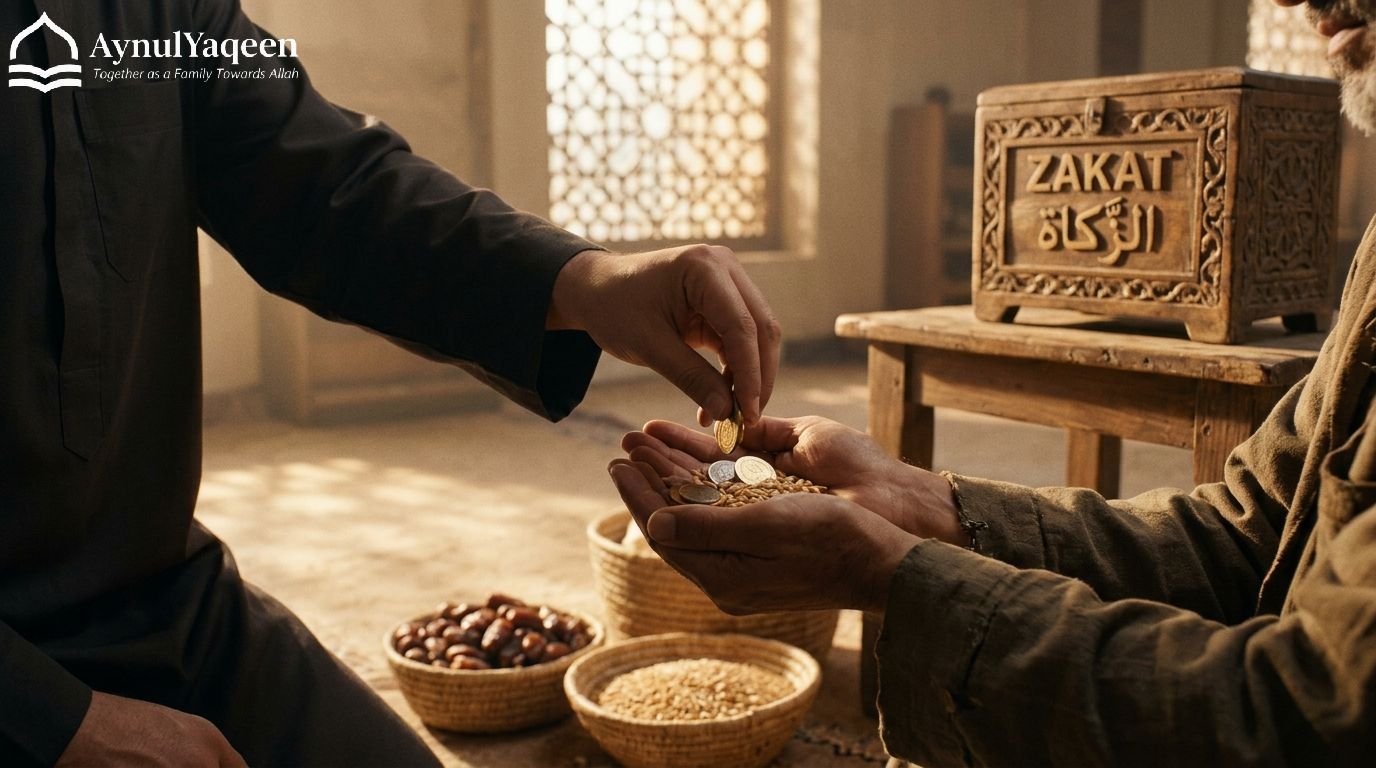
What is Zakat, and why does Islam make giving a portion of one’s wealth such an important responsibility? Imagine a young Muslim named Adam who has worked hard for several years, saved money, and finally started building a financially secure life.
One evening, he hears a friend talking about Zakat. His friend explains that a portion of his eligible savings could help families struggling to afford food, shelter, and other basic needs.
Adam becomes curious. He wonders whether Zakat is simply another form of charity, whether everyone must pay it, and how much money he should give.
These are questions many people ask when learning about Islam.
Zakat is much more than a financial payment. It is an act of worship, a responsibility towards society, and a way to develop generosity and gratitude. It teaches Muslims that wealth is not only a personal blessing but also a means of helping others.
In this guide, you will discover everything you need to know about Zakat, including its meaning, importance, rules, calculation, eligibility, and the people who can receive it.
What Is Zakat in Islam?
Zakat is one of the Five Pillars of Islam. It is the obligation to give a specific portion of eligible wealth to people who qualify to receive it.
The word “Zakat” comes from the Arabic language and carries meanings associated with purification, growth, and blessing.
In Islam, Zakat helps purify a person’s wealth by fulfilling the rights of those in need. It also encourages Muslims to become less attached to material possessions and more concerned about the well-being of their communities.
For Muslims who meet the required conditions, paying Zakat is an obligation rather than an optional act of kindness.
The commonly applied Zakat rate on eligible monetary wealth is 2.5%, provided the wealth meets the required Nisab threshold, and the relevant conditions are fulfilled.
For example, if a Muslim has £10,000 in eligible Zakatable wealth, the amount of Zakat would generally be £250.
However, Zakat is not calculated on every type of possession in the same way. Different rules apply to savings, gold, silver, business inventory, agricultural produce, and other assets.
Why Is Zakat Important in Islam?
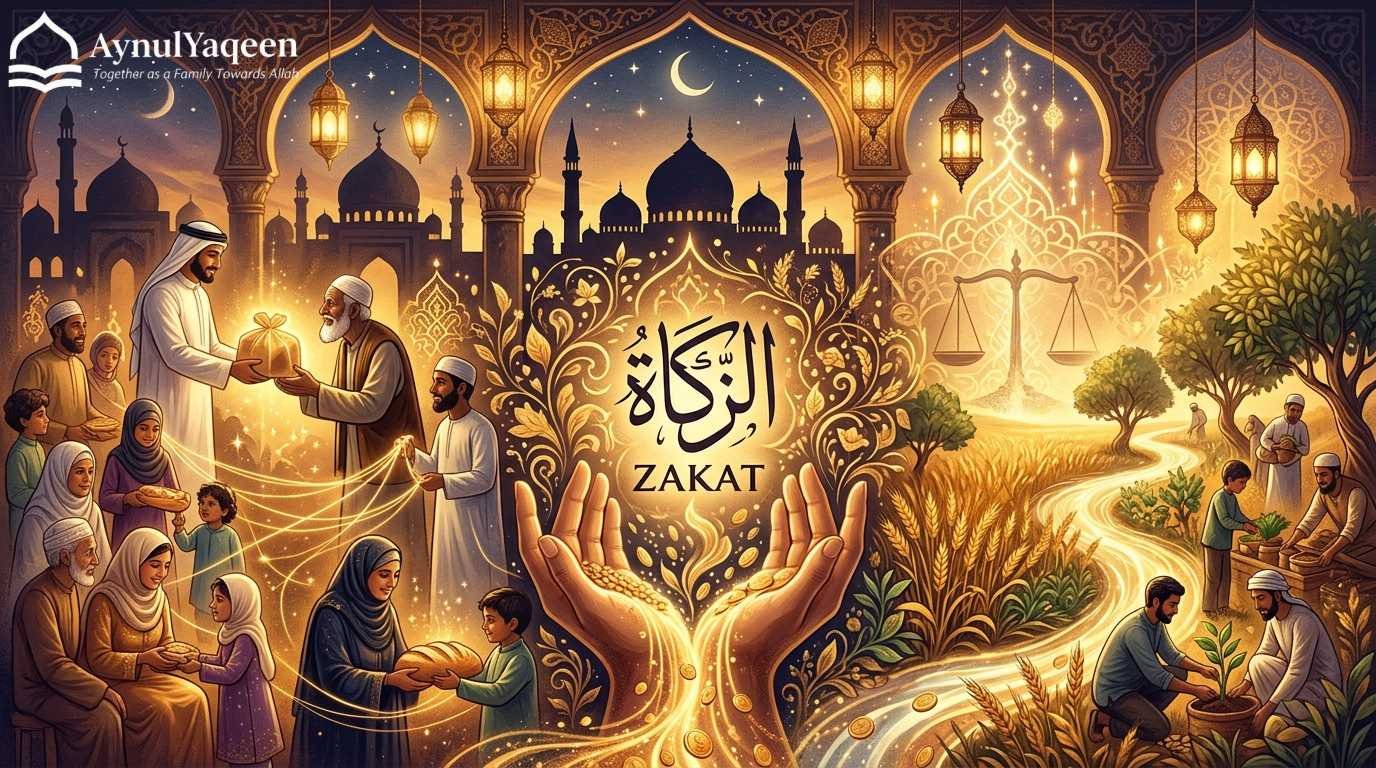
To understand the importance of Zakat, it helps to look beyond the financial calculation.
Imagine two families living in the same neighborhood. One family has enough money to buy food, pay rent, and provide education for their children. The other struggles to afford even basic necessities.
Zakat creates a connection between these two parts of society.
It reminds those with sufficient wealth that helping people in difficult circumstances is a religious responsibility.
There are several important reasons why Zakat holds such a central position in Islam.
1. It Is One of the Five Pillars of Islam
The Five Pillars form the foundation of a Muslim’s religious life:
- Shahada: Declaration of faith.
- Salah: Performing the five daily prayers.
- Zakat: Giving obligatory charity when eligible.
- Sawm: Fasting during Ramadan.
- Hajj: Pilgrimage to Makkah for those who are able.
Zakat is therefore not simply a charitable tradition. It is an essential part of Islamic practice.
2. It Helps People Experiencing Poverty
Zakat provides financial support to people who cannot meet their basic needs.
Depending on their circumstances and eligibility, recipients may use this assistance for food, housing, clothing, education, healthcare, and other essential expenses.
3. It Encourages Generosity
People naturally become attached to the money they earn. Zakat teaches Muslims that wealth should not become the centre of their lives.
Giving a portion of their wealth encourages generosity, compassion, and gratitude.
4. It Promotes Social Responsibility
Zakat creates a system in which eligible wealth supports vulnerable members of society.
Instead of allowing wealth to remain concentrated among a small group, it provides a way to support people experiencing financial hardship.
5. It Strengthens Faith
For Muslims, paying Zakat is an act of obedience to Allah.
It encourages believers to remember that their wealth is a blessing and that fulfilling their religious responsibilities is more important than holding on to every possession.
What Are the Conditions for Paying Zakat?
Not every Muslim has to pay Zakat on every possession. Understanding what Is Zakat and its requirements helps determine when this obligation becomes due. Certain conditions must generally be fulfilled before Zakat becomes obligatory.
Understanding these conditions makes the process much easier.
1. Being Muslim
Zakat is an Islamic religious obligation for Muslims who meet its requirements. Knowing What Is Zakat also means understanding that it is one of the fundamental obligations of Islam.
2. Owning Wealth Above the Nisab
A person must possess eligible wealth that reaches or exceeds a minimum threshold known as Nisab.
If their eligible wealth is below this threshold, Zakat is generally not obligatory.
3. Completion of One Lunar Year (Hawl)
For many categories of wealth, including cash savings, gold, silver, and business inventory, one Islamic lunar year must pass after reaching Nisab.
A lunar year is approximately 354 days, which is shorter than the Gregorian calendar year.
Some categories, such as agricultural produce, have different payment rules and do not follow the same one-year condition.
4. Ownership of Zakatable Wealth
Zakat applies to specific types of wealth rather than every item a person owns. Understanding What Is Zakat helps distinguish zakatable assets from personal possessions.
For example, personal belongings such as everyday clothes, ordinary household furniture, and a home used for personal residence are generally not subject to Zakat.
Gold jewelry intended for personal use is an area where scholars differ. Some schools require Zakat on qualifying jewelry, while others exempt ordinary personal-use jewelry under specific conditions.
5. Meeting the Relevant Financial Conditions
Outstanding debts, financial obligations, and other liabilities may affect the calculation, so students can explore related Islamic financial principles through an Islamic online Quran academy.
The treatment of debts and certain asset categories differs among Islamic scholars and schools of jurisprudence. Therefore, people with complicated financial situations should consult a qualified Zakat scholar.
What Is Nisab in Zakat?
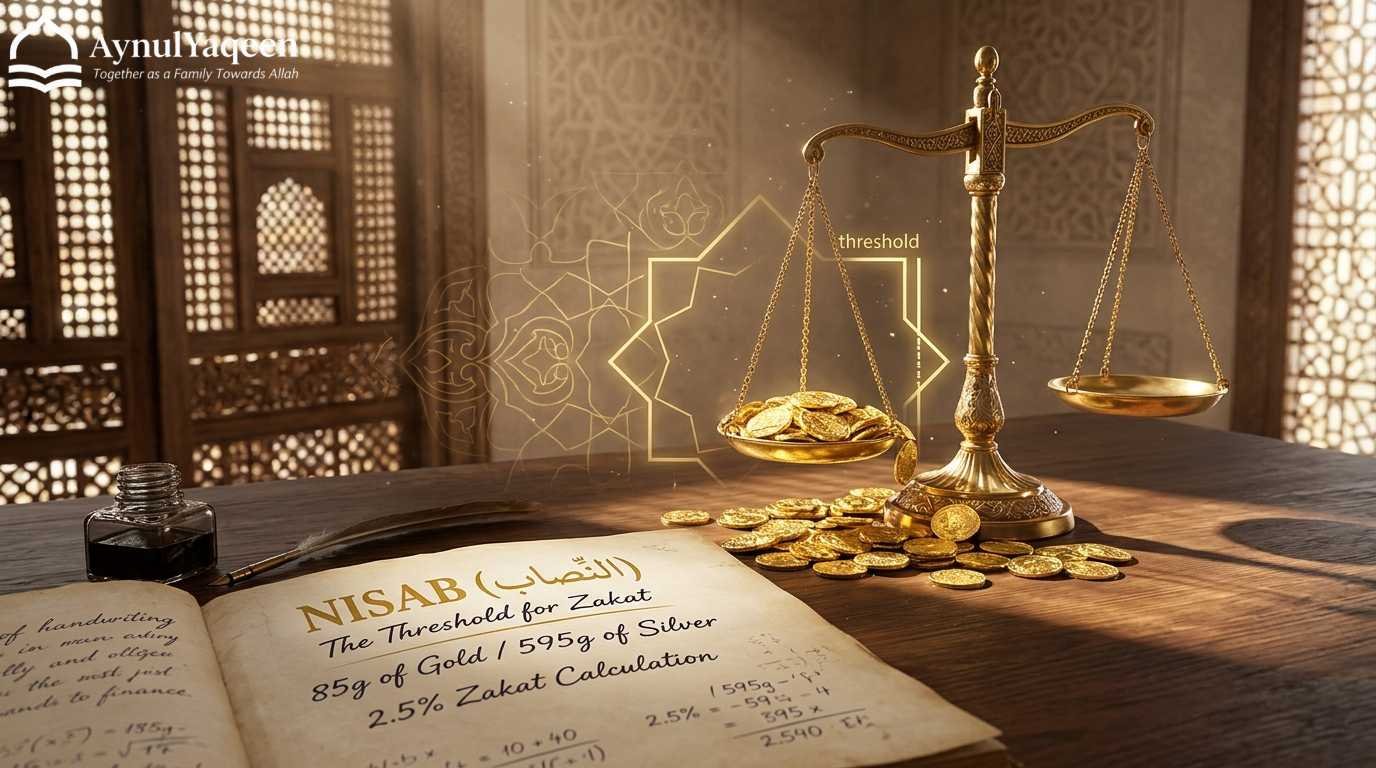
Nisab is the minimum amount of eligible wealth a Muslim must own before becoming liable to pay Zakat.
Think of it as a financial threshold.
If Adam has eligible savings below Nisab, he generally does not have to pay Zakat. However, if his wealth reaches or exceeds Nisab and the applicable conditions are fulfilled, Zakat becomes due.
Nisab is traditionally measured using the value of gold or silver.
The commonly recognized traditional measurements are
- Gold: Approximately 85 grams.
- Silver: Approximately 595 grams.
For this reason, Muslims should check the current value of Nisab when calculating their Zakat rather than relying on an old fixed amount.
There are differences among scholars regarding whether the gold or silver threshold should be used in particular circumstances. The silver threshold is lower in monetary value in many market conditions, so it may make a person eligible to pay Zakat sooner.
Following a consistent method recommended by a trusted scholar or recognized Islamic institution can help avoid confusion, especially when you learn Islam online and study different Islamic rulings.
How Much Zakat Should You Pay?
For eligible monetary wealth, the commonly applied Zakat rate is 2.5%.
This means that a Muslim who fulfills the relevant conditions generally pays 2.5% of their net zakatable wealth.
Here is a simple example:
Imagine Adam has the following eligible assets on his annual Zakat date:
| Asset | Amount |
|---|---|
| Cash savings | £8,000 |
| Money in bank accounts | £5,000 |
| Eligible investment in gold | £3,000 |
| Business inventory | £4,000 |
| Total eligible wealth | £20,000 |
For simplicity, assume all listed assets are subject to Zakat, the gold qualifies under the calculation method being followed, and there are no deductible liabilities.
Zakat calculation:
£20,000 × 2.5% = £500
Adam would therefore pay £500 in Zakat.
This is a simplified example. Actual calculations may differ depending on asset types, business arrangements, debts, investments, and the Islamic school of thought followed.
How to Calculate Zakat Step by Step
If you are calculating Zakat for the first time, the following steps can make the process easier.
Step 1: Choose Your Zakat Date
Choose the date on which you first owned wealth equal to or above Nisab.
This becomes your annual Zakat date, based on the Islamic lunar calendar.
Step 2: Calculate Your Eligible Assets
Make a list of the assets that may be subject to Zakat, such as:
– Cash at home.
– Money in bank accounts.
– Gold and silver.
– Business inventory.
– Certain investments.
– Money owed to you that is expected to be repaid.
The treatment of some investments and financial products requires additional guidance, which learners can explore through an Aqidah course online alongside their study of Islamic principles and obligations.
Step 3: Review Your Liabilities
Identify debts and financial obligations that may be deducted under the calculation method you follow.
For example, certain immediately payable debts may be treated differently from long-term mortgage balances or future expenses.
Not every future expense or long-term debt is necessarily deducted in full.
Step 4: Calculate Your Net Zakatable Wealth
Add your eligible assets and subtract any allowable deductions.
The remaining amount is your net zakatable wealth.
Step 5: Apply the 2.5% Rate
If your net zakatable wealth meets the Nisab requirement, calculate 2.5%.
For example:
– Net Zakatable wealth: £12,000
– Zakat rate: 2.5%
– Total Zakat: £300
Step 6: Give Your Zakat to Eligible Recipients
Once your Zakat becomes due, arrange to distribute it to people who qualify under Islamic guidelines.
You may give it directly to eligible individuals or through a trustworthy organisation that distributes Zakat according to Islamic principles.
Who Can Receive Zakat?
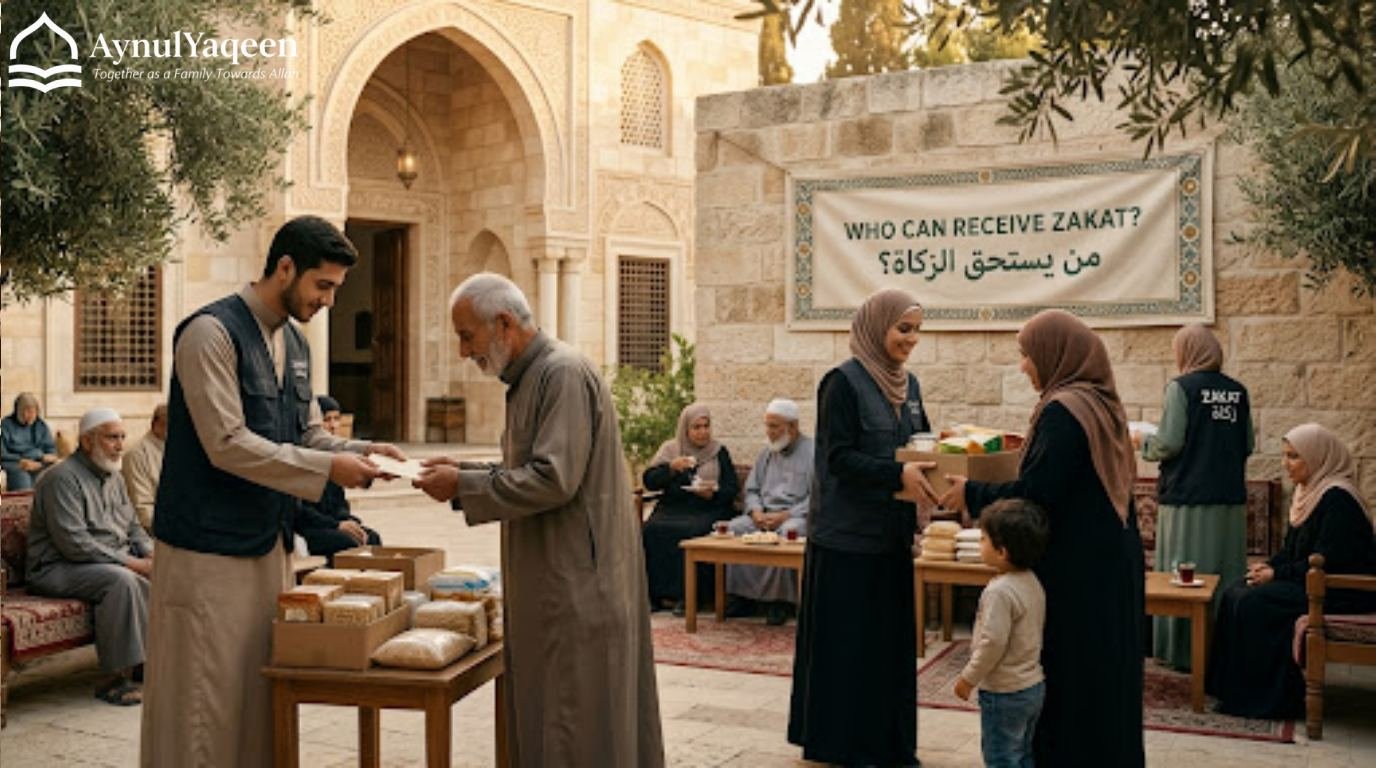
Islam identifies eight categories of people who may receive Zakat.
These categories are mentioned in the Quran, in Surah At-Tawbah (9:60).
They are:
1. The Poor (Al-Fuqara): People who have very limited financial resources and struggle to meet their basic needs.
2. The Needy (Al-Masakin): People who experience financial hardship and cannot adequately support themselves.
3. Zakat Administrators (Al-Amilina Alayha): People authorised to collect, manage, and distribute Zakat according to the relevant Islamic requirements.
4. Those Whose Hearts Are to Be Reconciled (Al-Mu’allafati Qulubuhum): People who fall within this category as recognised by Islamic scholarship and applicable rulings.
5. People in Bondage (Fir-Riqab): This category relates to freeing people from slavery and bondage, according to the relevant Islamic principles.
6. People in Debt (Al-Gharimin): Individuals who have legitimate debts and cannot repay them without experiencing serious financial difficulty, provided they meet the applicable conditions.
7. In the Cause of Allah (Fi Sabilillah): This category has scholarly interpretations concerning eligible activities and purposes. It should not automatically be understood as permission to direct Zakat towards any charitable project.
8. Stranded Travellers (Ibn As-Sabil): Travellers who have become separated from their financial resources and need assistance to complete their journey or return home.
These eight categories provide the religious framework for Zakat distribution.
It is important to remember that not every person experiencing difficulty automatically qualifies. Eligibility must be assessed according to Islamic guidelines.
What Is the Difference Between Zakat and Sadaqah?
Many people confuse Zakat with Sadaqah because both involve giving to others.
However, they are not the same, and Islamic courses for beginners can help new learners understand the differences between obligatory Zakat and voluntary Sadaqah.
| Zakat | Sadaqah |
| Obligatory for eligible Muslims | Generally voluntary |
| Has specific eligibility conditions | Can be given to a wider range of people |
| Usually calculated at 2.5% for eligible monetary wealth | No fixed percentage |
| Has specific categories of recipients | Can support many charitable causes |
| Becomes due according to specific rules | Can be given at any time |
For example, if Adam gives £500 as his obligatory Zakat, he fulfils his Zakat responsibility if the payment meets the relevant requirements.
If he later gives another £100 to help a neighbour, that additional contribution is Sadaqah.
Both forms of giving encourage kindness and compassion, but Zakat has specific religious rules that must be followed.
When Should Muslims Pay Zakat?
For most forms of Zakatable wealth, Zakat becomes due when the relevant conditions are fulfilled and one lunar year has passed after reaching Nisab.
Muslims do not have to wait until Ramadan to pay their annual Zakat, and learning about this obligation through Islamic studies for kids helps children understand its importance and develop values of generosity and social responsibility.
However, many people prefer to pay during Ramadan because it is a special month of worship, generosity, and reflection.
Some Muslims also choose to pay early, where permitted, so that people in need can receive assistance sooner.
It is important to distinguish annual Zakat (Zakat al-Mal) from Zakat al-Fitr.
Zakat al-Fitr is a separate obligatory charitable payment associated with the end of Ramadan. It is generally due before the Eid prayer and is paid on behalf of eligible individuals in the household according to the applicable rules.
Unlike annual Zakat on wealth, Zakat al-Fitr is not calculated as 2.5% of savings.
Common Mistakes to Avoid When Paying Zakat
Learning the rules can help Muslims avoid common mistakes. Here are some important points to remember:
- Ignoring the Nisab threshold: Always check whether your eligible wealth reaches the required minimum.
- Using the wrong Zakat date: Remember that the Islamic calendar follows lunar years.
- Forgetting certain assets: Savings, investment gold, business inventory, and other eligible assets may need to be included.
- Confusing Zakat with Sadaqah: Voluntary charity does not automatically replace obligatory Zakat.
- Giving to ineligible recipients: Zakat must be distributed according to the categories established in Islamic teachings.
- Using outdated Nisab values: Gold and silver prices change, so check current values.
- Ignoring differences in Islamic rulings: Some calculations depend on the type of wealth and the school of jurisprudence followed.
- Deducting every debt automatically: Debt deductions depend on the applicable Islamic ruling and the nature of the obligation.
If you are uncertain about your personal circumstances, seek advice from a qualified Islamic scholar or a reliable Zakat authority.
Frequently Asked Questions About What Is Zakat
Discover the answers to the most common questions about Zakat, its rules, calculation, and importance in Islam.
1. What is Zakat in simple words?
Zakat is an obligatory form of charity in Islam. Muslims who meet the required financial conditions must give a specific portion of their eligible wealth to people who qualify to receive it. The commonly applied rate for monetary wealth is 2.5%.
2. Is Zakat compulsory for every Muslim?
No. Zakat is not compulsory for every Muslim regardless of their financial situation. It becomes obligatory when the relevant conditions are met, including owning eligible wealth at or above Nisab and fulfilling the applicable requirements.
3. How much Zakat do I have to pay?
The commonly applied rate is 2.5% of eligible net wealth. For example, if your Zakatable wealth is £10,000, your Zakat would generally be £250, assuming the relevant conditions are fulfilled.
4. Can I give Zakat to my family members?
Certain relatives may qualify to receive Zakat if they meet the eligibility conditions. However, there are restrictions concerning spouses, parents, children, and individuals whose financial maintenance is already your responsibility. The detailed rulings can differ between Islamic schools of jurisprudence. Consult a qualified scholar before making such a payment.
5. Is Zakat only paid during Ramadan?
No. Annual Zakat does not have to be paid exclusively during Ramadan. It becomes due when the relevant conditions are fulfilled, including the completion of the required lunar year for applicable assets. Muslims may choose to pay during Ramadan, but they should not unnecessarily delay an already-due payment.
Conclusion
So, what is Zakat, and why does it matter so much in Islam?
Returning to Adam’s story, he now understands that Zakat is not simply about giving away a percentage of his savings. It is about recognising the rights of others, appreciating the blessings he has received, and helping create a more caring society.
Through Zakat, Islam teaches that wealth carries responsibility. A portion of what a person owns can become a source of hope for someone facing poverty, debt, or hardship.
For Muslims who fulfil the required conditions, paying Zakat is an important act of worship and an opportunity to strengthen their relationship with Allah while supporting those in need.
Whether you are a new Muslim, someone exploring Islam, or a believer learning more about your responsibilities, understanding Zakat is an important step towards understanding the social and spiritual values of Islam.
Wealth becomes more meaningful when it is used not only for ourselves but also to improve the lives of others.
