

Quranic Arabic language course provides a structured learning path for Muslims who want to understand the Quran through its original language. This Quranic Arabic language course helps students recognize important vocabulary, understand sentence structures, and explore the deeper meanings of Quranic verses.
At Aynulyaqeen Quran Academy, learners study with qualified teachers through organized lessons designed for different levels, from beginners to advanced students. The program focuses on building strong Arabic foundations while connecting language skills directly to the Quran through practical examples and guided learning.
Through interactive classes, exercises, and continuous support, students can improve their reading, comprehension, and reflection on the Quran. Whether you want to understand daily recitation, prepare for Islamic studies, or develop a stronger relationship with the Book of Allah, this Quranic Arabic language course offers an effective way to achieve your goals. With consistent practice and expert guidance, learners can enjoy a more meaningful Quran learning experience.
Why Should You Enroll in a Quranic Arabic Language Course?

Many Muslims spend years reading the Quran beautifully without fully understanding its message. Although translations are helpful, they cannot always convey the precise meanings, grammar, rhetorical beauty, and spiritual depth found in the original Arabic.
A structured Quranic Arabic language course allows students to gradually understand the Quran directly from its original language. Instead of relying on translated interpretations, learners begin recognizing vocabulary, sentence structures, verb patterns, and expressions that appear repeatedly throughout the Quran.
This ability transforms the entire learning experience. Every prayer, recitation, and reflection becomes more meaningful because the words are no longer unfamiliar sounds—they become messages that the learner can personally understand.
Students who study Quranic Arabic often notice improvements in several areas, including:
- Better concentration during Salah.
- Easier memorization of Quranic verses.
- Stronger understanding of Tafsir.
- Greater appreciation of Arabic grammar.
- Increased Islamic knowledge.
- More confidence when reading the Quran independently.
Unlike Modern Standard Arabic, Quranic Arabic focuses specifically on the vocabulary and grammar used in the Quran, making it a more direct path for Muslims whose primary objective is understanding the Book of Allah.
Learn Online with Aynulyaqeen Quran Academy
Choosing the right online Quran academy can make a significant difference in your learning journey. Aynulyaqeen Quran Academy provides structured Quran courses for beginners and advanced learners, focusing on accurate Quran reading, Tajweed, memorisation, and Islamic studies. With qualified teachers, flexible class schedules, and personalised one-on-one lessons, students of all ages can learn at their own pace while building confidence in reciting and understanding the Holy Quran from anywhere in the world.

What Makes a Great Quranic Arabic Language Course?
Not every Arabic program is designed for Quran learners. Some focus mainly on conversational Arabic, while others emphasize academic grammar without connecting it to Quranic verses.
A high-quality Quranic Arabic language course should combine language learning with Quranic application. Instead of teaching grammar in isolation, students learn Arabic for beginners with Egyptian teachers how grammatical rules appear inside actual verses from the Quran.
The best courses usually include:
- Mastery of the Arabic alphabet for beginners.
- Correct pronunciation of Arabic letters.
- Quranic vocabulary taught by frequency.
- Essential Nahw (Arabic grammar).
- Sarf (word formation and morphology).
- Practical sentence analysis.
- Reading exercises directly from the Quran.
- Listening and speaking practice where appropriate.
- Regular revision sessions.
- Continuous progress assessments.
Learning becomes much easier when every lesson immediately connects new grammar and vocabulary to authentic Quranic examples.
Rather than memorizing complicated rules, students begin noticing recurring language patterns that appear throughout different Surahs. This practical approach significantly improves both understanding and long-term retention.
Benefits of Learning Quranic Arabic Instead of Relying Only on Translation
Translations are valuable educational tools, but every translation represents the translator’s understanding of the original text. Certain Arabic words contain multiple meanings, rhetorical devices, and grammatical subtleties that cannot always be expressed in another language.
Learning Quranic Arabic gives students direct access to these meanings. Some of the most important benefits include:
A Deeper Spiritual Connection
Understanding every verse while listening to or reciting the Quran creates a completely different spiritual experience. The heart interacts with the message immediately without waiting for an external explanation.
Better Quran Memorization
When students understand what they memorize, recalling verses becomes much easier. Meanings naturally reinforce memory, reducing dependence on repetition alone.
Recognition of Repeated Vocabulary
The Quran contains many frequently repeated words. Learning only a few hundred common Quranic words enables students to recognize a large percentage of Quranic vocabulary during recitation.
Improved Understanding of Tafsir
Studying Tafsir becomes far more rewarding when learners already understand the grammatical structure and vocabulary of the verses being explained.
Stronger Confidence During Worship
Whether reading during Salah, listening to Taraweeh, or reflecting on daily recitation, understanding Arabic increases focus and mindfulness throughout acts of worship.
These benefits explain why so many Muslims choose to study Quranic Arabic before pursuing more advanced Islamic sciences.
Who Can Join a Quranic Arabic Program?
One of the greatest misconceptions is that Quranic Arabic is only suitable for advanced students. In reality, modern online programs are designed for learners with completely different educational backgrounds.
A beginner who cannot recognize Arabic letters for kids can start with foundational lessons before gradually moving into vocabulary and grammar. Children benefit from interactive learning methods that combine games, visual exercises, and simplified explanations.
Adults often appreciate flexible schedules that fit around work and family responsibilities. Even students who already speak Arabic can gain tremendous value because Quranic Arabic differs in vocabulary, style, and linguistic richness from everyday spoken Arabic. For this reason, successful programs typically divide learners into multiple levels:
- Complete beginners.
- Elementary learners.
- Intermediate students.
- Advanced Quran students.
- Hifz students.
- Islamic studies learners.
This structured progression allows every learner to advance comfortably without feeling overwhelmed.
Learn with Qualified Teachers Who Understand Your Goals
The quality of the instructor often determines the quality of the learning experience.An experienced Quranic Arabic teacher does much more than explain grammar rules. They connect vocabulary with Quranic context, simplify complex concepts, answer students’ questions patiently, and adapt lessons according to individual progress.
At Aynulyaqeen Quran Academy, students learn from qualified teachers who specialize in teaching non-Arabic speakers through structured online classes. Lessons are designed to encourage gradual improvement while maintaining a balance between language development and Quranic understanding.
Personalized feedback, regular assessments, and interactive sessions help learners stay motivated throughout their educational journey instead of feeling overwhelmed by difficult grammar or unfamiliar vocabulary.
For many students, learning with an experienced teacher shortens the learning curve significantly and helps build confidence from the very first lessons.
How to Learn the Quran and Arabic Together Effectively?
Many learners wonder whether they should first study Arabic speaking classes and then move on to Quranic studies or learn both simultaneously. In reality, combining the two creates a more engaging and rewarding learning experience.
When vocabulary, grammar, and Quran recitation are taught side by side, students immediately apply what they learn. Instead of memorizing isolated grammar rules, they see how those rules function within actual Quranic verses. This practical approach strengthens both language skills and Quran comprehension.
For example, after learning a new verb pattern or grammatical structure, students can identify it in verses they recite every day. Repetition through real Quranic examples helps reinforce knowledge naturally and improves long-term retention.A balanced curriculum normally includes:
- Reading practice from the Quran.
- Basic Arabic grammar explained gradually.
- Common Quranic vocabulary.
- Listening exercises.
- Tajweed revision.
- Short Tafsir discussions that explain the meanings of selected verses.
This integrated learning method keeps students motivated because they continuously witness the practical results of their studies.
Building a Strong Quranic Vocabulary
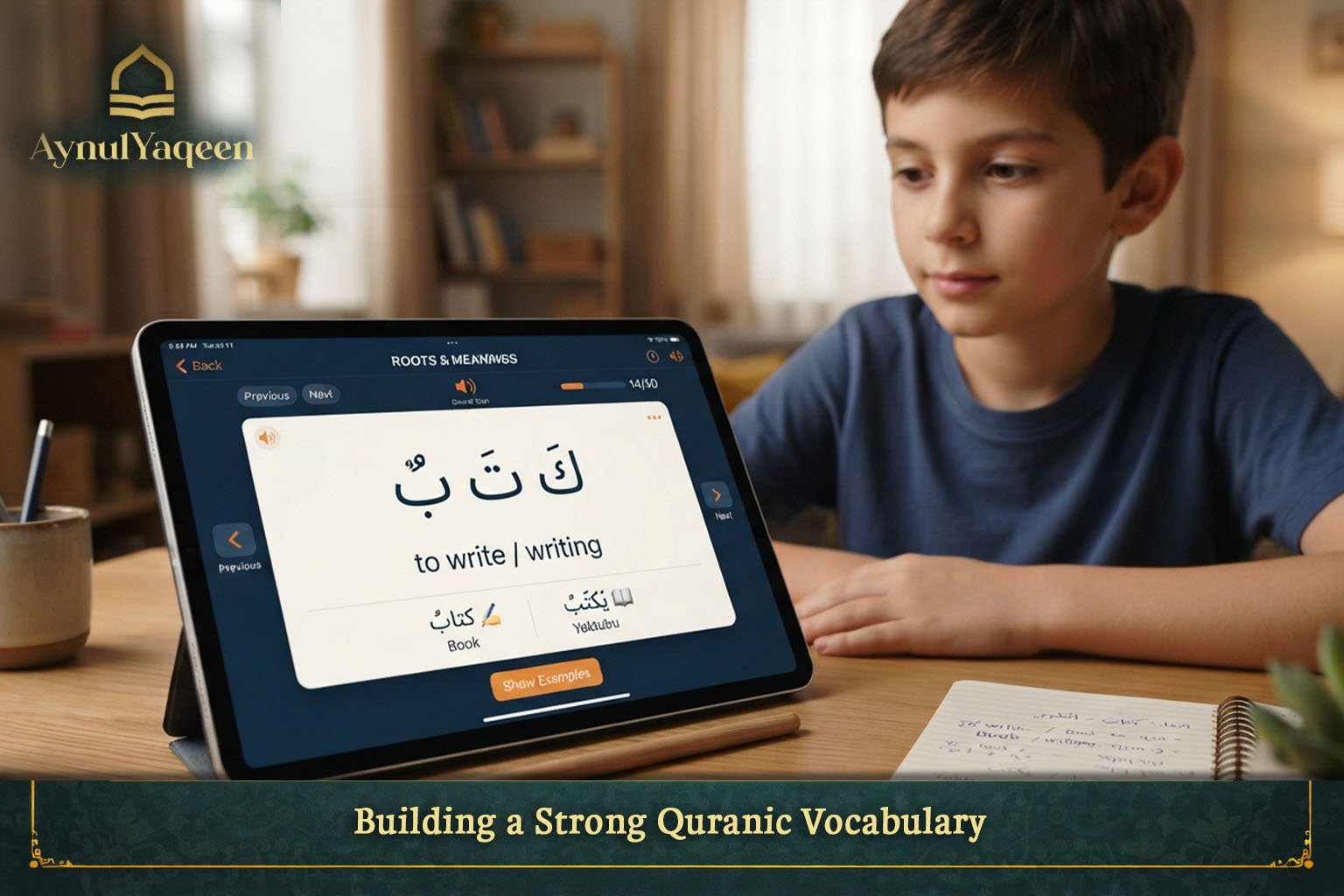
One of the fastest ways to improve Quran comprehension is by expanding your vocabulary. Many people assume that understanding the Quran requires memorizing thousands of Arabic words. Fortunately, this is not the case. A relatively small collection of frequently repeated words appears throughout the Quran.
Learning these high-frequency words allows students to recognize significant portions of many Surahs without constantly referring to translations.
A successful vocabulary plan focuses on:
- Frequently repeated nouns.
- Common verbs.
- Everyday Quranic expressions.
- Pronouns and particles.
- Connecting words.
- Prepositions.
- Expressions related to worship and faith.
Rather than memorizing long vocabulary lists, students should repeatedly encounter these words during reading, listening, and classroom discussions.
This repeated exposure helps transform passive vocabulary into active understanding.
Over time, learners begin recognizing familiar words instantly during Salah and Quran recitation.
Understanding Quranic Grammar Without Feeling Overwhelmed
Grammar often intimidates beginners because traditional Arabic books present numerous technical terms from the very beginning.
Modern Quranic Arabic programs take a different approach. Instead of overwhelming learners with detailed grammatical theory, lessons introduce one concept at a time using verses from the Quran as practical examples.
Students gradually become familiar with:
- Nominal sentences.
- Verbal sentences.
- Singular and plural forms.
- Masculine and feminine words.
- Verb conjugations.
- Common sentence structures.
- Pronouns.
- Question forms.
- Prepositions.
Learning grammar in context makes every lesson meaningful. Rather than asking students to memorize rules mechanically, teachers explain how grammar influences the meaning of Quranic verses.
As confidence grows, learners naturally become capable of reading increasingly complex passages without depending heavily on translations.
Why Online Learning Has Become the Preferred Choice?
Technology has transformed Islamic education. Students no longer need to live near an Islamic center or travel long distances to access qualified teachers. Online learning allows Muslims worldwide to study Quranic Arabic from home while maintaining their daily responsibilities.
The flexibility of online education benefits:
- Working professionals.
- University students.
- Parents.
- Children.
- New Muslims.
- Busy families.
Students can schedule classes during mornings, evenings, or weekends depending on availability. Modern virtual classrooms also include interactive tools such as digital whiteboards, screen sharing, lesson recordings, quizzes, and homework tracking.
These features make online education far more engaging than many people initially expect. Instead of reducing educational quality, technology often improves communication between teachers and students by allowing personalized attention and continuous feedback.
Choosing the Right Learning Schedule
One of the main reasons learners discontinue Arabic studies is unrealistic expectations. Some students attempt to study several hours every day before becoming overwhelmed after only a few weeks.
A more sustainable approach emphasizes consistency rather than intensity. For most learners, studying three to five sessions each week while reviewing vocabulary daily produces excellent long-term results.
Even thirty minutes of focused study every day can lead to remarkable progress over the course of a year. Consistency allows new vocabulary and grammar to become firmly established before moving on to more advanced topics. The goal is not speed. The goal is steady improvement that continues month after month.
How to Choose the Best Quranic Arabic Language Course?
Selecting the right program requires more than comparing prices. A quality Quranic Arabic language course should provide a structured roadmap that guides students from beginner level to advanced Quran comprehension. Before enrolling, consider the following factors:
Qualified Teachers
A successful quranic arabic language course depends greatly on the quality of its instructors. Teachers should possess strong Arabic language knowledge alongside experience teaching non-native speakers.
Structured Curriculum
The best quranic arabic language course follows a logical progression rather than presenting random topics each week. A clear curriculum helps students build their skills step by step without confusion.
Interactive Classes
Students learn more effectively when they actively participate through discussion, exercises, and live feedback. An interactive Quranic Arabic language course creates a better learning experience and keeps students motivated.
Flexible Scheduling
A professional Quranic Arabic language course should accommodate learners from different countries and time zones. Flexible schedules allow students to continue learning while managing work, family, and daily responsibilities.
Individual Progress Tracking
Regular assessments help students identify strengths while addressing weak areas before they become obstacles. A reliable Quranic Arabic language course uses progress tracking to ensure every learner receives suitable guidance.
Practical Quran Application
Every grammar lesson in a quality quranic arabic language course should connect directly to Quranic verses whenever possible. Applying rules through real examples makes understanding easier and more meaningful.
A carefully designed program encourages steady improvement instead of rushing through difficult material.
Common Mistakes That Slow Down Progress
Many students unknowingly develop habits that delay their progress. Recognizing these mistakes early can save months of frustration while improving the results of any Quranic Arabic language course.
Depending Entirely on Translation
Translations are useful references but should gradually become secondary as vocabulary grows. A structured Quranic Arabic language course helps learners move beyond translation and understand Quranic meanings directly.
Ignoring Daily Revision
Even short review sessions reinforce learning far more effectively than studying large amounts of new material without revision. Consistency is an essential part of every successful Quranic Arabic language course.
Memorizing Grammar Without Practice
Grammar only becomes useful when applied repeatedly during Quran reading. A practical Quranic Arabic language course focuses on using grammar in real Quranic contexts.
Comparing Yourself with Others
Every learner progresses differently. Age, previous education, available study time, and language background all influence learning speed. Consistent effort matters much more than rapid progress during a Quranic Arabic language course.
Skipping Vocabulary Review
Learning new words without revisiting previous lessons leads to unnecessary forgetting. Regular revision ensures continuous improvement and supports long-term success in a Quranic Arabic language course.
Learn at Your Own Pace
Every student’s journey is unique. Some learners complete introductory levels within a few months, while others prefer a slower pace because of work or family commitments. A flexible learning environment respects these differences.
At Aynulyaqeen Quran Academy, students can choose schedules that suit their lifestyles while receiving continuous support from experienced instructors. Personalized learning plans help each student focus on their individual goals, whether that means understanding daily Quran recitation, improving Arabic grammar, or preparing for more advanced Islamic studies.
This flexibility encourages long-term consistency, which is ultimately the key to mastering Quranic Arabic through a well-organized Quranic Arabic language course.
Practical Tips to Accelerate Your Learning

Although structured lessons are essential, your daily habits have an equally important impact on progress. Here are several strategies used by successful learners:
- Read a small portion of the Quran every day.
- Review recently learned vocabulary before sleeping.
- Listen to Quran recitation while following the Arabic text.
- Keep a notebook for new words and expressions.
- Revise previous lessons before starting new ones.
- Ask questions whenever concepts are unclear.
- Practice reading aloud to improve fluency and pronunciation.
- Set realistic weekly learning goals.
- Celebrate small achievements to stay motivated.
These simple habits require only a few extra minutes each day, yet they significantly strengthen comprehension and retention over time. They also maximize the benefits gained from a Quranic Arabic language course.
The Long-Term Benefits of Learning Quranic Arabic
Learning Quranic Arabic is not a short-term achievement; it is an investment that continues to enrich your life for years to come. Every new word you understand and every grammatical rule you master opens another door to appreciating the meanings of the Quran.
A comprehensive Quranic Arabic language course provides learners with the foundation needed to continue exploring Quranic meanings independently.
As your knowledge grows, you will notice positive changes in many aspects of your Islamic journey. Daily recitation becomes more meaningful because you begin to recognize familiar vocabulary and sentence structures.
Studying Quranic Arabic also creates a strong foundation for exploring other Islamic sciences. A beneficial Quranic Arabic language course prepares students to gain more from Tafsir, Hadith, Seerah, and classical Islamic books.
Perhaps the greatest reward is the personal connection that develops between you and the Quran. Every lesson brings you closer to understanding the words of Allah as they were revealed, making worship more reflective and spiritually fulfilling.
Why Consistency Is More Important Than Speed
Many learners believe they must progress quickly to succeed, but lasting results come from consistency rather than intensity.
Even a small amount of daily study can produce remarkable improvement over time. Reviewing vocabulary, reading a few verses with understanding, and attending regular lessons each week create steady progress without causing burnout.
A realistic learning routine allows knowledge to build naturally. Students who maintain regular practice in a Quranic Arabic language course develop genuine understanding that remains with them long after completing their studies.
The most successful learners are not always those who study the longest each day. They are the ones who remain committed, patient, and consistent throughout their journey.
Who Will Benefit Most from These Courses?
A structured Quranic Arabic program can benefit a wide range of learners, including:
- Beginners who have never studied Arabic before.
- Muslims seeking to understand the Quran without depending entirely on translations.
- Parents who want to strengthen their family’s connection with the Quran.
- University students interested in Islamic studies.
- Professionals looking for flexible online learning opportunities.
- Reverts to Islam who wish to understand the Quran from its original language.
- Anyone preparing for advanced Islamic education.
Regardless of age or previous experience, a gradual and well-organized curriculum makes Quranic Arabic accessible to everyone. Choosing the right Quranic Arabic language course can help learners build confidence and achieve their goals.
How Does Quranic Arabic Help You Understand the Context of Verses?
Learning Quranic Arabic is not only about knowing the meaning of individual words. It also helps students understand the context, connections, and deeper messages behind Quranic verses. Many words in Arabic gain their full meaning through sentence structure and the surrounding verses.
A well-designed Quranic Arabic language course teaches learners how vocabulary, grammar, and expressions work together within Quranic passages. When students understand the language patterns used in the Quran, they can recognize how words relate to each other and how do i learn the arabic language different expressions convey specific meanings.
Through a structured Quranic Arabic language course, learners develop the ability to approach Quranic reading with greater reflection and understanding. Instead of depending only on translations, students begin appreciating the complete message of each verse through the original Arabic language.
A professional Quranic Arabic language course helps learners move beyond word-for-word translation and discover the deeper meanings, linguistic beauty, and connections found throughout the Quran.
The Difference Between Learning Arabic and Learning Quranic Arabic
Although Quranic Arabic and general Arabic share the same foundation, they have different learning goals. General Arabic courses often focus on daily conversations, travel, and communication skills, while Quranic Arabic focuses specifically on understanding the language of the Quran.
A specialized Quranic Arabic language course focuses on vocabulary, grammar structures, and expressions that frequently appear in Quranic verses. This approach makes learning more effective for Muslims who want to understand the Quran directly.
Unlike general Arabic programs, a Quranic Arabic language course provides lessons designed around Quranic examples, helping students connect language rules with actual verses.
Choosing the right type of Arabic education depends on your personal goal. If your main purpose is understanding the Quran, enrolling in a Quranic Arabic language course offers a more direct and focused learning path.
How Does Quranic Arabic Improve Reflection and Tadabbur?
One of the greatest benefits of a Quranic Arabic language course is improving the ability to practice Tadabbur (reflection upon the Quran). When Muslims understand the words they read, they can reflect more deeply on the guidance, lessons, and messages contained in the verses.
A quality Quranic Arabic language course allows learners to explore the meanings behind Quranic expressions instead of completing recitation without understanding. This creates a more thoughtful Quran experience and encourages a stronger spiritual relationship with Allah’s Book.
By studying vocabulary and grammar through a Quranic Arabic language course, students gradually develop the ability to recognize important meanings while reading Quranic verses.
Developing Independent Quran Learning Skills
A good Quranic Arabic language course does not only teach information; it helps students become independent learners. Over time, students develop skills that allow them to analyze words, recognize grammar patterns, and understand new verses with less dependence on external explanations.
The goal of a successful Quranic Arabic language course is to build confidence so learners can continue exploring the Quran after completing their formal studies.
These skills gained through a Quranic Arabic language course continue benefiting learners throughout their lives because they create a strong foundation for lifelong Quran study.
Building a Lifelong Relationship with the Quran
A Quranic Arabic language course is not simply an academic subject; it is a valuable skill that continues benefiting Muslims throughout their lives. Every new word understood creates a stronger connection with Quranic guidance.
Through a comprehensive Quranic Arabic language course, learners gain greater confidence in reading, listening, and reflecting on the Quran.
The knowledge gained from a Quranic Arabic language course supports continuous learning and helps students appreciate the Quran’s message more deeply.
For many Muslims, completing a Quranic Arabic language course becomes the beginning of a lifelong journey of understanding, reflection, and spiritual growth.
Why Start Learning Quranic Arabic Today?
Many people delay studying Quranic Arabic because they believe it requires years before seeing results. However, a consistent Quranic Arabic language course can help learners notice improvements from the early stages.
Recognizing common words, understanding repeated expressions, and following basic sentence structures become easier through regular practice in a structured Quranic Arabic language course.
Starting a Quranic Arabic language course today allows learners to build their knowledge gradually while enjoying continuous progress throughout their Quran journey.
With the guidance provided in a reliable Quranic Arabic language course, students can overcome hesitation and begin developing a meaningful connection with the Quran.
Frequently Asked Questions
This section answers the most common questions about the Quranic Arabic Language Course, including learning duration, suitable levels, teaching methods, and how students can achieve a better understanding of the Quran through structured study.
1. How long does it usually take to understand Quranic Arabic?
The learning period varies depending on your previous experience and study schedule. With regular lessons and consistent practice, many students begin recognizing common Quranic vocabulary within a few months, while deeper comprehension develops gradually over time.
2. Do I need to speak Arabic fluently before studying Quranic Arabic?
No. Quranic Arabic courses are designed specifically for learners who may have little or no background in Arabic. Most beginner programs start with the fundamentals before introducing grammar and vocabulary used in the Quran.
3. Can children and adults join the same type of program?
Most professional institutes offer separate learning paths for different age groups and experience levels. This ensures that every student follows lessons appropriate for their learning style and educational needs.
4. What is the best way to practice Quranic Arabic after lessons?
The best way to improve Quranic Arabic is through regular practice, including reading Quranic verses, reviewing vocabulary, listening to explanations, and applying grammar rules. Consistent daily practice helps learners strengthen their understanding and build confidence over time.
5. Are online Quranic Arabic classes effective for beginners?
Yes. Online Quranic Arabic classes can be highly effective when taught by qualified instructors using structured lessons and interactive methods. Beginners can learn step by step from the basics while receiving guidance, correction, and support throughout their learning journey.
In conclusion, enrolling in a Quranic Arabic language course is one of the most meaningful decisions for anyone who wishes to understand the Quran beyond translation. Rather than simply reading the words, you begin to appreciate their meanings, linguistic beauty, and timeless guidance.
A well-structured course provides far more than grammar lessons or vocabulary lists. It offers a clear learning path that develops reading skills, strengthens comprehension, improves memorization, and deepens your connection with the Book of Allah.
Whether you are taking your first steps in Arabic or continuing an existing learning journey, consistent study and qualified instruction will help you achieve lasting progress. The knowledge you gain today will continue benefiting your worship, your understanding of Islam, and your relationship with the Quran for years to come.
Start your journey with confidence, remain consistent in your learning, and allow every lesson to bring you one step closer to understanding the Quran in the language in which it was revealed.
