

Why Muslims fast during Ramadan is a question many people ask when they first learn about Islam or encounter Ramadan through Muslim friends, colleagues, or communities. At first glance, fasting may appear to be simply an act of avoiding food and drink from dawn until sunset. However, this view does not explain the deeper meaning of Ramadan.
For Muslims, fasting is an act of worship commanded by Allah. It is one of the Five Pillars of Islam and represents a period of spiritual training, self-discipline, gratitude, patience, charity, repentance, and reflection. Ramadan changes the daily routine of Muslims and encourages them to focus more intentionally on their relationship with Allah and their responsibilities toward other people.
The fast is physical, but its purpose goes far beyond the body. Muslims are encouraged to control their speech, behavior, emotions, desires, and actions while fasting. They are also encouraged to pray more, read the Quran, give charity, remember Allah, make dua, and seek forgiveness.
Understanding Ramadan therefore requires looking at fasting as a complete spiritual experience rather than a temporary change in eating habits. The following guide explores the religious, personal, social, and spiritual reasons behind Ramadan fasting and explains how its lessons can continue throughout the year.
Why Do Muslims Fast During Ramadan? Islamic Foundation
Why Muslims fast during Ramadan is a question that deserves more than a short answer. Muslims fast because Allah has commanded fasting, but Ramadan also carries deep spiritual, moral, personal, and social meanings. The fast teaches believers obedience, patience, self-control, gratitude, compassion, generosity, and awareness of Allah.
The Quran clearly establishes the obligation of fasting. Allah says:
“O you who have believed, decreed upon you is fasting as it was decreed upon those before you that you may become righteous.”
This verse from Surah Al-Baqarah connects fasting with taqwa, or God-consciousness. Therefore, why Muslims fast during Ramadan can first be understood through the purpose of developing greater awareness of Allah.
Learn Online with Aynulyaqeen Quran Academy
Choosing the right online Quran academy can make a significant difference in your learning journey. Aynulyaqeen Quran Academy provides structured Quran courses for beginners and advanced learners, focusing on accurate Quran reading, Tajweed, memorisation, and Islamic studies.
With qualified teachers, flexible class schedules, and personalised one-on-one lessons, students of all ages can learn at their own pace while building confidence in reciting and understanding the Holy Quran from anywhere in the world.

Why do Muslims fast during Ramadan according to Islam?
The most direct answer is that Muslims fast because fasting during Ramadan is an act of worship commanded by Allah. A Muslim does not fast simply because fasting is an old tradition or because other family members fast. The believer fasts as an expression of faith and obedience.
During daylight hours, Muslims refrain from eating, drinking, and other actions that invalidate the fast. They then break the fast after sunset. This daily pattern creates a clear connection between ordinary activities and worship.
The question of why Muslims fast during Ramadan therefore begins with submission. Muslims believe that Allah knows what is best for His servants, and following His commands is part of their relationship with Him.
Fasting also creates a private form of worship. Other people may not know whether someone has secretly eaten or drunk, but Allah knows. This encourages sincerity because the fasting person continues to obey Allah even when nobody else is watching.
Read Also:quran recitation mistakes
Ramadan fasting is one of the Five Pillars of Islam
To understand why Muslims fast during Ramadan, it is important to understand the position of fasting within Islam. Fasting in Ramadan is one of the Five Pillars of Islam, alongside the testimony of faith, prayer, zakat, and Hajj for those who are able.
This means fasting is not simply a cultural practice. For Muslims who are required and able to fast, it is a major religious obligation.
The Five Pillars demonstrate that Islam combines belief with action. Muslims express their faith through worship, charity, prayer, fasting, and other acts of obedience.
Fasting is particularly distinctive because it requires physical restraint. A person may have food and water available but chooses not to consume them during the fasting period because Allah has commanded the fast.
This is one reason why Muslims fast during Ramadan has an answer rooted in both faith and daily practice.
Learn Also: Quranic Arabic language course
The connection between fasting and taqwa
One of the clearest answers to why Muslims fast during Ramadan is found in the concept of taqwa. Taqwa can be understood as God-consciousness, piety, or awareness of Allah.
A person with taqwa tries to remember Allah when making decisions. This awareness encourages obedience, discourages wrongdoing, and motivates sincere repentance after mistakes. Fasting gives Muslims repeated opportunities to practice this awareness.
Imagine that someone becomes extremely thirsty shortly before sunset. A bottle of water may be close by, and nobody else may be present. Nevertheless, the fasting person waits until the appropriate time because Allah knows what they do. That private decision is an example of taqwa.
The lesson can then extend beyond fasting. A person may become more careful about lying, cheating, gossiping, breaking promises, or treating others unfairly.
Therefore, why Muslims fast during Ramadan is connected to developing a conscience that remains aware of Allah throughout everyday life.
Read Also: wudu step by step
Why do Muslims fast during Ramadan to develop self-discipline?
Self-discipline is another important reason. Human beings naturally have desires and physical needs. Islam does not teach that having desires is inherently wrong. Instead, Muslims are encouraged to control their desires and use them responsibly. Fasting creates daily opportunities to practice restraint.
A fasting person becomes hungry but waits. The person becomes thirsty but waits. Someone may feel tired but still wakes for Suhoor and prayer. Someone may become irritated but tries to respond with patience. These repeated decisions can strengthen self-control.
Modern life often encourages immediate satisfaction. Food can be ordered quickly, entertainment is available constantly, and many desires can be satisfied almost instantly. Ramadan introduces a different rhythm. The believer learns that wanting something does not mean receiving it immediately.
This explains another aspect of why Muslims fast during Ramadan. Fasting can train Muslims to manage impulses and make decisions according to faith rather than immediate desire.Parents looking for suitable Quran learning options for their daughters can explore How can a girl child learn Quran online for practical guidance on learning the Quran online.
Fasting teaches patience
Patience is central to the answer to why Muslims fast during Ramadan. A Muslim experiences hunger and thirst for many hours but knows that the difficulty will end at sunset. The person learns to tolerate temporary discomfort without reacting impulsively.
Patience during Ramadan can have several forms:
- Physical patience means enduring hunger and thirst.
- Emotional patience means controlling anger and frustration.
- Social patience means treating others respectfully.
- Spiritual patience means continuing worship even when motivation becomes difficult.
A person may experience a stressful day at work or school. Fatigue can make irritation easier, yet Ramadan encourages the believer to control the reaction.
This demonstrates that fasting is not supposed to produce bad behavior. Avoiding food while becoming aggressive or insulting others contradicts the character that Ramadan is intended to develop.
Consequently, why Muslims fast during Ramadan is to learn how to respond to difficulties with greater patience.
Learn Also:Egyptian quran teacher online
Why do Muslims fast during Ramadan to appreciate blessings?
Another important answer to why Muslims fast during Ramadan is gratitude. People often become accustomed to blessings that are available every day. Food, water, shelter, family, health, and security can become so familiar that their value is overlooked. Fasting temporarily changes this perspective.
After several hours without food or water, a simple glass of water can become deeply appreciated. A few dates can feel especially satisfying. A normal family meal can become an opportunity to thank Allah.
This experience encourages Muslims to recognize blessings instead of taking them for granted.
Gratitude is an important Islamic value. Muslims are encouraged to recognize that their ability to eat, drink, work, sleep, and live safely depends upon blessings from Allah.
Therefore, why Muslims fast during Ramadan is also connected to learning to appreciate ordinary necessities.
Fasting can even encourage people to reduce food waste. When someone becomes more conscious of the value of food, they may become more thoughtful about how much they prepare, consume, and discard.
Read Also: What Are the Five Pillars of Islam?
Hunger can increase compassion for others
Another answer to why Muslims fast during Ramadan involves compassion. A fasting Muslim experiences temporary hunger and thirst. This experience does not mean that fasting is identical to chronic poverty. A person who fasts generally knows that food will be available at sunset, while someone experiencing severe poverty may not know when the next meal will arrive.
However, temporary hunger can still encourage greater awareness of people who struggle with food insecurity.
A believer may think about families who cannot afford sufficient food, people living without reliable water, or individuals who need community support. That awareness can encourage action.
Muslims may donate money, provide meals, support charitable projects, assist neighbors, or help vulnerable families. The experience becomes spiritually valuable when it produces greater concern for others.
This gives another meaningful dimension to why Muslims fast during Ramadan: fasting can transform personal discomfort into greater social awareness.
Why do Muslims fast during Ramadan and increase charity?
Ramadan is widely associated with generosity. Muslims often increase charitable activities during the month because they view it as an opportunity to help others and seek Allah’s reward.
Someone with substantial financial resources may make a large donation. Someone with limited resources may share food, volunteer, help a neighbor, or provide practical assistance.
Generosity is not measured only by the amount of money given.A kind action can also express charitable character.
This is another reason why Muslims’ fasting during Ramadan cannot be separated from concern for other people. The month encourages Muslims to look beyond their own hunger and think about the needs of family members, neighbors, friends, and vulnerable communities.
At Aynulyaqeen Quran Academy, learners can study Quranic teachings related to worship, character, generosity, and responsibility while developing a stronger understanding of how Islamic principles apply to everyday life.
Ramadan strengthens the relationship with the Quran
The Quran has a special connection with Ramadan. Muslims believe that its revelation began during this blessed month, and as a result, Quran recitation and study receive particular attention.
Many Muslims establish Quran goals during Ramadan. Some aim to complete the Quran, while others choose a smaller daily reading schedule.
A beginner may read a few verses each day. Someone who cannot read Arabic fluently may listen to recitation while studying a translation. Another learner may focus on memorization or revision.
The most important principle is consistency and reflection.
The Quran should not simply be treated as a book to finish as quickly as possible. Muslims are encouraged to consider its meanings and apply its guidance.
This gives another answer to why Muslims fast during Ramadan. Ramadan creates an environment in which believers can reconnect with the Quran while fasting, praying, and reflecting.
Aynulyaqeen Quran Academy can support learners who want to improve Quran reading, Tajweed, memorization, and understanding throughout the year.
Why do Muslims fast during Ramadan and increase prayer?
Prayer is closely connected to fasting. Muslims continue performing the five obligatory prayers during Ramadan, while many also increase voluntary worship.
Tarawih is one of the most recognizable Ramadan practices. Muslims may perform this additional night prayer individually or with a congregation. The evening therefore becomes an important part of the spiritual experience.
After Iftar, Muslims may pray, read the Quran, make dua, remember Allah, and spend time with family. Many also use the quiet hours of the night to reflect on their lives.
This helps explain why Muslims fast during Ramadan as part of a wider pattern of worship. The month is not limited to avoiding food and drink during daylight.
Instead, Ramadan encourages Muslims to organize both their days and nights around spiritual growth.
The spiritual meaning of avoiding food and drink
It is important to understand that Islam does not teach Muslims to suffer simply for the sake of suffering. Hunger and thirst are means rather than the ultimate objective.
The physical restrictions of fasting create opportunities to practice obedience, patience, gratitude, discipline, and awareness of Allah.
This helps explain why Muslims fast during Ramadan, while Islamic teachings also recognize legitimate exemptions. The purpose of fasting is spiritual development rather than deliberate harm.
For Muslims who are able to fast, temporary hunger can provide an important reminder of human dependence. People need food and water to survive, yet they cannot create these blessings independently.
Fasting can therefore encourage humility and remind believers that health, strength, and provision are blessings from Allah.
Who is required to fast in Ramadan?
Adult Muslims who are capable of fasting and meet the relevant conditions are generally required to fast Ramadan. However, Islamic law recognizes different circumstances.
People who are ill may have permission not to fast depending on their condition. Travelers may receive concessions. Specific rulings also apply to circumstances involving pregnancy, breastfeeding, menstruation, old age, and chronic illness.
The exact ruling depends on the individual circumstances and, in some cases, the Islamic school of jurisprudence being followed.
Anyone uncertain about their obligation should consult a qualified and trusted Islamic scholar. When health is involved, appropriate medical advice should also be considered.
This balance between obligation and mercy is important when explaining why Muslims fast during Ramadan. Islam does not treat every person as if they have identical physical circumstances.
Ramadan encourages repentance and forgiveness
Human beings make mistakes, and Ramadan offers an opportunity to reflect and return to Allah. Sincere repentance involves recognizing wrongdoing, regretting it, seeking Allah’s forgiveness, and making a genuine effort to avoid repeating the mistake. The spiritual atmosphere of Ramadan encourages Muslims to examine their lives.
A person may reflect on neglected prayers, harmful speech, damaged relationships, dishonesty, anger, or other weaknesses. Instead of allowing guilt to lead to hopelessness, Islam encourages believers to seek Allah’s mercy and improve their behavior.
This is another important aspect of why Muslims fast during Ramadan. The month provides a structured opportunity for spiritual renewal.
The Prophet Muhammad ﷺ taught about the great reward associated with fasting Ramadan with faith and seeking Allah’s reward. Muslims therefore approach the month with both effort and hope.
Why do Muslims fast during Ramadan to improve character?
Character is one of the most important areas that Ramadan should influence. A person may successfully avoid food and drink but continue lying, gossiping, insulting others, cheating, or behaving unjustly. Such behavior should encourage reflection on the deeper purpose of the fast.
Islamic teachings emphasize that fasting should influence the tongue, behavior, and attitude. For this reason, why Muslims fast during Ramadan is closely connected to character development.
Someone may use Ramadan to work specifically on controlling anger. Another person may focus on avoiding gossip. Someone else may try to become more patient with parents, children, coworkers, or neighbors. Small behavioral changes can have significant long-term effects.
If someone usually reacts immediately to criticism, Ramadan can become an opportunity to pause before responding. If someone complains frequently, the person can practice gratitude. If someone spends too much time on distractions, that time can be redirected toward Quran reading or useful activities.
The importance of Laylat al-Qadr
Laylat al-Qadr, often translated as the Night of Decree or Night of Power, is among the greatest opportunities of Ramadan.
The Quran describes this night as better than a thousand months. It has a special connection with the revelation of the Quran and occupies a central place in Islamic spirituality.
The exact night is not definitively specified, encouraging Muslims to seek it during the final ten nights, especially the odd-numbered nights.
During this period, believers may increase prayer, Quran reading, dua, charity, and repentance.
This shows another dimension of why Muslims fast during Ramadan. The month is not merely a period of physical endurance. It contains opportunities for intensified worship and spiritual reward.
The final ten nights can become the spiritual peak of the month.
Why do Muslims fast during Ramadan while controlling their behavior?
Fasting affects more than eating and drinking. Muslims are encouraged to avoid behavior that contradicts the purpose of worship. Lying, insulting people, gossiping, unnecessary arguments, and other harmful actions can undermine the moral benefits of fasting.
This is why Muslims often pay particular attention to their speech during Ramadan. Before speaking, a believer can ask whether the words are truthful and beneficial. Before reacting in anger, the person can pause. Before judging another person, the believer can consider whether the judgment is fair.
These habits demonstrate why Muslims fast during Ramadan as a comprehensive form of character training rather than a purely physical practice.
Preparing spiritually for Ramadan
Preparation can begin before Ramadan arrives. Muslims may increase prayer, read more Quran, make repentance, give charity, and establish realistic spiritual goals.
Practical preparation can also help. People may organize work schedules, plan meals, adjust sleeping patterns, and determine how to balance worship with family and professional responsibilities.
However, spiritual preparation should remain the priority.
A Muslim can ask:
- What do I want to improve this Ramadan?
- Which harmful habit should I leave?
- How can I strengthen my relationship with the Quran?
- How can I become more patient?
- Who can I help?
- Which acts of worship have I neglected?
These questions help explain why Muslims fast during Ramadan as a deliberate spiritual journey rather than simply a change in eating patterns.
The significance of Suhoor
Suhoor is the meal eaten before dawn.Its practical purpose is obvious because it provides nourishment before the fasting day begins. Yet Suhoor also has spiritual value.
Waking before dawn gives Muslims an opportunity for dua, Quran reading, remembrance, and prayer.
Suhoor also teaches preparation. The fasting person knows that the fast will begin at a specific time and therefore organizes the night accordingly. This is another way why Muslims fast during Ramadan connects worship with discipline.
The believer learns to plan ahead and prepare for a commitment rather than simply responding to immediate needs.
The significance of Iftar
Iftar is the meal with which Muslims break the fast at sunset. After many hours without food or drink, this moment often produces strong feelings of gratitude.
Many Muslims break the fast with dates and water, following the Prophetic tradition, before eating their main meal.
Iftar also has an important social dimension. Families may gather around one table. Friends may invite each other. Mosques and community organizations may provide meals.
This creates opportunities for hospitality, generosity, gratitude, and family connection.
For someone learning why Muslims fast during Ramadan, Iftar demonstrates that Ramadan is both spiritually serious and socially meaningful.
Why do Muslims fast during Ramadan and celebrate Eid al-Fitr?
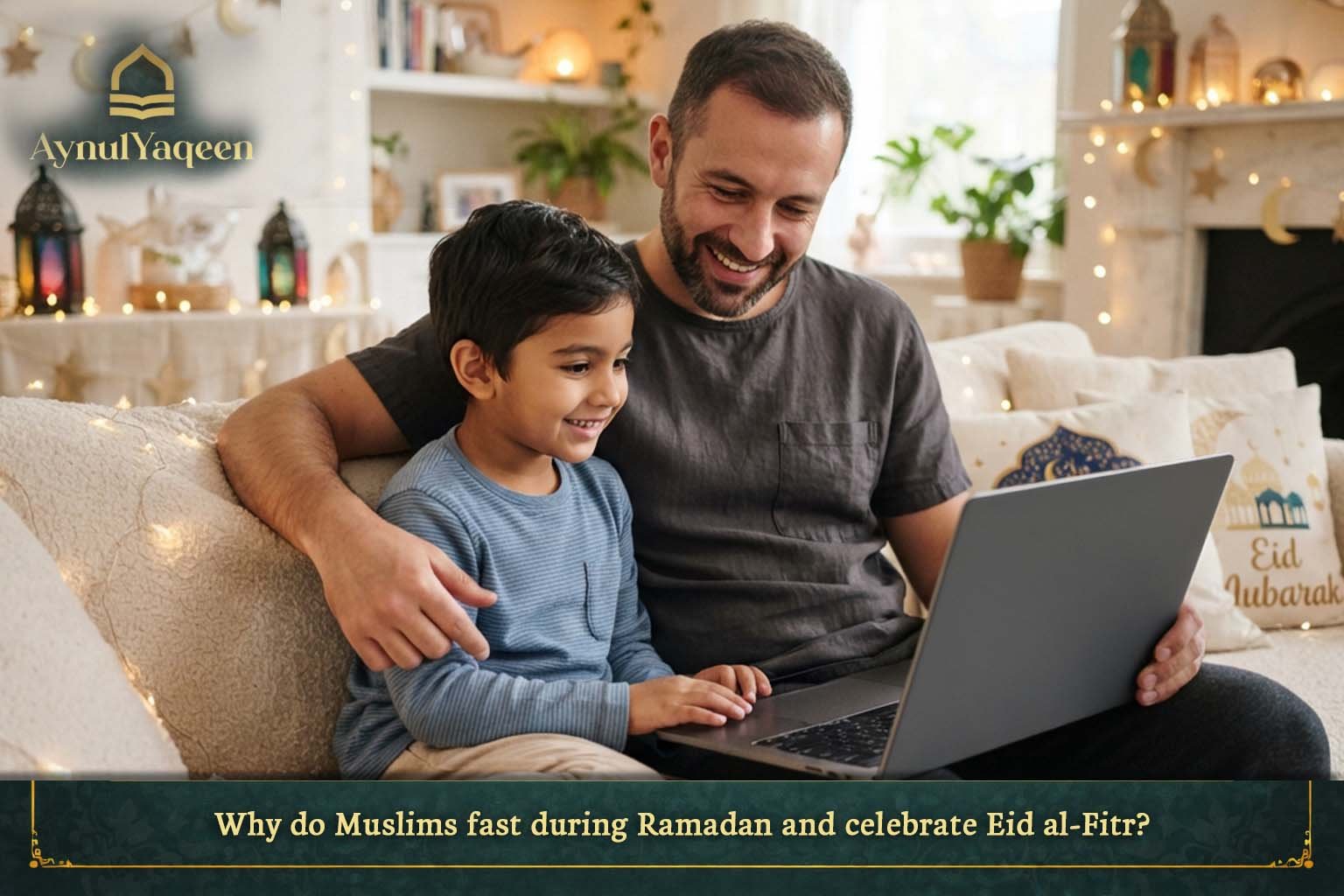
Ramadan ends with Eid al-Fitr, one of the major Islamic celebrations. Eid is a day of gratitude and happiness after completing a month of fasting and worship. Muslims perform the Eid prayer, visit relatives and friends, share food, and celebrate together.
Zakat al-Fitr is given before the Eid prayer according to the applicable rules, helping people in need participate in the celebration.
This provides another perspective on why Muslims fast during Ramadan. The month begins with discipline and ends with gratitude, joy, generosity, and community.
However, Eid does not mean that worship ends.
The lessons of Ramadan should continue through prayer, charity, good character, and Quran engagement.
Ramadan strengthens family and community relationships
Although fasting is an individual act of worship, Ramadan can have a powerful communal effect.
Families share Suhoor and Iftar. Relatives visit one another. Neighbors exchange food. Mosques become centers for prayer and community interaction.
These activities can strengthen relationships. Ramadan also provides opportunities to reconnect with relatives and resolve disagreements.
Community charity becomes another source of connection. People may organize food distributions, support vulnerable families, and assist those experiencing financial difficulties.
This demonstrates why Muslims fast during Ramadan as a practice that can influence both personal spirituality and social responsibility.
The relationship between fasting and gratitude
Gratitude is one of the strongest themes of Ramadan.Fasting makes people more aware of blessings because they temporarily experience the absence of things they normally have.
Water becomes more noticeable. Food becomes more appreciated. Family meals can feel more meaningful. This can encourage Muslims to become less wasteful and more grateful.
Gratitude also changes perspective. Rather than focusing exclusively on what is missing, a person learns to recognize what is already available.
This does not mean ignoring genuine difficulties. Instead, it encourages believers to acknowledge difficulties while continuing to recognize blessings.
Thus, why Muslims fast during Ramadan also includes developing a healthier attitude toward everyday blessings.
Why do Muslims fast during Ramadan as preparation for life beyond Ramadan?
The strongest Ramadan experience should create lasting change. If someone becomes more patient, that patience should continue after Ramadan. If someone establishes a Quran habit, they should try to maintain it. If someone becomes more generous, they can continue helping others.
Ramadan can therefore be viewed as an annual period of spiritual training. The goal is not necessarily to maintain every Ramadan practice at exactly the same intensity. Instead, Muslims can preserve the most valuable habits at a sustainable level.
For example, someone who reads many Quran pages each day during Ramadan may continue with a smaller daily portion after Eid.
Consistency is often more important than intensity. This is another reason why Muslims fast during Ramadan has implications that extend beyond the month itself.
Learning the Quran beyond Ramadan
Because the Quran occupies such an important place during Ramadan, the month often inspires Muslims to improve their Quran education.
Some learners want to improve pronunciation. Others want to memorize Surahs, study Tajweed, understand Quranic vocabulary, or explore Tafsir.
These goals should continue throughout the year. Aynulyaqeen Quran Academy can provide structured learning for students who want to improve Quran reading, Tajweed, memorization, and understanding.
Regular study helps ensure that the Quran remains part of everyday life instead of becoming something associated only with Ramadan.
This also strengthens the answer to why Muslims fast during Ramadan, because fasting and Quran learning can work together to deepen spiritual awareness.
Common misconceptions about Ramadan
People unfamiliar with Islam may have several misconceptions about fasting. One misconception is that Muslims fast simply to suffer. In reality, the physical difficulty is a means through which believers practice obedience, patience, self-control, and awareness of Allah.
Another misconception is that Muslims do not eat for the entire month. Muslims actually fast during daylight hours and eat before dawn and after sunset.
Some people also assume that every Muslim must fast regardless of health. Islamic law includes exemptions and concessions for people who cannot safely fast or have legitimate reasons to postpone fasting. Another misconception is that Ramadan is mainly about food.
Food is only one visible part of Ramadan. Prayer, Quran recitation, charity, repentance, remembrance, discipline, and good character are equally important.
These points provide a clearer explanation of why Muslims fast during Ramadan and what the month actually represents.
Ramadan and spiritual reflection
Ramadan creates opportunities for self-reflection. Daily responsibilities can make people focus heavily on work, education, finances, family duties, and other practical concerns. Spiritual reflection can sometimes receive less attention. Ramadan changes the daily rhythm.
The believer wakes before dawn, remembers Allah, fasts during the day, breaks the fast at sunset, prays at night, and spends additional time with the Quran.
These repeated reminders can bring spiritual priorities back into focus.
A Muslim may ask:
- Am I using my time wisely?
- Am I treating people fairly?
- Am I grateful?
- Am I praying consistently?
- What do I need to change?
These questions help explain why Muslims fast during Ramadan as a month of reflection as well as physical fasting.
Why do Muslims fast during Ramadan as a complete spiritual experience?
When all these elements are considered together, the purpose of fasting becomes clearer.
- The physical fast teaches restraint.
- Hunger encourages gratitude.
- Thirst reminds believers of their dependence on Allah.
- Difficulty develops patience.
- Charity encourages compassion.
- The Quran provides guidance.
- Prayer strengthens worship.
- Repentance creates renewal.
- Community creates connection.
- Laylat al-Qadr provides an opportunity for intensified devotion.
For this reason, why Muslims fast during Ramadan cannot be reduced to a nutritional or cultural explanation. Ramadan is an integrated form of worship designed to influence the believer’s inner character and outward behavior.
The social lessons of Ramadan
Ramadan also teaches social responsibility. People across a community wait for sunset together. Differences in wealth, age, occupation, and background remain, but fasting creates a shared experience.
Muslims may pray together, share Iftar, exchange food, and contribute to charitable projects. These practices strengthen solidarity.
They also remind believers that religious devotion should influence how people treat others. Someone who becomes more conscious of Allah should ideally become more conscious of poverty, loneliness, injustice, and hardship.
This is another important answer to why Muslims fast during Ramadan: fasting can encourage stronger concern for the wider community.
How parents can teach children about Ramadan
Children are generally not required to fast before reaching the age at which Islamic obligations apply, but parents can introduce them gradually to Ramadan.
Children can help prepare Iftar, participate in charitable activities, listen to Quran, learn duas, or join family prayers in age-appropriate ways. The focus should be education rather than unnecessary pressure.
Parents can explain that Ramadan is not only about waiting for food. It is also about gratitude, kindness, patience, generosity, prayer, and remembering Allah.
This approach helps children understand why Muslims fast during Ramadan and creates positive associations with the month.
How can new Muslims understand Ramadan?
For a new Muslim, Ramadan may initially seem overwhelming. There may be new prayers, fasting rules, Quran reading, Islamic terminology, community practices, and changes to daily routines.
The best approach is gradual learning. A new Muslim does not need to understand every Islamic ruling immediately. Learning can take place step by step.
Starting with the basic purpose of fasting, the prayer schedule, essential rules, and the meaning of Ramadan can provide a strong foundation.
Quran study is also valuable because it helps new Muslims engage directly with Islam’s primary scripture.
Aynulyaqeen Quran Academy can help learners develop Quran skills through structured education while they gradually strengthen their understanding of Islam.
This gradual approach makes why Muslims fast during Ramadan easier to understand without making new Muslims feel overwhelmed.
Why do Muslims fast during Ramadan and continue worship after Eid?
When Ramadan ends, the special daily routine changes. Tarawih is no longer part of the regular Ramadan schedule. Iftar gatherings become less frequent, and people return to ordinary routines.
However, Muslims are encouraged to preserve the good habits they developed. A person who established daily Quran reading can continue. Someone who became more charitable can keep giving. Someone who improved their patience can continue practicing it.
The five daily prayers remain obligatory after Ramadan. This continuity demonstrates why Muslims fast during Ramadan as a form of training rather than temporary enthusiasm. The purpose is to help believers become stronger in faith and better in character throughout the year.
The Lasting Lessons Muslims Learn From Fasting

Several lessons from Ramadan can remain valuable after the month ends.
- Self-control: Fasting teaches that experiencing a desire does not mean that it must immediately be satisfied.
- Patience: Waiting until sunset teaches perseverance and emotional restraint.
- Gratitude: Hunger and thirst can make ordinary blessings more visible.
- Compassion: Temporary hunger can encourage greater awareness of people facing hardship.
- Generosity: Ramadan motivates Muslims to give and support others.
- Discipline: Daily fasting, prayer, and Quran routines encourage organization and commitment.
- Reflection: The month provides opportunities to evaluate personal behavior and priorities.
- Spiritual awareness: Fasting repeatedly reminds Muslims of Allah throughout the day.
These lessons explain why Muslims fast during Ramadan and why the month remains one of the most significant periods in the Islamic calendar.
Frequently Asked Questions About Ramadan Fasting
Answers common questions about the rules, purpose, exemptions, and spiritual benefits of fasting during Ramadan.
Is Ramadan fasting required for children?
Children are generally not required to fast before reaching the age at which Islamic obligations apply. Parents can introduce fasting gradually and appropriately so children learn about Ramadan without unnecessary hardship.
Can a Muslim fast while traveling?
Islamic law provides concessions for travelers. A person may be permitted to break the fast while traveling and make up the missed days later. The details depend on the circumstances, so a qualified scholar can provide appropriate guidance.
What should a Muslim do if fasting becomes medically unsafe?
Someone whose health makes fasting unsafe should seek appropriate medical advice and consult a qualified Islamic scholar about the religious ruling. Islam recognizes genuine health-related limitations.
Why is Ramadan based on the lunar calendar?
The Islamic calendar follows lunar months. As a result, Ramadan moves approximately ten or eleven days earlier each year in relation to the solar calendar. Over time, Muslims experience Ramadan during different seasons.
Does the spiritual benefit of Ramadan end when Eid begins?
No. Eid marks the end of the Ramadan fast, but the lessons of Ramadan can continue. Muslims can maintain prayer, Quran reading, charity, gratitude, patience, and other good habits throughout the year.
In conclusion, why Muslims fast during Ramadan is not simply a question about avoiding food and drink. Muslims fast because Allah has commanded fasting, while Ramadan also provides a profound opportunity to develop taqwa, patience, self-discipline, gratitude, compassion, generosity, and stronger character.
Fasting encourages Muslims to become more conscious of Allah, appreciate His blessings, care about people in need, increase charity, strengthen prayer, and build a closer relationship with the Quran. Therefore, the purpose of fasting extends far beyond physical hunger. It is a spiritual journey that can transform the heart and influence everyday behavior.
Ultimately, why Muslims fast during Ramadan can be answered through the broader purpose of worship: to obey Allah, improve oneself, strengthen faith, and live with greater awareness and responsibility. When the lessons of Ramadan continue after Eid, fasting becomes more than a temporary practice—it becomes a means of lasting spiritual growth and a closer relationship with Allah.
