

Quran recitation mistakes are among the most common challenges faced by many Muslims who want to recite the Quran correctly and beautifully. Although millions of people read the Quran every day with sincerity and love, some pronunciation and Tajweed errors can remain unnoticed for years without proper correction.
Reciting the Quran is not only about reading the words from the Mushaf; it is about preserving the exact pronunciation, rhythm, and rules that were transmitted through generations. A person may have excellent memorization skills and still make repeated mistakes in articulation, elongation, stopping points, or pronunciation of specific Arabic letters.
Many readers are surprised when they discover that small habits developed during childhood can affect the accuracy of their recitation. These mistakes are usually not caused by a lack of respect for the Quran, but because many learners did not receive continuous guidance from a qualified teacher who could identify and correct subtle issues.
At Aynulyaqeen Quran Academy, students receive structured Quran lessons and expert guidance to identify and correct Quran recitation mistakes. Through personalized feedback, proper Tajweed training, and continuous practice, learners can improve their pronunciation and develop a more accurate and confident recitation style.
Understanding these errors is the first step toward improving recitation. When a reader recognizes the areas that need attention, practicing becomes more focused and effective.
Why Is Correcting Quran Recitation Mistakes Important?
The Quran was revealed in the precise Arabic language, and every letter has its own characteristics, pronunciation point, and sound quality. Changing a letter or ignoring a Tajweed rule can sometimes affect the meaning of the words being recited. Islamic scholars have traditionally divided recitation errors into two main categories:
Major Errors (Al-Lahn Al-Jali)
These are clear mistakes that may change the meaning of a word. They usually happen when a person replaces one Arabic letter with another, changes a vowel, or makes a pronunciation mistake that transforms the original word.
For example, Arabic letters such as س (Seen) and ص (Saad) may look similar to non-Arabic speakers, but they are completely different letters with different sounds. Pronouncing one instead of the other can lead to a different meaning.
These types of mistakes require immediate attention because they directly affect the accuracy of Quranic words.
Minor Errors (Al-Lahn Al-Khafi)
These mistakes do not usually change the meaning but affect the beauty and correctness of recitation. Examples include incorrect nasal sounds, inconsistent elongation, or weak application of Tajweed rules.
Although they are less severe, correcting them helps a Muslim achieve a more accurate and confident recitation.
A balanced learning approach focuses first on correcting major pronunciation issues before moving toward improving advanced Tajweed skills.
Learn Online with Aynulyaqeen Quran Academy
Choosing the right online Quran academy can make a significant difference in your learning journey. Aynulyaqeen Quran Academy provides structured Quran courses for beginners and advanced learners, focusing on accurate Quran reading, Tajweed, memorisation, and Islamic studies. With qualified teachers, flexible class schedules, and personalised one-on-one lessons, students of all ages can learn at their own pace while building confidence in reciting and understanding the Holy Quran from anywhere in the world.

Quran Recitation Mistakes Related to Letter Pronunciation
One of the biggest reasons behind incorrect Quran recitation is misunderstanding the correct pronunciation points of Arabic letters, known as Makharij Al-Huroof.
Arabic contains sounds that do not exist in many other languages. Because of this, non-Arabic speakers often replace certain letters with sounds that are familiar to them.
Confusing Similar Arabic Letters
Some Arabic letters may seem similar in sound, but each letter has a unique pronunciation, articulation point, and quality. Learning these differences helps readers avoid mistakes and improve accurate Quran recitation.
Mixing Between Seen (س) and Saad (ص)
The letter Seen is a light letter with a clear and soft sound, while Saad is a heavy letter pronounced with elevation of the tongue.
Many learners pronounce both letters the same way because their native language does not contain a distinction between light and heavy sounds.
This mistake can affect words where changing the letter changes the meaning. Practicing these letters separately with attention to tongue position helps develop accuracy.
Confusing Haa (ح) and Haa (ه)
Arabic has two letters that are often represented by the same English letter “h,” but their pronunciation is completely different.
- ح (Haa) comes from the middle of the throat.
- ه (Haa) is a lighter sound produced closer to the mouth.
Many beginners pronounce both letters similarly because they rely on transliteration instead of learning the original Arabic sounds.
Difficulty With Ayn (ع)
The letter Ayn is one of the most challenging Arabic letters for many learners because it has no direct equivalent in English and several other languages.
It originates from the middle of the throat and requires specific muscle control. Some readers replace it with a simple vowel sound, which removes the unique identity of the letter.
Consistent practice with a qualified instructor is usually the fastest way to improve this pronunciation.
Common quran recitation mistakes in Makharij and Tajweed Application
Correct pronunciation is not achieved only by memorizing the alphabet. A reader must understand where every sound begins and how the mouth, tongue, and throat work together. For anyone interested in how to learn quran, understanding Makharij and Tajweed is an essential step toward developing accurate and confident recitation.
Mispronouncing Qaf (ق)
The letter Qaf is produced from the deepest part of the tongue near the throat. Many learners pronounce it closer to Kaf (ك) because both sounds feel similar.
However, they are different letters with different characteristics.
A useful practice method is repeating the letter alone before reading words containing Qaf. This helps train the speech muscles and creates a stronger connection between the correct sound and its pronunciation point. This approach is especially helpful for students who want to understand how to read the quran for beginners and build correct habits from the start.
Difficulty With Dhad (ض)
Dhad is often described as one of the most difficult Arabic letters. Many learners replace it with a D sound or another nearby pronunciation.
The correct pronunciation requires controlling the side of the tongue and maintaining the heaviness of the letter.
Because this sound is unique, listening carefully to skilled Quran reciters and receiving personal correction can make a significant difference. Students following a structured program to learn Arabic for beginners with Egyptian teachers can receive guidance on difficult Arabic sounds and improve their pronunciation gradually.
Incorrect Pronunciation of Khaa (خ) and Ghayn (غ)
The letters Khaa and Ghayn come from the upper throat area. Learners sometimes replace them with sounds closer to K or G because they are easier to pronounce.
Developing these sounds requires repeated practice, especially when they appear in different words and positions. Proper pronunciation training also supports students who are learning how to memorize the noble quran easily, because correct reading helps create stronger memorization habits.
How Lack of Correction Creates Long-Term Recitation Habits?
Many Quran readers develop pronunciation habits gradually. A person may begin learning at a young age, repeat the same patterns for years, and eventually believe that the pronunciation is correct simply because it feels natural.
The challenge is that the human ear often accepts familiar sounds. Without someone trained to identify small differences, a learner may not notice the mistake.
This is why regular evaluation is valuable. A reader who records their recitation and compares it with a qualified teacher’s feedback can discover areas that need improvement.
Programs such as Aynulyaqeen Quran Academy focus on helping learners improve Quran reading through structured guidance and attention to correct pronunciation principles. These lessons also help students who want to explore interpretation of the quran for kids by building a strong foundation in reading and understanding Quranic verses.
The Role of Tajweed in Improving Quran Recitation
Tajweed is not simply a set of complicated rules to memorize. It is a method of protecting the pronunciation of Quranic words and maintaining the way they were traditionally recited.
A strong Tajweed foundation helps readers understand:
- Where each letter comes from.
- How long sounds should be extended.
- When letters merge or remain separate.
- How to stop and continue correctly.
- How to maintain a balanced recitation style.
Many people think Tajweed is only necessary for advanced students, but even beginners benefit from learning basic rules early because it prevents incorrect habits from becoming permanent. Learning these foundations is an important part of how to learn quran correctly and developing lifelong Quran reading skills.
Understanding quran recitation mistakes related to Madd and Sound Duration
One of the most common areas where readers struggle is the correct application of Madd, which refers to the elongation of certain sounds in Quranic recitation. The length of a sound in the Quran is not based on personal preference or the reader’s mood; it follows specific Tajweed principles.
Many learners focus on pronouncing letters correctly but overlook the importance of maintaining the correct duration of extended sounds. This can affect the rhythm, flow, and beauty of the recitation.
Shortening Natural Madd
Natural Madd, known as Madd Tabee’i, is the basic type of elongation in Quran recitation. It normally requires two counts.
A common mistake happens when readers shorten this extension because they are reading quickly. The long vowel becomes too short, making the recitation lose its proper balance.
For example, when a word contains a long vowel sound from Alif, Waw, or Ya, the reader should allow the sound to complete its required duration rather than rushing through it.
Excessive Extension of Sounds
Another issue occurs when some readers extend every long sound for too many counts, believing that longer sounds make the recitation more beautiful.
However, Tajweed is based on accuracy, not personal style. Adding extra length without a rule can disturb the natural structure of the verse.
Beautiful recitation comes from following the rules correctly, not from exaggerating sounds.
Inconsistent Madd During Reading
Some readers pronounce the same type of Madd differently throughout one Surah. They may extend one word correctly but shorten another similar word without realizing it.
This inconsistency often happens because the reader depends on feeling rather than counting.
A useful training method is to practice slowly while counting the duration of each Madd. With time, the correct timing becomes natural.
Quran recitation mistakes in Ghunnah and Noon Rules
Ghunnah is another important part of Tajweed that many learners find difficult. It refers to the nasal sound that appears in specific situations involving Noon and Meem. A correct Ghunnah should come through the nasal passage and usually lasts for two counts.
Missing Ghunnah Completely
Some readers pronounce Noon and Meem without applying the required nasal sound. This usually happens because they focus only on the letter itself and overlook the Tajweed rule connected to it.
For example, when Noon Mushaddad or Meem Mushaddad appears, the nasal sound is an essential part of correct pronunciation.
Weak or Short Ghunnah
Another frequent problem is producing Ghunnah but not completing its required duration. The sound may appear for a very short moment instead of maintaining the proper two counts. Practicing isolated examples before reading full verses can help strengthen this skill.
Producing Ghunnah From the Wrong Place
Some learners create a sound that feels nasal but does not actually come from the nasal passage.
A simple exercise is gently holding the nose while practicing Ghunnah. If the sound changes significantly, it indicates that the nasal passage is involved correctly.
Mistakes in Noon Sakinah and Tanween Rules
The rules of Noon Sakinah and Tanween are among the most frequently practiced Tajweed topics because they appear throughout the Quran. These rules include:
- Izhar
- Idgham
- Iqlab
- Ikhfa
Many learners understand the definitions but struggle when applying them during actual recitation.
Confusing Idgham and Ikhfa
Idgham means merging one sound into another, while Ikhfa means partially hiding the Noon sound while maintaining Ghunnah.
A common problem is applying Idgham where Ikhfa is required or treating every situation as a simple merging rule.
This happens because learners memorize the rules but do not practice enough examples from the Quran.
The best approach is learning the letters associated with each rule and practicing them repeatedly until recognition becomes automatic.
Forgetting Iqlab
Iqlab occurs when Noon Sakinah or Tanween is followed by the letter Baa. In this situation, the Noon sound changes into a hidden Meem sound with Ghunnah.
Some readers pronounce the original Noon directly and miss this transformation completely. Regular practice with examples helps make this rule easier to recognize.
Correct Stopping and Starting: An Essential Part of Quran Recitation
Many readers focus on pronunciation but underestimate the importance of stopping correctly while reading the Quran.
Stopping, known as Waqf, affects how the listener understands the meaning of the verses. A reader who stops in the wrong place may unintentionally create confusion or give an incomplete meaning.
Stopping Based Only on Breathing
One of the most common habits is stopping whenever the reader runs out of breath. Although breathing is necessary, Quranic stopping should also consider the meaning and structure of the verse.
The symbols found in the Mushaf guide suitable places to stop and places where continuing is better.
Ignoring Waqf Signs
Many readers see stopping symbols but do not understand their meanings. Learning these signs helps the reader know:
- Where stopping is recommended.
- Where continuing is preferred.
- Where stopping may affect meaning.
Understanding Waqf improves both accuracy and confidence during recitation.
The Problem of Reading Too Quickly
Speed is another factor behind many quran recitation mistakes. Some readers believe that finishing more pages quickly means they are achieving more reward. While reading more Quran is valuable, speed should not come at the expense of correct pronunciation. The Quran encourages measured and thoughtful recitation:
“And recite the Quran with measured recitation.” (Surah Al-Muzzammil 73:4)
Tarteel means reading with calmness, clarity, and attention. When a person rushes:
- Madd becomes shorter.
- Ghunnah becomes incomplete.
- Letter pronunciation becomes weaker.
- Tajweed rules are easily forgotten.
A slower practice speed helps build accuracy. Once correct habits become established, the reader can naturally increase their pace without losing quality.
Practical Steps to Correct quran recitation mistakes
Recognizing mistakes is only the beginning. Real improvement requires a consistent method and patience.
1. Record Your Own Recitation
Many errors become obvious when listening to a recording. Choose a short Surah and record yourself reading it. Then listen carefully and compare your pronunciation with a reliable recitation. This practice can reveal issues that are difficult to notice while reading.
2. Learn From a Qualified Teacher
Some pronunciation problems cannot be corrected through self-study alone.A teacher can identify:
- Incorrect articulation points.
- Weak Tajweed application.
- Problems with rhythm and timing.
Personal feedback helps shorten the learning process because the learner knows exactly what needs improvement.
Learners who want structured Quran education can benefit from programs such as Aynulyaqeen Quran Academy, where attention is given to proper recitation methods and individual progress.
3. Focus on One Mistake at a Time
Trying to fix every problem at once can make improvement difficult. A better approach is choosing one area, such as letter pronunciation or Madd timing, and practicing it consistently before moving to another skill. Small improvements repeated regularly create lasting results.
4. Practice Daily Even for a Short Time
Consistency is more important than long but irregular study sessions. Fifteen or twenty minutes of focused practice every day can create stronger results than occasional long sessions. The goal is to build correct habits until accurate recitation becomes natural.
Choosing the Right Learning Approach
Every Quran learner has different needs. Some may need help with basic pronunciation, while others may need advanced Tajweed correction. A suitable learning program should provide:
- Experienced instructors.
- Clear explanations.
- Regular feedback.
- Practice opportunities.
- A supportive learning environment.
Modern online learning has made Quran education more accessible for students worldwide. With proper guidance, learners can improve their recitation regardless of their location or previous experience.
Aynulyaqeen Quran Academy provides Quran learning opportunities designed to support students who want to strengthen their reading skills and build confidence in their recitation journey.
Advanced quran recitation mistakes That Many Readers Overlook
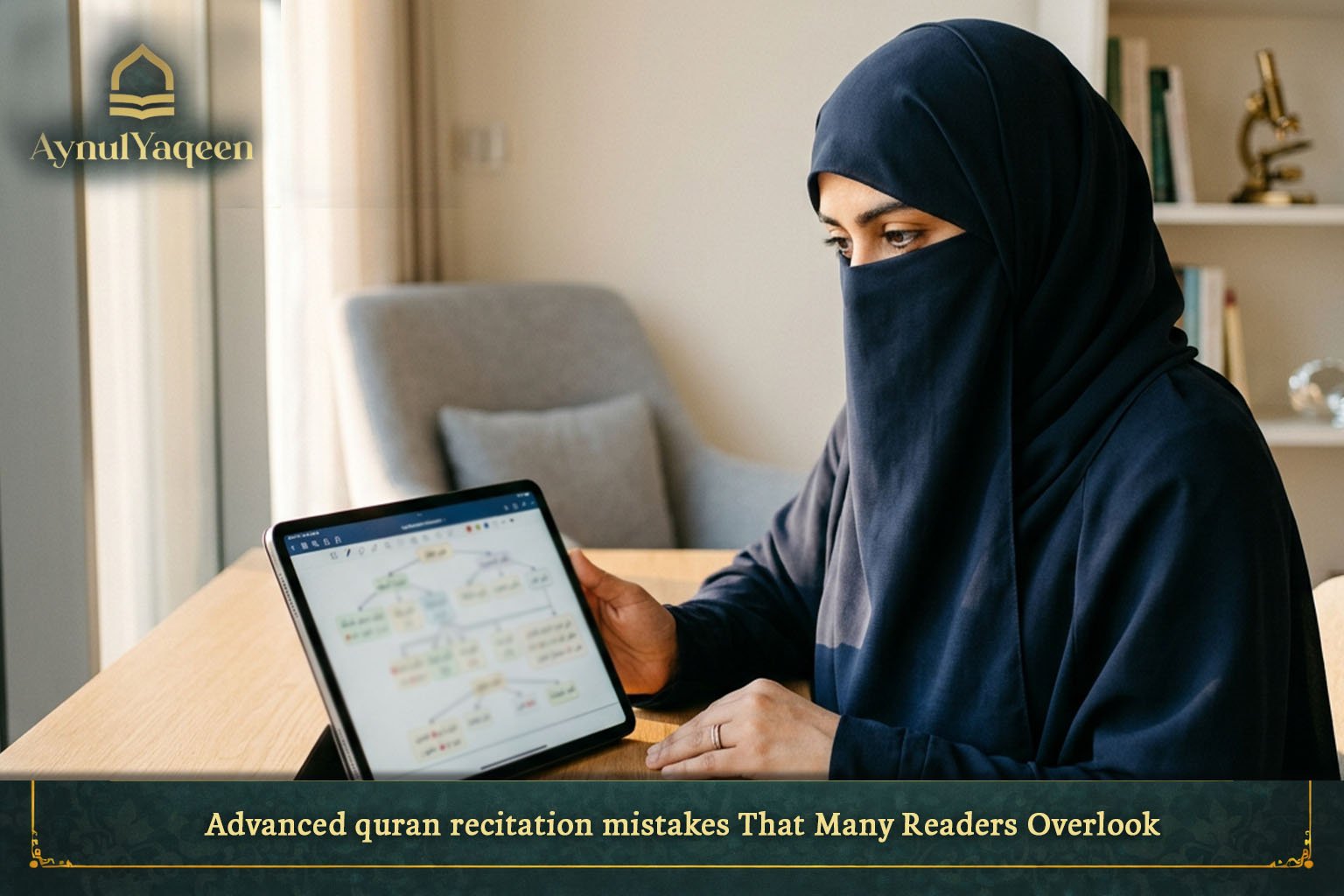
As learners progress in their Quran journey, they often correct the obvious pronunciation problems and begin focusing on smaller details. However, some advanced quran recitation mistakes can continue for years because they are subtle and difficult to notice without careful listening.
These advanced quran recitation mistakes do not always come from a lack of knowledge. Sometimes they happen because a person learned a certain style of recitation early and continued practicing it without receiving detailed correction.
Improving Quran recitation requires continuous awareness. Even experienced readers benefit from reviewing their pronunciation, listening to qualified reciters, and receiving feedback from knowledgeable teachers to identify hidden quran recitation mistakes.
Weakness in Tafkheem and Tarqeeq
Arabic letters are divided into letters that are naturally heavy (Tafkheem) and letters that are naturally light (Tarqeeq).
One of the less obvious quran recitation mistakes is failing to maintain the correct quality of heavy and light letters. When Tafkheem and Tarqeeq are not applied properly, the natural beauty and accuracy of Quran recitation may be affected.
For example, letters such as:
- ص (Saad)
- ض (Dhad)
- ط (Taa)
- ظ (Dhaa)
- ق (Qaaf)
- غ (Ghayn)
- خ (Khaa)
require heaviness, while most other letters are read lightly.
Some readers make heavy letters too light, while others make light letters unnecessarily heavy. These are common quran recitation mistakes that can affect pronunciation and the correct characteristics of Arabic letters.
The solution is learning the characteristics of each letter and practicing words that contain these letters repeatedly. Consistent training helps reduce quran recitation mistakes and improves overall recitation quality.
Incorrect Application of Qalqalah
Qalqalah is the slight echoing sound produced when certain letters have a Sukoon. Understanding its correct application helps prevent many quran recitation mistakes related to letter sounds. The Qalqalah letters are:
ق
ط
ب
ج
د
A common misunderstanding is that Qalqalah means adding an exaggerated bouncing sound. Some readers make it too strong, while others barely pronounce it. Both situations are examples of quran recitation mistakes that reduce the balance of recitation.
The purpose of Qalqalah is clarity, not adding unnecessary sounds. A balanced Qalqalah allows the listener to recognize the letter clearly while maintaining the natural flow of the verse.
Practicing Qalqalah correctly with a qualified teacher can help learners identify and correct hidden quran recitation mistakes.
Ignoring the Characteristics of Letters
Every Arabic letter has specific qualities that distinguish it from others. These qualities are called Sifaat Al-Huroof. Many students learn where letters come from but do not study their characteristics.
Ignoring these qualities can lead to quran recitation mistakes because correct pronunciation depends not only on the place of articulation but also on the way each letter should sound.For example, some letters have qualities such as:
- Strength.
- Softness.
- Openness.
- Elevation.
- Whistling sound.
Understanding these characteristics improves pronunciation because the reader learns not only where the letter comes from but also how it should sound.
Learning Sifaat Al-Huroof is an important step in overcoming advanced quran recitation mistakes and developing a more accurate Quran reading style.
With continuous practice, careful listening, and proper guidance, many advanced quran recitation mistakes can be corrected, allowing readers to improve their Tajweed and recite the Quran with greater confidence.
How to Know If Your Quran Recitation Is Improving?
Improvement in Quran recitation does not happen only by reading more pages. It appears through specific signs that show better control, understanding, and correction of quran recitation mistakes. When learners focus on identifying and improving their quran recitation mistakes, they can develop stronger pronunciation, better Tajweed application, and more confidence during reading.
Greater Awareness of Your Own Errors
A beginner may not notice quran recitation mistakes at all. As learning develops, the reader becomes more aware of small pronunciation differences and understands which areas require improvement. Recognizing quran recitation mistakes is actually a positive sign because awareness is the beginning of correction.
Better Control of Reading Speed
An improving reader can maintain a comfortable pace without rushing or losing Tajweed rules. Avoiding quran recitation mistakes related to speed helps maintain proper Madd, Ghunnah, and accurate pronunciation. The goal is not the fastest recitation but the most accurate and meaningful one.
More Confidence With Difficult Letters
Letters that once felt impossible become easier through repeated practice. A learner who once struggled with letters like Ayn, Dhad, or Qaaf may eventually pronounce them naturally after consistent training and by correcting common quran recitation mistakes.
Receiving Positive Feedback From Teachers
External evaluation remains one of the strongest indicators of progress. A qualified teacher can notice improvements that the learner may not recognize personally and can help correct remaining quran recitation mistakes through detailed guidance.
Building a Long-Term Plan for Better Quran Recitation
Correcting quran recitation mistakes is not a one-time task. It is a continuous journey that requires commitment, patience, and regular practice. A successful plan should include several important habits.
Listen Before You Read
Listening to skilled Quran reciters helps train the ear. Before attempting difficult passages, listen carefully to how experienced reciters pronounce letters, apply Tajweed rules, and manage pauses. Listening alone does not replace learning, but it creates a strong foundation for reducing quran recitation mistakes.
Repeat Difficult Verses
When a specific verse contains challenging letters or rules, repeat it several times. Instead of reading quickly and moving forward, focus on mastering the difficult parts. Quality practice creates greater improvement than simply increasing the amount of reading and helps prevent repeated quran recitation mistakes.
Review Previously Learned Rules
Even advanced learners can forget details over time. Regular review of Tajweed principles keeps knowledge active and prevents old quran recitation mistakes from returning.
Maintain Humility During Learning
The Quran is a lifelong journey. Every learner, regardless of their level, can continue improving. Approaching correction with patience and openness allows progress to happen naturally and helps overcome quran recitation mistakes.
The Importance of Learning Quran With Proper Guidance
Many people try to correct their recitation by watching videos or listening to recordings. These resources can be helpful, but they may not identify personal pronunciation issues or specific quran recitation mistakes.
Every person has different challenges. One learner may struggle with Arabic letters, while another may need improvement in Madd or stopping rules. A teacher provides personalized correction that cannot always be achieved through independent learning.
Structured Quran programs can help students build strong foundations and continue improving step by step. Aynulyaqeen Quran Academy supports learners who want guidance in developing accurate Quran reading skills through organized lessons and practical correction.
Common Misunderstandings About Quran Recitation Improvement
Many learners have incorrect beliefs about improving Quran recitation, such as thinking that years of reading automatically guarantee accuracy or that Tajweed is only for advanced students. Understanding these misconceptions helps readers focus on proper correction, continuous learning, and improving their recitation skills.
Some people believe that experience alone prevents quran recitation mistakes, but regular evaluation and correction are still necessary for progress.
“I Have Been Reading for Years, So My Recitation Must Be Correct”
Experience is valuable, but time alone does not guarantee accuracy. A person can repeat the same mistake for many years if nobody points it out. Correction and feedback are important parts of improvement.
“Tajweed Is Only for Advanced Students”
Tajweed is beneficial for everyone. Beginners especially benefit because learning correct pronunciation from the beginning prevents difficult habits and quran recitation mistakes from forming.
“Beautiful Voice Is More Important Than Correct Pronunciation”
A pleasant voice can make recitation enjoyable, but accuracy comes first. The beauty of Quran recitation comes from respecting the words of Allah and preserving their correct pronunciation.
Improving Quran Recitation: A Journey of Correction and Learning

Every Quran reader wants to connect with the words of Allah in the best possible way. Recognizing and correcting quran recitation mistakes is not a sign of weakness; it is a sign of commitment to improvement.
Many readers discover that their recitation contains habits they never noticed before. With proper guidance, regular practice, and patience, these challenges can be overcome.The most important steps are simple:
- Listen carefully.
- Practice consistently.
- Seek correction.
- Focus on accuracy.
- Continue learning.
The goal of Quran recitation is not only to complete more pages but to recite with care, understanding, and respect.
Correcting quran recitation mistakes allows the reader to preserve the beauty of Quranic words and develop a stronger connection with the message of the Quran.
Every improvement, even a small one, is valuable. A single corrected letter, a properly applied Tajweed rule, or a more thoughtful pause can transform the quality of recitation.
The journey may require time, but every step taken toward better Quran recitation is meaningful.
Frequently Asked Questions: Quran recitation mistakes
Find answers to common questions about correcting quran recitation mistakes, improving Tajweed skills, and developing a more accurate and confident Quran reading style.
How can I identify my Quran recitation mistakes?
The best way is to record your recitation and receive feedback from a qualified Quran teacher. Some pronunciation issues are difficult to notice without external evaluation.
How long does it take to improve Quran recitation?
The time depends on the learner’s current level, the types of mistakes, and the consistency of practice. Regular daily practice usually produces steady improvement over time.
Can I learn correct Quran recitation without a teacher?
Self-learning resources can provide useful information, but personal correction from a qualified teacher is often necessary, especially for pronunciation points and advanced Tajweed rules.
In conclusion,quran recitation mistakes are an important area that every Quran learner should focus on improving. Correcting these mistakes requires patience, regular practice, and proper guidance to achieve accurate pronunciation and stronger Tajweed skills.
Improving Quran recitation is a continuous journey that requires dedication and learning. By identifying and correcting quran recitation mistakes, learners can enhance their pronunciation, apply Tajweed rules correctly, and develop a more beautiful and confident recitation style.
Every small improvement, whether correcting a letter, applying a Tajweed rule correctly, or improving the quality of sounds, brings the reader closer to reciting the Quran with care and respect. With consistent practice and support from qualified teachers, overcoming quran recitation mistakes becomes easier and more achievable.
The purpose of Quran learning is not only to complete more verses but to preserve the beauty, meaning, and correct pronunciation of the Quran while building a stronger spiritual connection through accurate and meaningful recitation.
