

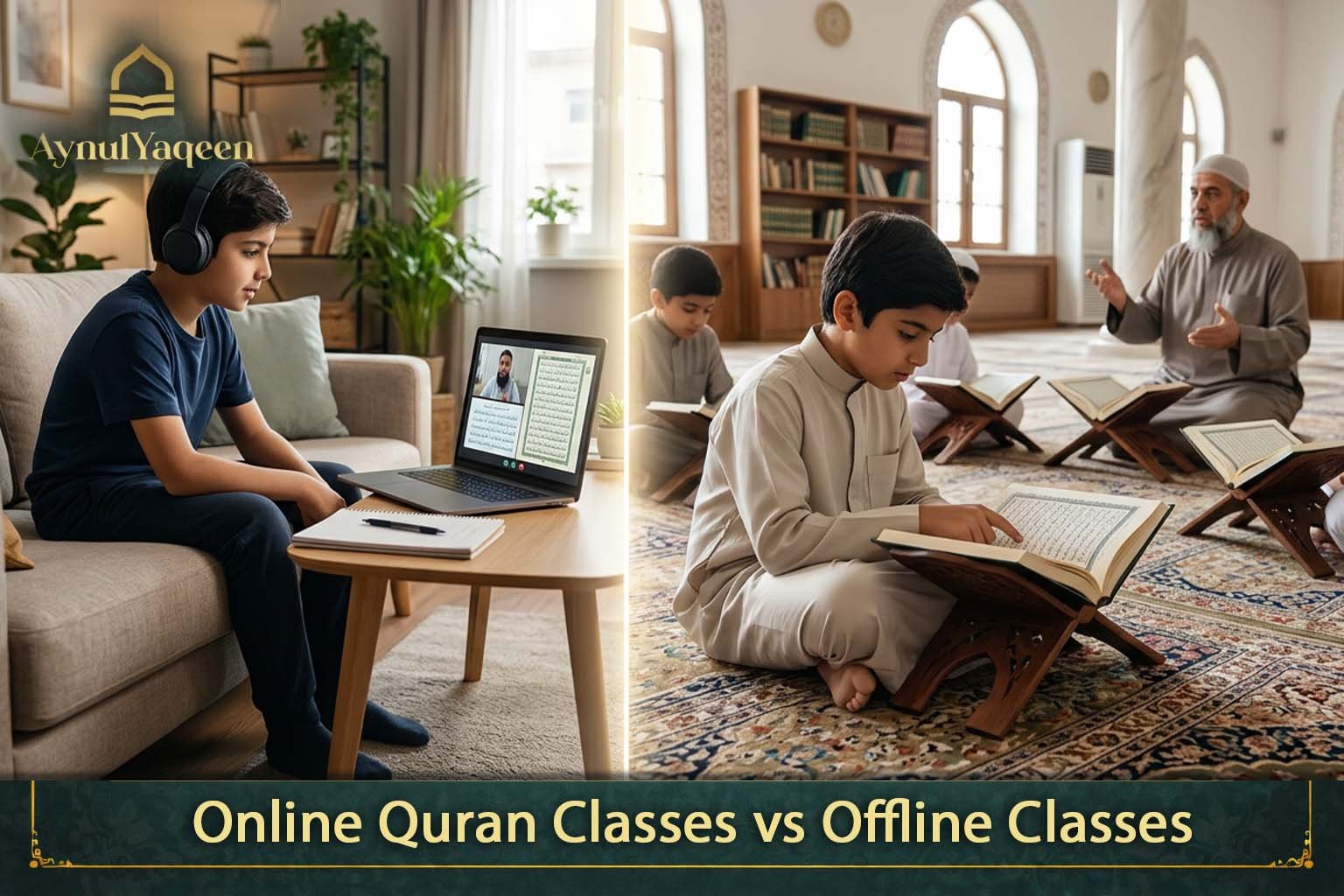
Online Quran Classes vs. Offline Classes is an important comparison for parents, adults, and anyone seeking a suitable way to learn the Quran. Both methods can help students improve recitation, understand Tajweed rules, and build a consistent learning routine. However, each offers a different learning environment, level of flexibility, and type of interaction.
Choosing between online and traditional lessons depends on the student’s age, daily schedule, learning goals, and personal preferences. A busy adult may prefer studying from home, while a child may benefit from the social environment of a local learning center.
Aynulyaqeen Quran Academy is an option families can explore when considering online Quran education. Reviewing its available learning options can help them decide whether its teaching arrangements match their needs.
There is no single method that suits every learner. This guide explains the main differences and practical considerations to help students choose an approach that supports long-term Quran learning.
Comparing Online and Traditional Quran Learning Methods

The main difference between online and offline Quran education is the learning environment. Online lessons take place through digital communication platforms, allowing students and teachers to meet without being in the same physical location. Traditional lessons usually happen in a mosque, Islamic center, madrasa, or private classroom.
When comparing online Quran classes vs. offline classes, it is useful to consider how each method affects the student’s daily routine. Online education removes the need to travel, while traditional education provides direct physical interaction with the teacher and other learners. Both methods can cover similar subjects, including:
- Quran reading and pronunciation.
- Basic Arabic letters and their sounds.
- Tajweed rules and practical recitation.
- Memorization of short surahs and longer passages.
- Revision and correction of previously learned material.
- Understanding selected Quranic meanings.
The quality of learning depends on more than the teaching format. A suitable teacher, clear learning objectives, regular attendance, and consistent practice are important in either environment.
| Comparison factor | Online learning | Traditional learning |
|---|---|---|
| Location | Study from home or another suitable place | Attend a physical learning location |
| Travel | Usually unnecessary | Often required |
| Scheduling | May offer greater flexibility | Depends on center or teacher availability |
| Interaction | Through video and audio communication | Direct face-to-face interaction |
| Learning environment | Depends on the student’s home setup | Shared classroom or mosque environment |
| Social contact | Depends on group activities and communication | More opportunities for in-person interaction |
| Technology | Requires a suitable device and internet | Usually requires fewer digital tools |
This comparison shows that neither option is automatically better. The right choice depends on which environment helps the student remain focused, motivated, and consistent.
Learn Online with Aynulyaqeen Quran Academy
Choosing the right online Quran academy can make a significant difference in your learning journey. Aynulyaqeen Quran Academy provides structured Quran courses for beginners and advanced learners, focusing on accurate Quran reading, Tajweed, memorization, and Islamic studies.
With qualified teachers, flexible class schedules, and personalized one-on-one lessons, students of all ages can learn at their own pace while building confidence in reciting and understanding the Holy Quran from anywhere in the world.

Individual Attention and Quran Teaching Quality
Individual attention is essential because students learn Quran reading and Tajweed at different speeds. Some beginners need help recognizing Arabic letters, while others require pronunciation correction.
Online lessons may offer one-to-one instruction, allowing teachers to identify mistakes and provide focused practice. Traditional private lessons offer similar attention, while group classes divide the teacher’s time among learners.
- Will the student receive individual feedback?
- How much time is available for personal recitation?
- Can the teacher explain difficult Tajweed rules clearly?
- Does the learning plan consider the student’s current level?
- Is there an opportunity to review previous mistakes?
The teaching method matters more than the location of the lesson. A well-organized online lesson can be productive, just as a traditional lesson can be effective when the teacher provides suitable guidance.
Flexibility and Scheduling for Different Lifestyles
Time management is one of the most noticeable differences between digital and traditional Quran education. Students who have school, work, family responsibilities, or other commitments may find it difficult to attend lessons at fixed locations.
Online learning can make scheduling easier because students do not need to travel to a classroom. Depending on the teacher’s availability, families may be able to arrange lessons around school hours, working schedules, or other daily responsibilities.
This flexibility can be particularly useful for adults. Someone who works during the day may prefer a lesson in the evening. Similarly, parents may find it easier to arrange their children’s lessons at home.
Traditional classes often follow a fixed timetable. Students may need to attend at specific times and consider transportation arrangements. However, a regular schedule can also help learners develop discipline and maintain a consistent routine.
When considering online Quran classes vs. offline classes, remember that flexibility should not mean irregular attendance. Students still need a realistic weekly plan and enough time to revise what they learn.
A useful schedule should include:
- Regular lesson times.
- Short daily recitation practice.
- Revision of previously learned material.
- Time to prepare questions for the teacher.
- Periodic review of learning progress.
The best schedule is one that students can maintain without unnecessary pressure.
The Learning Environment and Student Concentration
A suitable learning environment helps students concentrate, but individual needs differ. Online learners study at home, where familiar surroundings may provide comfort. However, noise, notifications, and interruptions can affect their focus.
Parents can improve concentration by preparing a quiet study area, reducing distractions, and maintaining a regular lesson routine.
Traditional classrooms provide a dedicated learning space and opportunities to study alongside others. However, noise, large groups, and different learning speeds may also affect concentration.
When comparing online Quran classes vs. offline classes, families should consider which environment best supports the student’s focus and learning habits. Before choosing a method, consider whether the learner:
- Focuses better in a quiet personal space.
- Enjoys learning alongside other students.
- Needs frequent reminders to stay attentive.
- Feels comfortable asking questions.
- Can follow instructions through a screen.
A short trial lesson or observation period can help parents understand which setting is more suitable.
Choosing the Right Learning Method for Children
Children need Quran lessons that match their age, attention span, and reading ability. Short sessions, repetition, encouragement, and simple activities can support their learning.
When comparing online Quran classes vs. offline classes, parents should consider convenience and teaching methods. Online lessons reduce travel, but younger children may need help using devices and staying focused.
Traditional classes offer opportunities for group activities and friendships. However, some children prefer individual instruction and additional practice.
Ultimately, online Quran classes vs offline classes should depend on the child’s confidence, attention, and learning needs. Parents should choose the setting that encourages participation and consistent progress.
Choosing between online Quran classes and offline classes also requires considering whether the child benefits more from individual guidance or group interaction.
Parents can support their children by:
- Establishing a consistent learning routine.
- Listening to their recitation when appropriate.
- Encouraging questions instead of criticizing mistakes.
- Celebrating steady effort and improvement.
- Providing a quiet and comfortable study space.
- Communicating with the teacher about learning difficulties.
For more practical ideas, parents can explore how to motivate kids to memorize quran. Motivation is important because children are more likely to continue when learning feels manageable and encouraging.
Quran Education for Adults: Online or In Person?

Adults often have different learning needs from children. Some are complete beginners, while others can read Arabic but want to improve their recitation or memorize additional portions of the Quran.
Work commitments, family responsibilities, and limited free time can make regular attendance challenging. For this reason, online learning may be a practical option for adults who prefer studying from home.
A student can arrange lessons around other responsibilities, provided suitable times are available. This may reduce the difficulty of maintaining a regular learning routine.
Traditional lessons can also be valuable for adults. Some learners prefer meeting the teacher directly and interacting with other students. A physical learning environment may also help those who find it difficult to concentrate at home.
The decision between online Quran classes and offline classes should reflect the adult learner’s actual circumstances rather than general assumptions. Adults should consider:
- Their current Quran reading level.
- The time available for weekly lessons.
- Their preferred teaching environment.
- Whether they need individual or group instruction.
- Their goals in reading, Tajweed, or memorization.
- Their ability to practice between lessons.
A beginner may need structured guidance with Arabic letters and pronunciation. A more advanced learner may focus on fluency, Tajweed application, or memorization revision.
The important point is to choose a learning arrangement that supports steady improvement without creating an unrealistic schedule.
Learning Tajweed Through Digital and Traditional Lessons
Tajweed helps students recite the Quran according to established pronunciation rules. Learning these rules requires explanation, listening, repeated practice, and correction.
Online teaching can support Tajweed learning when the student has a clear audio connection and can communicate with the teacher effectively. The teacher can listen to the recitation and explain pronunciation mistakes through live interaction.
For instance, a student may need help distinguishing between similar Arabic sounds or applying a particular rule during recitation. The teacher can demonstrate the sound and ask the learner to repeat it.
Traditional lessons provide direct interaction in the same physical space. Some learners find it easier to follow demonstrations when the teacher is present. The teacher can also observe the student’s reading process without depending on a digital connection.
However, the physical setting alone does not guarantee accurate Tajweed instruction. The teacher’s knowledge, teaching ability, and attention to individual mistakes remain essential.
When assessing Online Quran Classes vs. offline classes for Tajweed, students should ask whether the teacher provides enough time for individual recitation and correction. A useful Tajweed learning process includes:
- Understanding the rule through a simple explanation.
- Listening to a correct pronunciation example.
- Practicing the sound or rule separately.
- Applying it while reading Quranic verses.
- Receiving feedback on mistakes.
- Revising the rule in later lessons.
Students should also practice regularly outside class. A lesson introduces and corrects skills, but consistent personal recitation helps reinforce them.
Finding a Suitable Quran Teacher
The teacher plays an essential role in successful Quran education. Students need clear explanations, appropriate Quran knowledge, patience, and constructive feedback.
When comparing online quran classes vs. offline classes, consider how each option affects teacher selection. Online learning may provide access to teachers beyond the student’s local area, while traditional classes usually offer locally available teachers.
However, location should not determine the choice alone. Students should review the teacher’s Quran education, relevant qualifications, teaching experience, and ability to correct recitation effectively. Useful questions include:
- What levels of students does the teacher work with?
- Can the teacher explain Tajweed rules clearly?
- How does the teacher assess a beginner?
- How are mistakes corrected during lessons?
- Does the teaching approach match the student’s age?
- What learning goals will be followed?
For additional guidance, read How to find a Quran teacher in the UK. The process of choosing a teacher should focus on suitable knowledge, communication, and the learner’s educational needs.
Comparing the Costs of Quran Lessons
Cost is another factor families should consider when evaluating online quran classes vs. offline classes. However, the total expense involves more than the advertised lesson price.
Online learning may reduce transportation expenses because students can study from home. Traditional learning may involve travel costs, especially when the learning center is far from the student’s location. Therefore, comparing online quran classes vs. offline classes requires looking beyond lesson fees.
Other expenses may depend on the learning arrangement. For example, online students need access to a suitable device and a reliable internet connection. Traditional students may need transportation or other materials required by the learning center.A fair comparison of online quran classes vs. offline classes should include all regular expenses.
| Expense | Online learning | Traditional learning |
|---|---|---|
| Lesson fees | Depends on the teacher and course arrangement | Depends on the teacher or learning center |
| Transportation | Usually not required | May be necessary |
| Internet | Required | Usually not required for lessons |
| Device | Computer, tablet, or suitable phone | Not normally required |
| Learning materials | May be digital or printed | May be printed or provided in class |
| Additional costs | Depend on the arrangement | May include travel or other fees |
Families should compare the actual services included in each arrangement. When assessing online quran classes vs offline classes, they should check lesson duration, frequency, class size, teaching format, and any additional charges.
For a more detailed discussion, see how much online quran classes cost. Understanding the full cost helps families make decisions based on their budgets and learning priorities. This information also makes evaluating online quran classes vs. offline classes more practical.
Tracking Student Progress and Maintaining Consistency
Progress in Quran learning is not measured only by the number of lessons attended. Students should gradually develop stronger reading skills, more accurate pronunciation, better understanding of Tajweed rules, or improved memorization.
Online lessons can make feedback easier to arrange during live sessions. Teachers can identify mistakes, explain corrections, and suggest areas for additional practice. This is an important consideration when comparing online quran classes vs offline classes.
Traditional teachers can provide similar feedback during in-person lessons. They may also observe students as they read and participate in classroom activities.
In either setting, progress should be reviewed regularly. Students and parents should understand what has been learned and which skills require more attention.
When considering online quran classes vs. offline classes, ask how learning progress will be evaluated. A simple progress review may consider:
- Recognition of Arabic letters and vowel marks.
- Reading fluency and pronunciation.
- Application of previously studied Tajweed rules.
- Accuracy when reciting familiar passages.
- Memorization progress and revision.
- Ability to correct repeated mistakes.
Progress may vary from one student to another. Therefore, comparisons between learners are not always helpful. A better approach is to evaluate each student against their previous performance and individual learning goals. This principle applies to both online quran classes and offline classes.
Consistency is also essential. Missing lessons frequently or avoiding revision can slow progress, regardless of the teaching format. Ultimately, online quran classes vs offline classes should be evaluated by considering the student’s progress, regular attendance, and ability to maintain a consistent learning routine.
Common Challenges and Practical Ways to Address Them
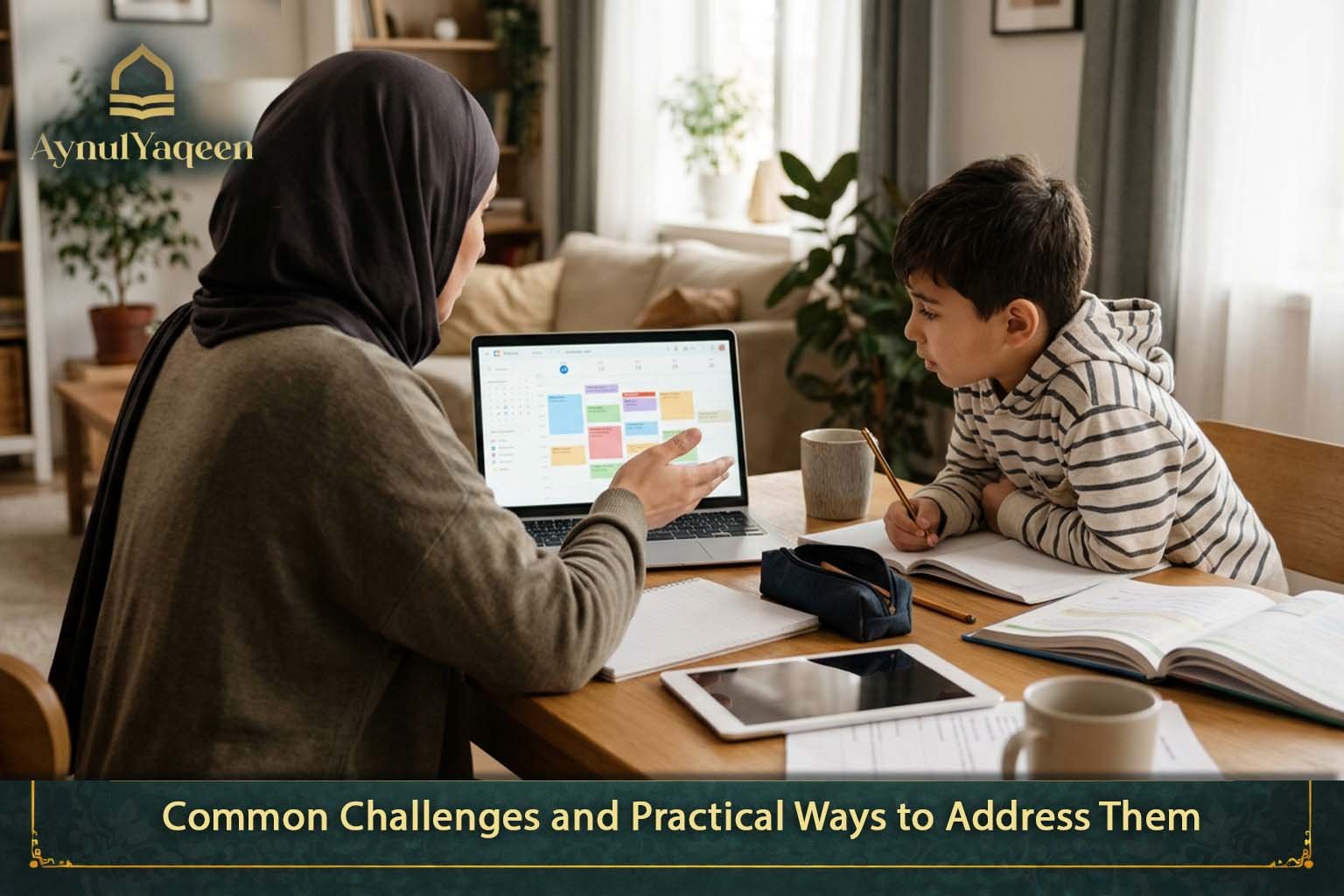
Understanding online quran classes vs offline classes means recognizing the difficulties students may face with each learning method. Preparing for these challenges can help families make better decisions.
Challenges of Online Quran Learning
Students attending online quran classes vs offline classes may experience technical interruptions, weak internet connections, or poor audio quality. These problems can make pronunciation correction more difficult.
Screen distractions and household activities may also affect concentration. To reduce these problems:
- Use a quiet room for lessons.
- Check the microphone and internet connection beforehand.
- Keep the Quran and learning materials nearby.
- Close unnecessary applications.
- Inform the teacher when audio quality affects recitation.
Challenges of Traditional Quran Learning
When comparing online quran classes vs. offline classes, traditional students should consider transportation and fixed schedules. Traveling regularly may become difficult during busy periods or unfavorable weather.
Some learners may also feel uncomfortable asking questions in groups or may need more individual attention.
Practical solutions include choosing a convenient learning location, discussing individual needs with the teacher, and setting aside additional revision time.
The comparison of online quran classes vs offline classes becomes more useful when families consider these everyday challenges instead of focusing only on benefits.
Can Students Combine Online and Traditional Quran Education?
Students do not always need to choose one learning method. Combining online quran classes vs offline classes through a balanced arrangement may suit some learners.
For example, a child may attend lessons at a local mosque while receiving additional individual instruction online. An adult may study remotely and participate in community Quran activities.
However, this arrangement requires careful planning. Students should avoid conflicting lesson plans or unnecessary repetition. A combined approach may work when:
- The student needs additional practice outside regular classes.
- Local lessons do not provide enough individual attention.
- The family wants to maintain community involvement.
- The student needs flexibility during certain periods.
- Different learning activities support clear goals.
Ultimately, online quran classes vs offline classes do not have to be competing choices. The decision should reflect the student’s needs, available time, and ability to maintain a manageable routine.
How to Choose the Most Suitable Quran Learning Method?
Choosing online quran classes vs offline classes requires an honest assessment of the learner’s circumstances. Families should avoid selecting a method only because it is popular or convenient for other people.
When comparing online quran classes vs offline classes, consider the following factors before deciding.
1. Identify the Student’s Learning Goals
Some students want to learn Arabic letters and begin reading the Quran. Others want to improve Tajweed, memorize surahs, or revise previously memorized passages.
The learning goal helps determine whether online quran classes vs offline classes better support the student’s educational needs.
2. Consider the Available Time
A student with a demanding schedule may prefer online quran classes vs offline classes because studying remotely can reduce travel. Another learner may have enough time to attend a nearby learning center regularly.
3. Evaluate the Learning Environment
Think about where the student can concentrate more effectively. When choosing between online quran classes vs offline classes, consider whether a quiet home or structured classroom provides better focus.
4. Check the Teacher’s Suitability
Ask about the teacher’s knowledge, teaching approach, and experience with the student’s learning level. Comparing online quran classes vs offline classes should include the quality of instruction and opportunities for constructive correction.
5. Compare the Total Costs
Include lesson fees, transportation, internet access, devices, and any additional expenses. The cost of online quran classes vs. offline classes should be evaluated according to the complete learning arrangement rather than price alone.
6. Review the Student’s Comfort
The learner should feel able to ask questions, repeat difficult passages, and discuss mistakes without embarrassment. Personal comfort is an important consideration when selecting online quran classes vs offline classes.
Families should also consider whether online quran classes vs offline classes match the student’s age, preferences, and ability to learn independently.
Finally, comparing online quran classes vs offline classes helps families identify the most suitable environment. These considerations provide a practical way to make an informed decision without assuming that one option suits everyone.
Online Quran Classes at Aynulyaqeen Quran Academy
Students comparing online quran classes vs offline classes can explore Aynulyaqeen Quran Academy and review its available learning options. The choice should depend on the student’s age, current level, and educational goals.
When evaluating online quran classes vs offline classes, beginners should consider their need for Arabic reading support, while advanced learners may focus on recitation and Tajweed.
Aynulyaqeen Quran Academy is one option to consider when researching online Quran education. Families should review the course details and confirm that the teaching arrangement suits their needs.
Comparing online quran classes vs offline classes also involves checking lesson schedules, teacher guidance, and learning structure. Parents should discuss their children’s requirements before enrollment.
Ultimately, online quran classes vs offline classes should be assessed according to the learner’s circumstances. Aynulyaqeen Quran Academy may be considered after reviewing its available courses and confirming their suitability.
The Role of Arabic and Islamic Studies in Quran Learning
Quran education may also involve learning basic Arabic and developing an understanding of Islamic principles. These subjects can support a student’s broader educational journey, depending on age, level, and learning objectives.
Beginners who cannot yet recognize Arabic letters may benefit from a structured introduction to reading. Learning letter shapes, vowel marks, and connected forms provides a foundation for reading Quranic words.
Students who already read Arabic may focus on pronunciation, fluency, and Tajweed. Their needs will differ from those of learners who are just starting.
Families may also want children to develop basic Islamic knowledge alongside Quran reading. The six pillars of iman provide an important subject for age-appropriate Islamic education.
Similarly, students who are beginning Arabic reading can benefit from understanding the purpose of introductory lessons. The guide to noorani qaida lessons explained can help families understand how foundational reading skills are introduced.
When evaluating online quran classes vs. offline classes, consider whether the selected learning arrangement supports the subjects the student wants to study. Some learners may need Quran reading only, while others may have broader educational goals.
Mistakes to Avoid When Selecting Quran Lessons

Families can make better decisions by avoiding common mistakes during the selection process.
Choosing Only by Price
A low price does not automatically mean that a course offers the right teaching arrangement. Families should compare lesson content, duration, class size, and teacher suitability.
Ignoring the Student’s Learning Level
A complete beginner and an advanced reader should not necessarily follow the same learning plan. The selected lessons should reflect the student’s current abilities.
Overlooking the Teacher’s Communication Style
Students need explanations they can understand. Parents should consider whether the teacher communicates clearly and responds appropriately to learning difficulties.
Expecting Immediate Results
Quran reading, Tajweed, and memorization require regular practice. Students should not expect major improvements without sufficient time and effort.
Focusing Only on Convenience
Convenience matters, but it should not be the only deciding factor. The learning environment must also support concentration, interaction, and meaningful progress.
Forgetting About Revision
Attending lessons without reviewing previously learned material can make it difficult to retain information. A realistic revision routine should be part of the learning plan.
Avoiding these mistakes makes online quran classes vs. offline classes more thoughtful and helps families focus on long-term educational needs.
Frequently Asked Questions: Online Quran classes vs offline classes
This section answers common questions about online and traditional Quran learning to help students choose the method that best suits their needs.
Are online Quran lessons suitable for complete beginners?
Yes, online lessons can suit complete beginners when the teaching approach matches their level. Students may start with Arabic letters, vowel marks, and basic reading practice. They should receive clear explanations, enough repetition, and regular correction from the teacher.
Can children learn Quran online without parental supervision?
The answer depends on the child’s age, independence, and ability to use the learning device. Younger children may need parental support to prepare for lessons and avoid distractions. Older children may manage more independently, although parents should continue to follow their progress.
How can students improve their Quran recitation between lessons?
Students can improve through regular practice, careful listening, and reviewing the corrections received during lessons. They should focus on a manageable passage rather than rushing through large sections. Repeating difficult words and applying previously studied Tajweed rules can also support improvement.
Should a student change learning methods after starting?
Not necessarily. A student should first identify the reason for dissatisfaction or slow progress. Sometimes, adjusting the schedule, changing the learning environment, or discussing difficulties with the teacher may solve the problem. Changing methods may be useful when the current arrangement no longer meets the learner’s needs.
Conclusion
Choosing between online and traditional Quran education depends on the student’s goals, schedule, learning preferences, and access to suitable teaching. Both approaches can support Quran reading, Tajweed, and memorization when lessons are well organized, and students practice consistently.
online quran classes vs. offline classes should not be treated as a competition with one universal winner. Online learning may offer convenience and reduce travel, while traditional lessons can provide direct interaction and a shared learning environment. The most suitable option is the one that helps the student remain comfortable, motivated, and consistent.
Before enrolling, compare the teacher’s suitability, lesson structure, available time, and total costs. Discuss the student’s needs and choose a realistic learning plan. With regular practice and appropriate guidance, learners can continue developing their Quran skills in either environment.
