

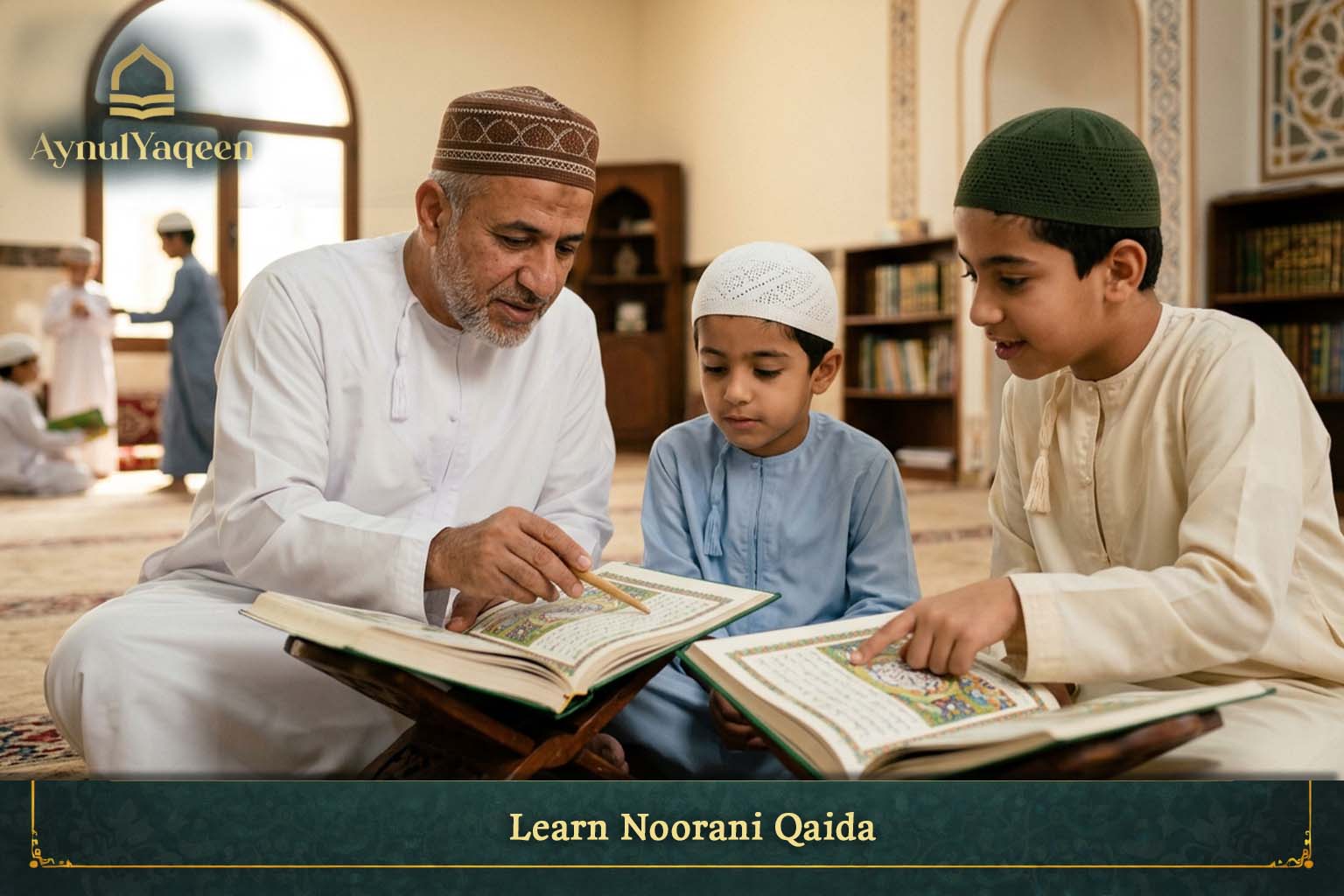
Learn Noorani Qaida offered by Aynulyaqeen Quran academy is the first step many Muslims look for when beginning their journey to recite the Holy Qur’an correctly, especially those who have no prior background in Arabic or Tajweed rules.
This method is not just a simple instructional booklet; it is a complete educational system designed to build a strong foundation for understanding Arabic letters, their articulation points, and precise pronunciation.
Through gradual learning and structured practice, it helps learners develop confidence and accuracy in reading. Ultimately, it directly improves the quality of Qur’an recitation and makes the learning process smooth, simple, and effective for beginners of all ages.
What is Noorani Qaida?
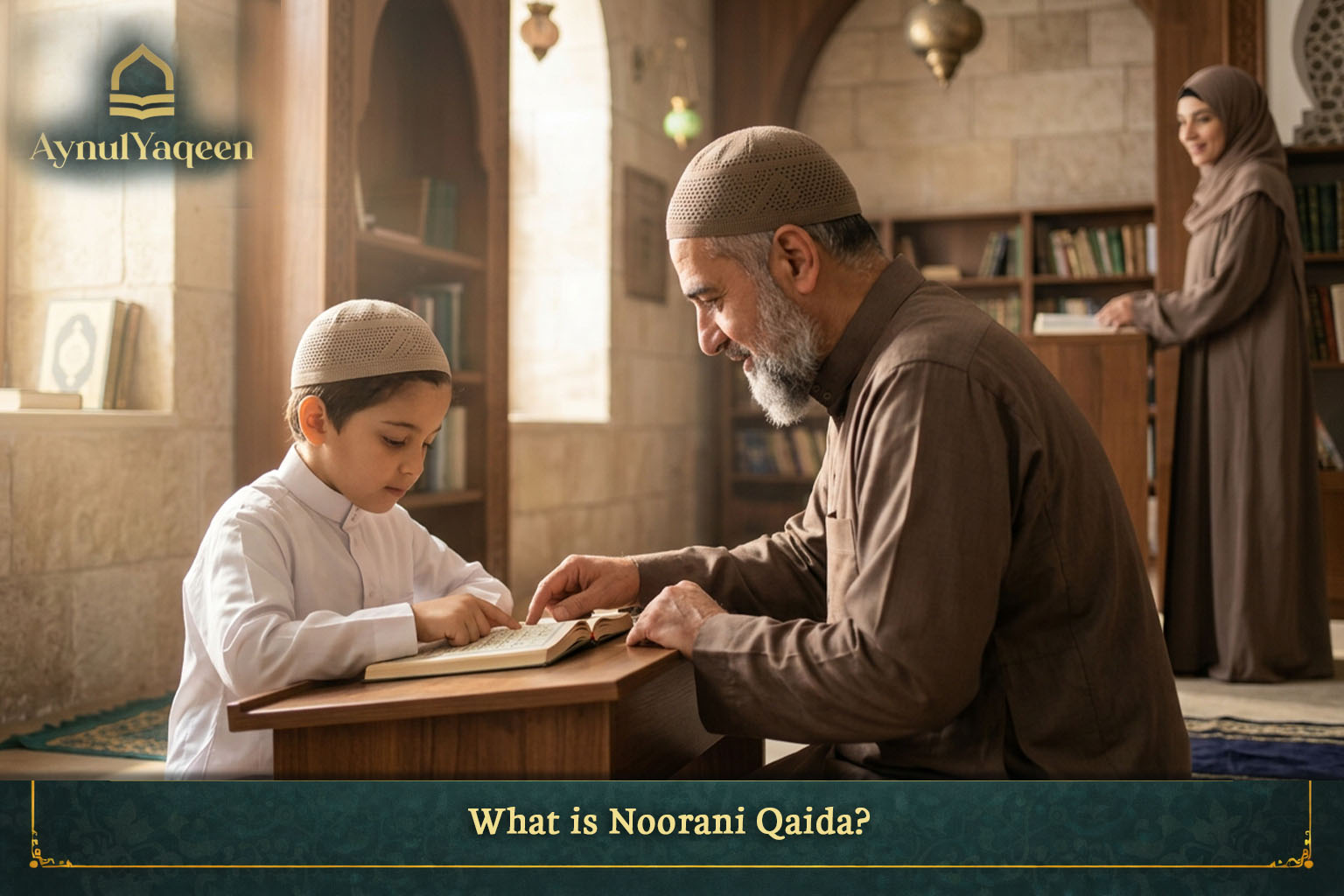
Noorani Qaida is a teaching method developed by Sheikh Noor Muhammad Haqqani. It aims to teach correct Qur’an recitation by focusing on:
- Arabic letters and their articulation points
- Short vowels (Fatha, Damma, Kasra)
- Tanween (double vowels)
- Sukoon and Shaddah
- Madd (elongation rules)
- Basic Tajweed applications
The key advantage of this method is that it requires no prior knowledge. It starts from zero, making it suitable for both children and adults.
Online Quran Academy
An Online Quran Academy offers a flexible and effective way to learn the Holy Qur’an from home with qualified teachers. It helps students of all ages improve recitation, Tajweed, and pronunciation through structured and interactive lessons.
This method is ideal for beginners and busy learners who need a convenient schedule without losing quality. One of the trusted platforms in this field is Aynulyaqeen Quran academy, which provides well-organized online classes that support steady progress. It ensures consistent learning, confidence, and accurate Qur’an reading skills.

Why Is Noorani Qaida the Right Start for Learning the Qur’an?
When a child begins learning the Qur’an directly without a proper foundation, they often struggle with correct pronunciation and understanding how Arabic words are formed. This is where Noorani Qaida becomes an essential and well-structured starting method.
Noorani Qaida does not only teach letters; it builds a complete foundation for reading by focusing on:
- Precise articulation points of letters (Makharij)
- Characteristics of letters (Sifaat)
- Basic vowel marks (Fatha, Damma, Kasra)
- Different types of Madd (elongation)
- Formation and combination of Qur’anic words
This gradual learning approach helps children move smoothly from basic recognition to accurate and confident reading.
Instead of feeling overwhelmed, learners progress step by step, building mastery naturally and developing strong reading skills without confusion or pressure. Learning how to learn quran is an important journey that helps students build a strong connection with the Holy Quran through proper guidance and consistent practice.
Read also: how to get an ijazah
Why is Noorani Qaida Ideal for Beginners?
There are several reasons why Noorani Qaida is considered highly effective:
- First, it follows a logical progression, where each lesson builds on the previous one.
- Second, it emphasizes correct pronunciation from the beginning, preventing mistakes from accumulating.
- Third, it uses smart repetition to reinforce learning without boredom.
- Fourth, it can be learned both offline and online, offering flexibility for learners.
That is why many structured programs, including those offered by Aynulyaqeen Quran Academy, rely on this method as a foundation for beginners.
How to Start Learning Noorani Qaida
Getting started is simple but requires consistency.Memorizing how to memorize the noble quran easily requires effective techniques, regular revision, and a clear learning plan to achieve better results. Key steps include:
- Setting a fixed daily learning time
- Learning with a qualified teacher if possible
- Focusing on listening and repetition
- Not moving to the next lesson until mastering the current one
Self-learning is possible, but having a teacher helps correct mistakes immediately-something provided through organized platforms like Aynulyaqeen Quran Academy.
Read also: What is Ihram
Simplified Explanation of Noorani Qaida Lessons
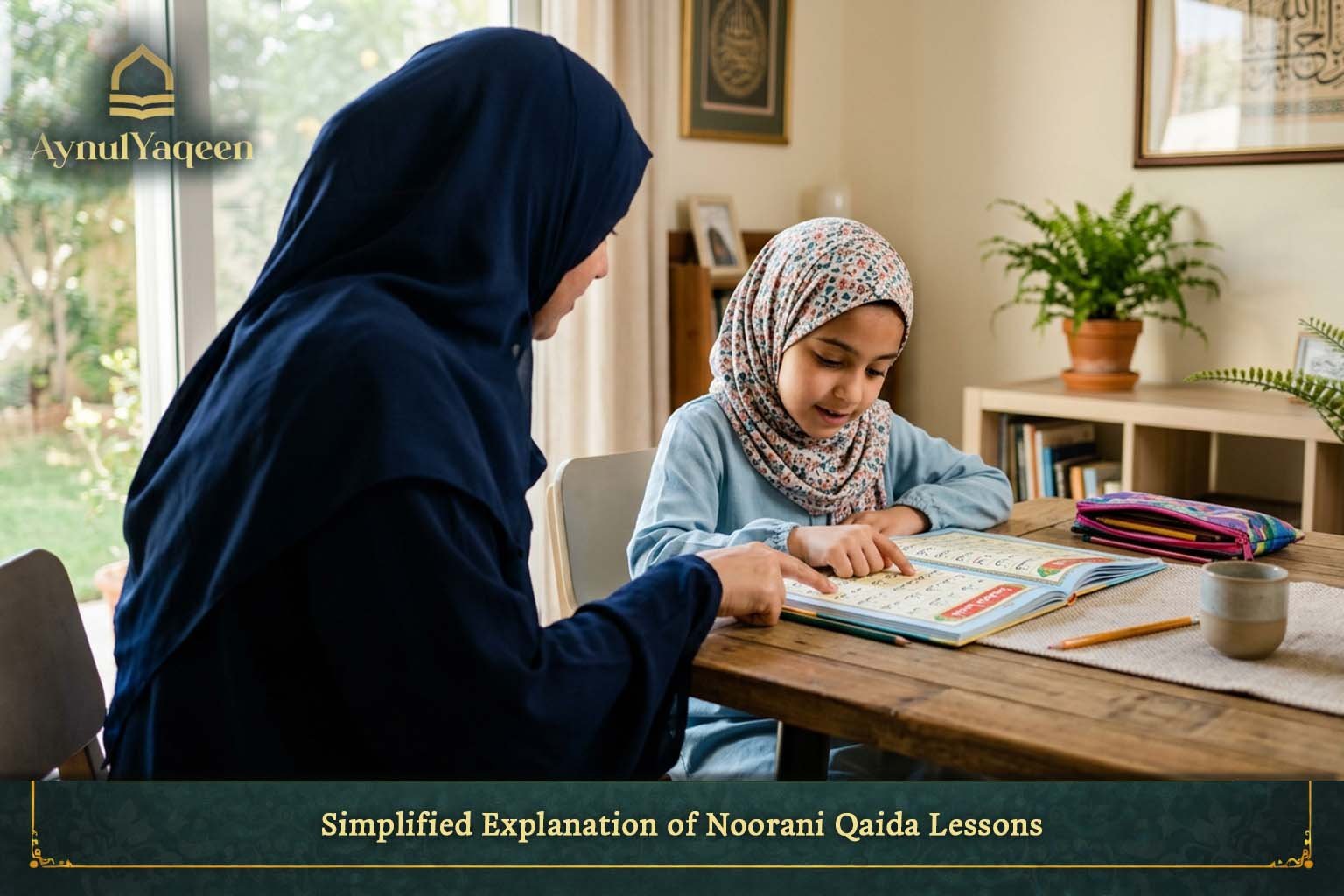
The Simplified Explanation of Noorani Qaida Lessons provides an easy, step-by-step overview of how beginners learn Arabic letters, pronunciation, and basic Tajweed rules in a gradual and structured way.
Lesson 1: Individual Letters
Students learn Arabic letters separately, focusing on accurate pronunciation. This stage builds the sound foundation.
Lesson 2: Combined Letters
Learners begin connecting letters, understanding their different forms in words.
Lesson 3: Disjointed Letters
Students recognize the unique letters found at the beginning of certain Qur’anic chapters, linking learning directly to the Qur’an.
Lesson 4: Short Vowels
Fatha, Kasra, and Damma are introduced, transforming letters into readable sounds.
Lesson 5: Tanween
Adds variation in pronunciation and enhances reading flexibility.
Lesson 6: Practice on Vowels and Tanween
Application begins, strengthening understanding through repetition.
Lessons 7-10: Advanced Rules
These include:
- Ghunnah (nasal sound)
- Madd (elongation)
- Sukoon
- Qalqalah
These rules form the foundation of Tajweed.
Final Lessons: Shaddah and Full Application
Students reach an advanced level, reading words and verses accurately with proper rules applied.
Read also: What is Hajj in Islam
The Role of Repetition in Mastery
Repetition is not just reviewing-it is a powerful learning tool. By repeating letters and words, the brain recognizes patterns, making recall easier.
Effective repetition should be:
- Audible
- Corrected when needed
- Done patiently without rushing
Learning for Children vs Adults
Children learn faster through:
- Visual aids
- Colors
- Interactive activities
Adults, however, benefit more from:
- Understanding rules
- Practical application
- Patience and consistency
Noorani Qaida works for both, but the teaching approach should differ based on age.
Read also: Seerah and Hadith course online
Is Online Learning Effective?
Today, online learning has become a highly effective option, especially with qualified instructors available. Its benefits include:
- Flexible scheduling
- Learning from home
- Ability to replay lessons
- Choosing suitable teachers
Many students achieve excellent results through structured programs like Aynulyaqeen Quran academy, where live interaction meets continuous guidance.
Read also: Islamic studies for kids
Common Mistakes When Learning Noorani Qaida
Some frequent mistakes include:
- Rushing through lessons
- Ignoring pronunciation corrections
- Lack of daily practice
- Memorizing without understanding
Avoiding these mistakes saves time and effort significantly.
Practical Tips to Master Noorani Qaida
- Read aloud daily
- Listen to correct recitations and imitate them
- Record your voice and compare
- Seek feedback from a teacher
- Do not progress without mastery
How Noorani Qaida Improves Qur’an Recitation
Once mastered, transitioning to Qur’an reading becomes smooth. The learner doesn’t just read-they understand how to pronounce each letter, when to elongate, and where to pause.
This leads to the ultimate goal: accurate, beautiful recitation that reflects the true essence of the Qur’an. Understanding the interpretation of the quran for kids helps children learn the meanings of Quranic verses in a simple and engaging way suitable for their age.
Real Learning Experience
Many learners begin with difficulty, but within weeks of consistent practice, noticeable improvement appears. The key is not intelligence-it is consistency.
With supportive environments like Aynulyaqeen Quran Academy, the journey becomes clearer and easier thanks to structured plans.
Read also: Hijrah of Prophet Muhammad
How Does Noorani Qaida Help Children Read Fluently?
Children naturally learn through repetition and gradual progression, and this is exactly what Noorani Qaida is built upon. Instead of overwhelming the child with too much information at once, it develops reading skills step by step in a structured and simple way.
At the beginning:
- The child learns to recognize each letter and its sound
Then:
- They start pronouncing letters with short vowels (harakat)
After that:
- They combine letters to form simple words
Finally:
- They read complete Qur’anic words and sentences
This step-by-step approach builds strong confidence in children, allowing them to feel a sense of achievement at every stage they complete. As a result, reading becomes easier, smoother, and more enjoyable over time.
The Role of Tajweed in Early Learning Stages
One common mistake is delaying Tajweed learning to advanced levels. In reality, Tajweed should be introduced from the very beginning.
Noorani Qaida teaches Tajweed in a practical, not theoretical, way. Through consistent practice, children learn:
- The correct pronunciation of each letter
- The difference between similar-sounding letters
- Basic elongation rules (Madd)
- Proper stopping rules (Waqf)
This early exposure makes future Qur’an recitation much easier and more fluent, eliminating the need to relearn pronunciation later. Starting how to read the quran for beginners begins with learning Arabic letters, correct pronunciation, and basic Tajweed rules for better recitation.
How Long Does It Take to Finish Noorani Qaida?
There is no fixed duration, but on average:
- There is no fixed duration to complete Noorani Qaida, as each learner progresses at a different pace depending on their ability and consistency.
- Children: 2 to 4 months, as they usually need more time for repetition, guidance, and gradual understanding of pronunciation.
- Adults: 1 to 3 months, since they can often grasp concepts faster and stay focused during lessons.
This depends on:
- Lesson frequency: Learners who attend daily or regular lessons tend to finish much faster than those with irregular schedules.
- Practice level: Consistent revision and reading aloud help reinforce learning and improve accuracy.
- Commitment: Motivation and dedication play a key role in maintaining steady progress and avoiding delays.
In general, learners who combine regular lessons with daily practice and strong commitment can complete Noorani Qaida more efficiently and build a solid foundation for accurate Qur’an recitation.
Why Do Many People Search for learn Noorani Qaida?

Many Muslims search for learn Noorani Qaida because it is considered one of the most effective and simplest methods for learning how to read the Holy Qur’an correctly from the very beginning. It does not rely only on memorization, but rather focuses on building reading skills through proper sound recognition and a well-structured gradual learning approach.
This method helps learners first recognize Arabic letters, then pronounce them correctly, and gradually move on to forming words and reading Qur’anic sentences with ease and confidence. Over time, students develop stable reading skills with fewer pronunciation and recitation mistakes.
Another reason for its popularity is that it is suitable for both children and adults, as it starts from zero and presents information in a simple, step-by-step manner.
For this reason, many educational programs rely on this method, including Aynulyaqeen Quran Academy, which uses it as a strong foundation for teaching beginners. It has proven its effectiveness over many years in improving Qur’an reading and recitation skills.Improving learn arabic for beginners with Egyptian teachers allows learners to develop Arabic skills and understand Quranic words more effectively.
Frequently Asked Questions (FAQ)
is a section that provides clear and direct answers to the most common questions users may have about a topic, helping them quickly find useful information without needing to search further.
1. Can Noorani Qaida be learned without a teacher?
Yes, but having a teacher greatly helps in correcting mistakes and speeding up progress.
2. What is the suitable age to start Noorani Qaida?
Children can start as early as 4-5 years old, and adults can begin at any age.
3. Is Noorani Qaida enough to fully learn Tajweed?
It provides a strong foundation, but advanced Tajweed lessons are needed afterward for mastery. Curious about seeking divine guidance? Check out our guide on performing istikhara prayer.
For a deeper look, read our article on the best website to learn Quran online.
If Arabic itself is what you’re after, we also have a dedicated program to learn Arabic online, covering both everyday and Quranic Arabic.
