


Hadith course online is becoming one of the most important ways for Muslims today to connect with the teachings of Prophet Muhammad ﷺ and understand Islam in a structured, authentic, and accessible way.
In a world where information is everywhere but not always reliable, many learners are searching for a clear path that helps them study Hadith with proper guidance, without confusion or misinterpretation.
This is exactly why structured learning programs such as those offered by Aynulyaqeen Quran academy have become a trusted option for students of all ages.
What is Hadith in Islam?
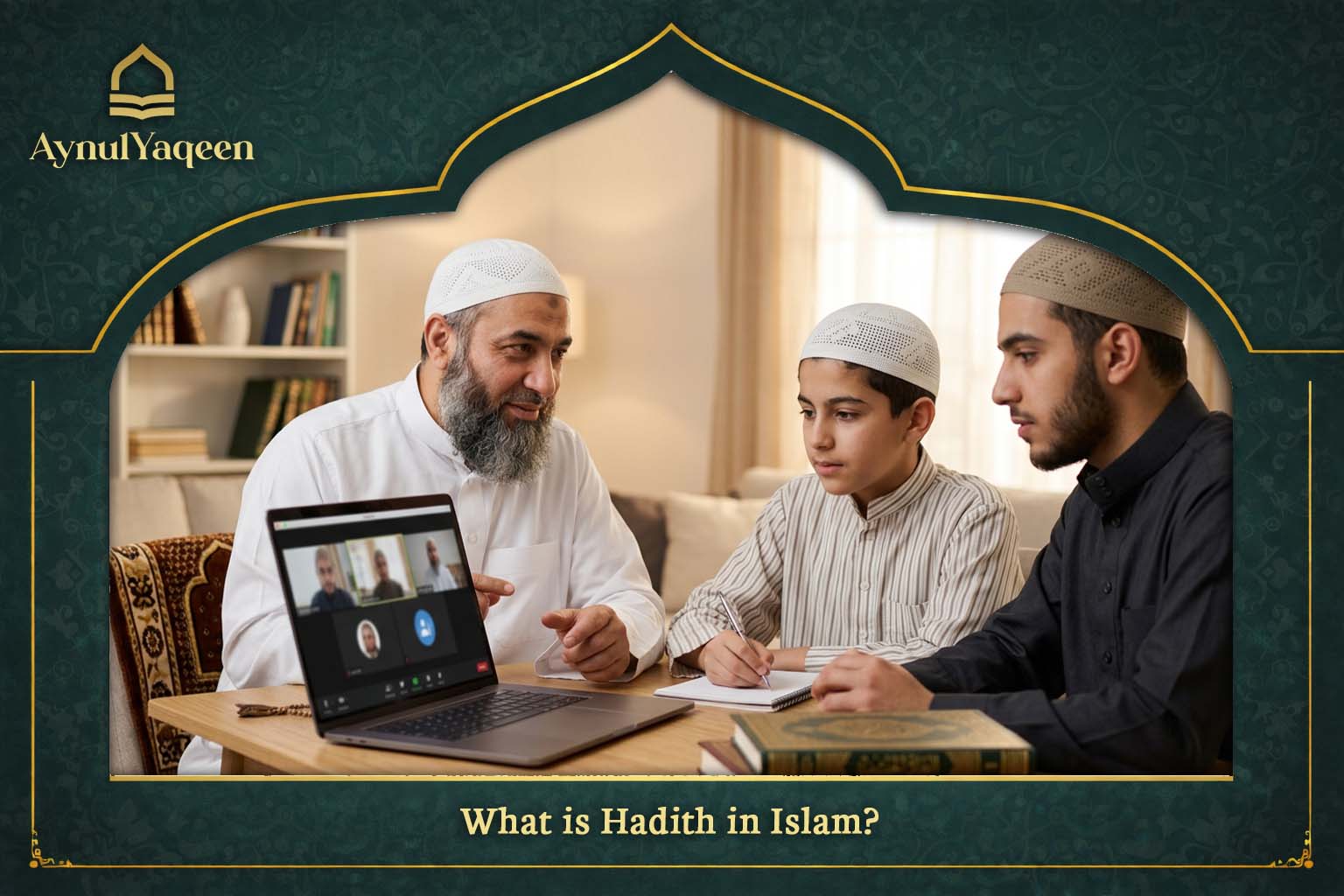
The word “Hadith” literally means “speech” or “report.” In Islamic terminology, it refers to everything attributed to the Prophet Muhammad ﷺ-whether he said it, did it, or approved it silently.
Hadith is not separate from the Quran; instead, it complements it. While the Quran provides the divine message, Hadith explains how that message is practiced in real life.
For example:
- The Quran commands Muslims to pray.
- The Hadith explains how the Prophet ﷺ performed prayer step by step.
Without Hadith, many Quranic instructions would remain general. With Hadith, they become practical and actionable.
This is why scholars emphasize that understanding Hadith is essential for understanding Islam itself.
Online Quran Academy
Learning the Quran has become easier and more accessible through modern online platforms that connect students with qualified teachers from anywhere in the world.
Aynulyaqeen Quran Academy provides a structured and supportive learning environment where students can study Quran recitation, Tajweed, and Islamic sciences with clarity and confidence.
Through personalized lessons and step-by-step guidance, Aynulyaqeen Quran Academy helps learners of all ages build a strong foundation in their religious education while maintaining flexibility and convenience in their daily schedule.

Hadith vs Sunnah: Understanding the Difference
Many beginners confuse Hadith and Sunnah, thinking they are identical. While closely related, there is an important distinction. Improving learn arabic for beginners with Egyptian teachers allows learners to develop Arabic skills and understand Quranic words more effectively.
The Sunnah refers to the complete way of life of the Prophet Muhammad ﷺ. It includes:
- His sayings
- His actions
- His approvals
The Hadith, on the other hand, is the recorded documentation that transmits the Sunnah across generations.
In simple terms:
- Sunnah = the practice of the Prophet ﷺ
- Hadith = the record of that practice
Without Hadith, the Sunnah would not have been preserved in detail. Together, they form the foundation of Islamic practice and law.
Students who enroll in a structured Hadith course online often begin with this distinction because it helps them understand the structure of Islamic knowledge more clearly.
The Structure of a Hadith: Isnād and Matn
One of the most fascinating aspects of Hadith studies is its scientific structure. Every Hadith is composed of two main parts:
1. The Chain of Narrators (Isnād)
The isnād is the chain of individuals who transmitted the Hadith from the Prophet ﷺ to later generations. It usually looks like a chain of people saying: “A narrated from B, who narrated from C…”
This system is unique in world history because it requires every single narrator to be identified and verified.
Scholars developed an entire discipline called the “Science of Narrators,” where they studied:
- Memory strength
- Moral integrity
- Accuracy of transmission
This ensured that only reliable reports were accepted.
2. The Text (Matn)
The matn is the actual content of the Hadith-the message, action, or approval being reported.
After verifying the chain, scholars also examined the text to ensure it:
- Did not contradict the Quran
- Did not oppose stronger Hadiths
- Made sense in the context of Islamic teachings
This double-layer system of verification is one of the reasons Hadith literature is considered so precise and reliable.
How Hadith Was Preserved Across Generations
The preservation of Hadith is one of the most remarkable achievements in Islamic history.
During the lifetime of the Prophet ﷺ, many companions memorized his sayings directly. Some also wrote them down privately. After his passing, this effort expanded significantly.
As Islam spread to different regions, scholars realized the importance of organizing and verifying Hadith systematically. This led to the development of Hadith sciences, where narrations were carefully collected, analyzed, and classified.
Over time, major compilations were created that remain authoritative today. These collections were not written casually; they were the result of decades of travel, research, and strict verification.
This level of precision ensured that authentic teachings were preserved for future generations without distortion.
Read also: Hijrah of Prophet Muhammad
Types of Hadith and Their Classification
Not all Hadith carry the same level of authenticity. Scholars developed a grading system to classify them based on reliability.
The main categories include:
1. Authentic (Sahih)
These Hadith have strong chains of narration and reliable transmitters. They are accepted as fully authentic and used in Islamic law.
2. Good (Hasan)
These are slightly weaker than Sahih but still reliable and widely accepted.
3. Weak (Da’if)
These contain issues in their chain or narration and are not typically used for legal rulings.
4. Fabricated (Mawdu’)
These are falsely attributed to the Prophet ﷺ and are rejected completely.
Understanding these categories is essential for any student. Many learners who join a Hadith course online often find this classification system both fascinating and essential for avoiding misinformation.
Read also: Islamic studies for kids
Why Hadith Matters in Everyday Life
Hadith is not just theoretical knowledge-it directly influences how Muslims live their daily lives.
Worship and Practice
Details of prayer, fasting, charity, and pilgrimage are all explained through Hadith. Without it, many acts of worship would lack structure.
Ethics and Character
Hadith teaches honesty, patience, kindness, forgiveness, and humility. It builds the moral foundation of a Muslim’s personality.
Social Life
From family relations to business ethics, Hadith provides guidance for almost every aspect of human interaction.
Because of this wide impact, many learners choose structured programs at Aynulyaqeen Quran academy to ensure they understand both the theory and practical application of Hadith in real life.
Read also: Seerah and Hadith course online
Learning Hadith Online: A Modern Approach
In the past, students had to travel long distances to study Hadith under scholars. Today, technology has made it possible to learn from qualified teachers from the comfort of home. Learning how to learn quran is an important journey that helps students build a strong connection with the Holy Quran through proper guidance and consistent practice.
Online learning offers several advantages:
- Flexible schedules
- One-on-one guidance
- Access to qualified instructors
- Step-by-step curriculum
- Ability to revisit lessons anytime
A structured Hadith course online helps learners progress gradually, starting from basic concepts and moving toward advanced understanding.
However, the key is choosing the right learning environment. Not all online resources provide authentic or structured knowledge, which is why guided learning is highly recommended.
Read also: What is Hajj in Islam
Why Choose Aynulyaqeen Quran Academy for Hadith Studies
When it comes to structured Islamic learning, Aynulyaqeen Quran Academy provides a focused and student-centered approach.
The academy is known for:
- Simplified explanations suitable for beginners
- Step-by-step curriculum design
- Qualified instructors with deep knowledge of Islamic sciences
- Personalized attention for each student
Many students prefer Aynulyaqeen Quran Academy because it focuses not just on memorization, but on understanding Hadith in a meaningful way that can be applied in daily life.
Another strength of Aynulyaqeen Quran Academy is its ability to guide students through complex topics in a clear and approachable manner, making it ideal for learners from different backgrounds. Memorizing how to memorize the noble quran easily requires effective techniques, regular revision, and a clear learning plan to achieve better results.
Read also: What is Ihram
Building a Strong Foundation in Hadith Studies
Before diving into advanced Hadith texts, understanding the interpretation of the quran for kids helps children learn the meanings of Quranic verses in a simple and engaging way suitable for their age. Students should focus on:
- Understanding basic terminology
- Learning how Hadith is structured
- Recognizing authenticity levels
- Studying selected short collections
A gradual learning approach ensures that students do not feel overwhelmed and can build confidence step by step.
This is why many beginners start with structured programs rather than self-study alone. Starting how to read the quran for beginners begins with learning Arabic letters, correct pronunciation, and basic Tajweed rules for better recitation.
The Role of Hadith in Islamic Law
Hadith plays a critical role in Islamic jurisprudence. Alongside the Quran, it forms the basis for legal rulings in matters such as:
- Prayer
- Fasting
- Marriage
- Business transactions
- Social conduct
Scholars use both sources together to derive rulings that are practical and relevant. Without Hadith, Islamic law would lack the detailed guidance needed for real-life application.
Challenges of Learning Hadith Today
One of the biggest challenges in the modern world is misinformation. Social media often spreads Hadith without verification, leading to confusion.
Many people share narrations without knowing whether they are authentic or not. This is why proper education is so important.
A structured learning environment helps students:
- Verify sources
- Understand grading systems
- Avoid spreading weak or fabricated narrations
This knowledge is essential for every Muslim today.
Hadith Studies: From Basics to Criticism & Takhrij
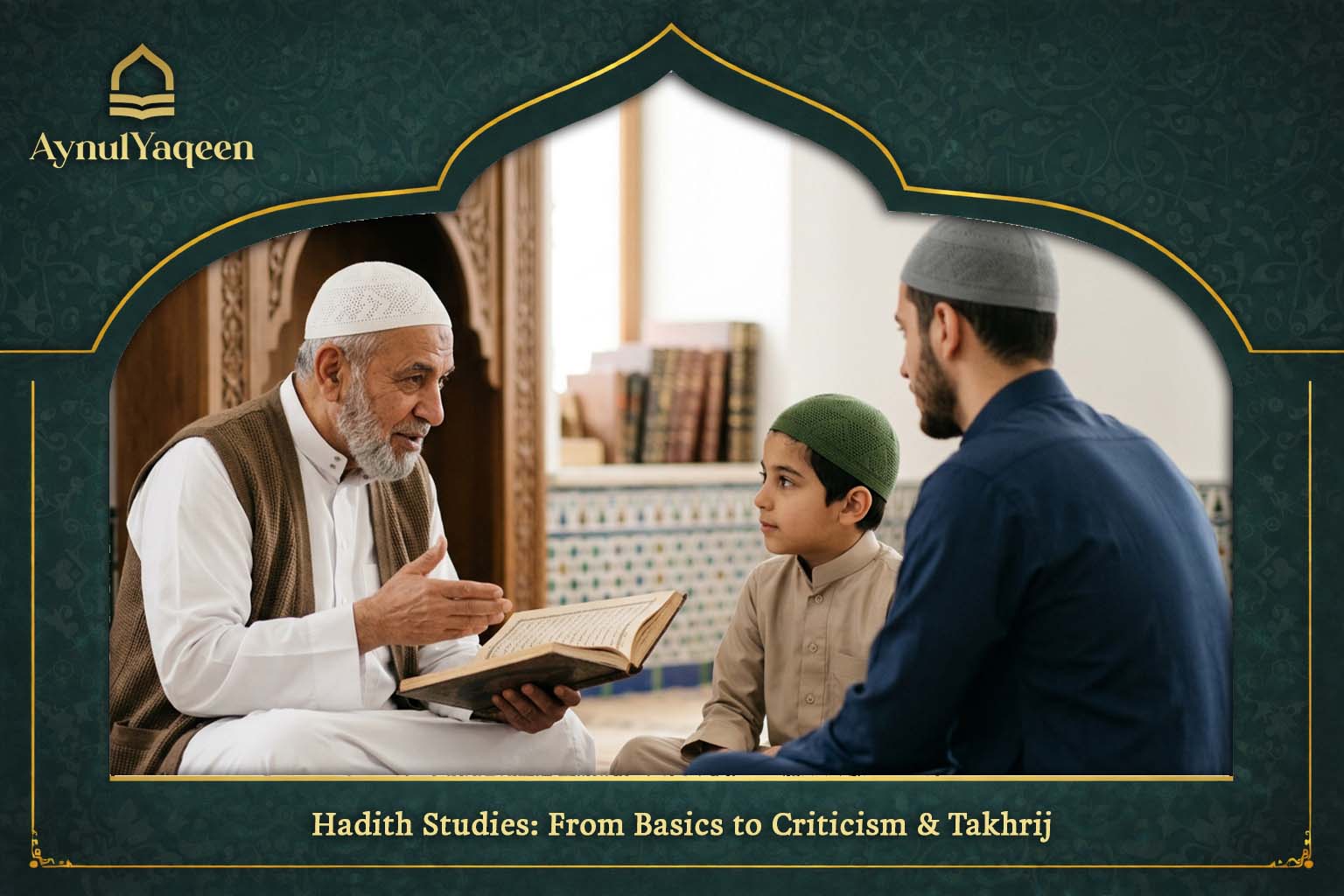
A comprehensive introduction to Hadith Studies that guides learners from foundational principles to advanced skills in criticism (naqd) and Takhrij, enabling them to evaluate, trace, and authenticate narrations with scholarly precision.
Level 1: Foundations of Hadith Sciences
Begin with essential terminology and core concepts. Learn the definitions of Hadith, Sunnah, and Athar. Understand the basic structure of a Hadith, including the Sanad (chain of narration) and Matn (text), and why authentication is fundamental in Islamic scholarship and practice.
Level 2: Major Hadith Collections
Explore the major Hadith compilations, including the Six Canonical Books (Kutub al-Sittah), with special focus on Sahih al-Bukhari and Sahih Muslim. Study their authors, compilation methodologies, and the scholarly criteria used to rank Hadith collections in terms of authenticity.
Level 3: Hadith Authentication Science
Develop a strong understanding of Ilm al-Rijal (the science of narrators). Learn how scholars evaluate narrators based on memory, integrity, precision, and reliability. Practice tracing chains of transmission (Sanad) and distinguishing between strong and weak narrations.
Level 4: Hadith Classification and Grading
Study the complete system of Hadith grading, including Sahih (authentic), Hasan (good), Da‘if (weak), and Mawdu‘ (fabricated), along with their subcategories. Learn how each category is determined and in which contexts each type can or cannot be used in Islamic rulings and practice.
Level 5: Practical Application of Hadith
Apply authenticated Hadith to real-life situations, including worship, financial dealings, family relationships, and personal development. Learn to differentiate between cultural practices and authentic Sunnah, and how to address apparent contradictions between narrations through scholarly methods.
FAQ
stands for Frequently Asked Questions, a section that provides clear and quick answers to common queries users may have.
1. Can beginners study Hadith without Arabic knowledge?
Yes, beginners can start with translated materials and guided instruction. Arabic can be learned gradually over time.
2. How long does it take to understand Hadith properly?
It depends on the learner’s consistency, but structured courses can build strong foundational knowledge within months.
3. Is online learning enough for Hadith studies?
Yes, if it is guided by qualified teachers and follows a structured curriculum like those offered by reliable institutes.
In conclusion, studying Hadith through a structured and guided approach helps learners gain a deeper and more accurate understanding of the Prophetic traditions.
An online learning path makes this knowledge more accessible, allowing students to progress from foundational concepts to advanced comprehension with clarity and confidence. For those seeking Allah’s guidance before a big decision, read our guide to performing istikhara prayer. Curious to learn more? Our guide on the steps of wudu covers this in detail.
Learn more in our detailed guide on the best online Quran lessons for adults.
Learn more in our detailed guide on the best website to learn Quran online.
If Arabic itself is what you’re after, we also have a dedicated program to learn Arabic online, covering both everyday and Quranic Arabic.
